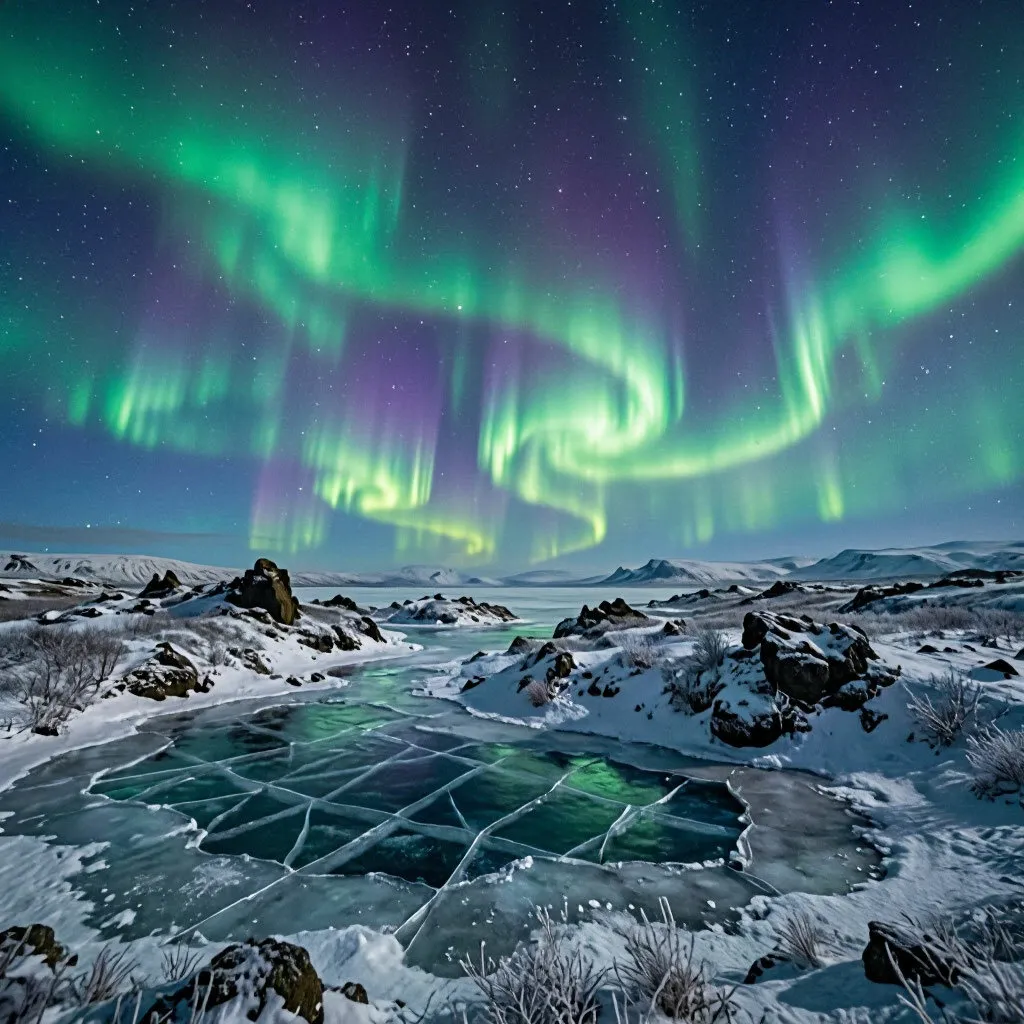
The aurora borealis is caused by charged particles from the sun colliding with gases in Earth’s upper atmosphere — oxygen produces green and red light, nitrogen produces blue and purple. The phenomenon circles the Arctic in an oval band, and Iceland sits almost directly beneath the most active portion of that oval. This geographic luck means that under the right solar conditions, the aurora can appear anywhere in the country — not just in the far north, but over Reykjavik, over the south coast waterfalls, over the Snæfellsnes peninsula. You do not need to reach a specific latitude to have a chance; you need clear skies and solar activity, and those two variables are what your entire trip revolves around.
Iceland’s small size and ring road infrastructure make it uniquely suited for self-drive aurora chasing. The Route 1 ring road circles the entire island in about 1,300 kilometers, and nearly every promising aurora viewing location is reachable by car within a few hours of Reykjavik. You do not need a 4×4 for most winter driving if you stay on the main roads, though a 4×4 opens up remote areas and provides better stability on icy surfaces. The key is flexibility — the ability to drive toward clear skies when the forecast says the aurora will be active but your current location is clouded over.
When to go: months, darkness, and solar cycles
The northern lights season in Iceland runs from late September to early April. Outside of this window, the nights are too short or nonexistent — Iceland sits just below the Arctic Circle, so summer brings near-constant daylight and aurora viewing becomes impossible even when geomagnetic activity is high. The best months balance sufficient darkness with reasonable driving conditions and a reasonable probability of clear skies.
September and October offer mild temperatures, relatively good road conditions, and nights that are long enough for aurora viewing. The trade-off is that autumn weather in Iceland is volatile — rain and wind are common, and cloud cover can frustrate aurora plans for days at a stretch. November brings longer nights and colder, more stable weather patterns, but some highland roads begin to close for winter. December and January offer the longest nights (up to nineteen hours of darkness in midwinter) and peak aurora viewing opportunities, but driving conditions are at their most challenging, with ice, snow, and limited daylight for sightseeing during the day. February and March are the sweet spot for many travellers — the nights are still long, solar activity tends to be high approaching the equinox, and roads are generally more manageable than midwinter. April marks the tail end of the season, with rapidly shortening nights and diminishing opportunities.
Solar activity operates on an approximately eleven-year cycle, and the current cycle is expected to peak around 2025–2026, which means 2026 remains an excellent year for aurora hunting. Higher solar activity does not guarantee sightings — you still need clear skies — but it increases the frequency and intensity of auroral displays, meaning more nights with visible activity and a greater chance of seeing stronger, more colorful auroras rather than faint green glows on the horizon.
Understanding the two forecasts you need
Aurora chasing is a game of two forecasts, and understanding both is the difference between success and frustration. The first is cloud cover — it does not matter how strong the aurora is if clouds block your view. The Icelandic Meteorological Office provides detailed cloud cover maps that show where skies will be clear at any given time. Your strategy on any aurora night is to drive to an area that the cloud forecast shows as clear, ideally one that is also away from light pollution.
The second forecast is geomagnetic activity, measured by the Kp index on a scale of 0 to 9. A Kp of 3 is enough to see a faint aurora on the northern horizon from Iceland, and a Kp of 5 or above often produces visible aurora directly overhead even from Reykjavik. Several apps and websites provide real-time Kp data and short-term predictions, and the most useful ones also show the aurora oval’s predicted position. The oval shifts and expands with solar activity, so a high Kp reading means the oval is wider and more likely to extend over Iceland.
The interaction between these two forecasts is what makes aurora chasing both an art and a science. A night with Kp 6 and total cloud cover gives you nothing. A night with Kp 2 and perfectly clear skies can still produce a beautiful display, especially in Iceland’s prime location under the oval. The experienced aurora hunter checks both forecasts every evening, identifies the nearest clear area within driving distance, and goes there — sometimes driving an hour or more to escape a patch of cloud.
Building your self-drive aurora itinerary
A self-drive aurora trip is not a fixed itinerary in the traditional sense — it is a framework with flexible waypoints. You set up a base in a region for two or three nights, and on each evening you check the forecasts and decide whether to stay put or drive to a better location. The goal is to position yourself in areas that offer both clear-sky potential and interesting foreground scenery, because a green ribbon over a waterfall, a black sand beach, or a glacial lagoon is far more memorable than the same ribbon over an empty field.
The following routes represent the most productive aurora hunting grounds in Iceland, chosen for their combination of dark skies, interesting scenery, and road accessibility in winter.
The golden circle and south coast
The area within a two-hour drive of Reykjavik is where most self-drive trips begin, and it is more productive than people expect. Thingvellir National Park offers wide open skies and almost no light pollution, and the rift valley landscape adds dramatic foreground interest. The Geysir area and Gullfoss waterfall are also accessible and dark at night. Heading south along Route 1, the waterfalls of Seljalandsfoss and Skógafoss are popular aurora photography locations — you can park nearby and walk a short distance to position the waterfall in your foreground. The town of Vík, about two and a half hours from Reykjavik, is an excellent base for two or three nights. Reynisfjara black sand beach, the Dyrhólaey sea arch, and the surrounding mountains create stunning foregrounds, and Vík itself is small enough that light pollution is minimal.
Snæfellsnes peninsula
About two hours north of Reykjavik, the Snæfellsnes peninsula sticks out into the North Atlantic and offers some of the darkest skies in western Iceland. The Kirkjufell mountain near the town of Grundarfjörður is one of the most photographed landmarks in Iceland, and framing an aurora behind its distinctive pyramid shape is a goal for many visitors. The peninsula is compact enough to drive in a day, and the northern coast faces away from prevailing winds, which can mean clearer skies when the south coast is socked in. The town of Stykkishólmur on the northern side makes a good overnight base.
The north and east fjords
For travellers with more time — ten days or more — driving the full ring road opens up the north and east of Iceland, which tend to have clearer weather than the south coast during winter. Akureyri, Iceland’s second-largest city, sits in the north and has surprisingly good aurora viewing just outside town. The Goðafoss waterfall, thirty minutes east of Akureyri, is a magnificent aurora foreground. Further east, the Mývatn geothermal area offers volcanic landscapes, hot springs for warming up between aurora sessions, and very dark skies. The east fjords are remote and sparsely populated, meaning light pollution is almost nonexistent, though winter road conditions require caution and a 4×4 vehicle.
Daytime planning: what to do while waiting for darkness
One of the underappreciated aspects of an aurora trip is that the northern lights do not appear until late evening, which means your days are free. A well-planned self-drive trip fills daylight hours with sightseeing that is rewarding in its own right, so that even on a trip where the aurora does not cooperate every night, you return home with extraordinary experiences. Iceland’s waterfalls, geothermal areas, black sand beaches, glaciers, and volcanic landscapes are all accessible in winter, and the shorter daylight hours of midwinter — about four to six hours of usable light — actually condense your sightseeing into a focused window.
The trick is to plan your daytime driving so that each evening finds you in a different dark-sky area, rather than returning to the same base every night. Drive south to Vík during the day, explore the waterfalls and beaches, and you are already positioned for aurora viewing when darkness falls. The next day, drive further east to the Jökulsárlón glacier lagoon, explore during daylight, and again you are in a prime aurora location by nightfall. This approach turns the entire trip into a rolling aurora chase rather than a nightly expedition from a fixed base, and it dramatically increases your chances of encountering clear skies on at least some nights.
Essential aurora photography settings
For many visitors, photographing the northern lights is a primary motivation, and the good news is that modern cameras — including high-end smartphones — can capture the aurora if the settings are right. The challenge is that the aurora is dim and moving, which means you need a balance of long exposure, high ISO, and a wide aperture, all while keeping the camera stable enough to avoid blur.
Before diving into specific settings, it helps to understand how the key parameters interact. The aurora’s brightness and movement speed determine everything — a slow, faint aurora allows longer exposures and lower ISO for cleaner images, while a fast, bright aurora demands shorter exposures to capture the structure before it blurs. The table below covers the most reliable starting configurations, which you then adjust based on conditions.
| Setting | Faint aurora (Kp 2–3) | Moderate aurora (Kp 4–5) | Strong aurora (Kp 6+) |
|---|---|---|---|
| Aperture | f/2.8 (or widest available) | f/2.8–f/4.0 | f/2.8–f/4.0 |
| ISO | 3200–6400 | 1600–3200 | 800–1600 |
| Shutter speed | 15–25 seconds | 5–10 seconds | 1–5 seconds |
| Focal length | 14–24mm (full frame) | 14–24mm | 14–24mm |
| Focus | Manual, set to infinity | Manual, set to infinity | Manual, set to infinity |
| White balance | 3500–4000K | 3500–4000K | Auto or 3500–4000K |
These are starting points, not rules. The most common mistake is overexposing a strong aurora — when the lights are dancing rapidly overhead, a ten-second exposure turns crisp curtains into a washed-out green smear. If the aurora is bright and active, drop your shutter speed to two or three seconds and lower the ISO, then review your image and adjust. Another frequent error is failing to focus manually — autofocus almost never works on the aurora, and you should set your lens to infinity focus while it is still light outside, then tape the focus ring or remember its position. For smartphone photographers, the newest models have dedicated night modes that can capture the aurora handheld if it is bright enough, but a small tripod and a third-party app that allows manual exposure control will produce far better results.
What you need to bring for a winter self-drive aurora trip
Iceland in winter is not a place where you improvise your gear. The combination of dark, cold, wind, and remote driving means that the right equipment is not a luxury — it is the difference between a successful trip and a miserable or dangerous one. The following list covers everything that matters, based on what experienced aurora chasers carry on every trip.
- Layered clothing rated for sub-zero wind chill. Iceland’s winter temperatures are not extreme (typically minus five to plus five degrees Celsius), but the wind amplifies cold dramatically. A merino wool base layer, an insulating mid-layer, and a windproof outer shell are essential. Bring more layers than you think you need — standing still in the dark for an hour drains heat faster than hiking.
- Insulated boots with good grip. You will be standing on frozen ground, ice, or snow for extended periods. Cold feet end aurora sessions faster than cloud cover. Choose boots with thick soles and consider chemical hand warmers tucked inside.
- A sturdy tripod. Even the best image stabilization cannot hold a camera still for a twenty-second exposure. A lightweight carbon fiber tripod is ideal, but any sturdy tripod will work. Avoid cheap, flimsy models — wind is a constant in Iceland, and a wobbling tripod ruins long exposures.
- A headlamp with a red light mode. White light ruins your night vision, which takes twenty to thirty minutes to fully develop. Red light preserves night vision while allowing you to see your camera controls and walk safely. A headlamp (rather than a flashlight) keeps your hands free.
- A thermos and hot drinks. Standing in the cold for hours is physically demanding. A thermos of hot coffee, tea, or soup is not a comfort item — it is practical survival gear that extends how long you can stay out.
- A full tank of fuel at all times. Gas stations in rural Iceland are sparse, and many close at night in winter. Fill up whenever you have the chance, and never start an evening aurora drive with less than half a tank. Remote areas may have no fuel for 100 kilometers or more.
- An offline maps app. Mobile signal is unreliable in rural Iceland, and you will be driving in the dark on unfamiliar roads. Download maps for offline use before you leave Reykjavik, and have a GPS device or phone app with downloaded route data.
- Extra camera batteries. Cold temperatures drain batteries far faster than normal — expect 40–60% reduced battery life in winter conditions. Carry at least two spare batteries, and keep them in an inside pocket close to your body to keep them warm.
- A reflective vest and hazard triangle. Icelandic law requires a reflective vest in every vehicle, and it is genuinely useful when you step out of your car on a dark road. Make sure you can find it in the trunk without a long search in the dark.
This gear is the practical foundation of a successful aurora trip. Every item on the list exists because someone, on a cold night somewhere in Iceland, discovered they needed it and did not have it. The northern lights will not wait while you drive back to town for a forgotten tripod or an extra pair of gloves, and the difference between a good aurora photo and a great one is often just a matter of being prepared enough to stay out fifteen minutes longer.
Driving in Iceland during aurora season
Winter driving in Iceland demands respect but not fear. The ring road (Route 1) is generally well-maintained and plowed throughout winter, and most aurora-accessible locations are on or near this road. The hazards are ice, wind, and darkness — not impassable terrain. Black ice is the most common danger, especially on bridges and shaded sections of road, and it is nearly invisible at night. Drive slowly, keep your speed consistent, and never brake suddenly on ice — ease off the accelerator and steer gently.
A 4×4 vehicle is not legally required on the ring road in winter, but it provides better traction on icy surfaces and is required by law on roads marked with an F-prefix (highland roads), most of which are closed in winter anyway. The practical benefit of a 4×4 is stability in wind — Icelandic winter winds can gust to 100+ km/h, and a small 2WD car can feel unnervingly light in crosswinds. If your budget allows, a 4×4 provides peace of mind; if not, a front-wheel-drive car with winter tires is adequate for ring road travel.
One specific hazard to be aware of is stopping on the ring road for aurora viewing. Iceland’s roads are narrow, and pulling off onto the shoulder in the dark can be dangerous if oncoming traffic is present. Always look for designated pull-offs, parking areas, or side roads where you can stop safely. If no safe stopping point is available, keep driving until you find one — the aurora will still be there in five minutes.
Realistic expectations and managing disappointment
The single most important thing to understand about aurora hunting is that sightings are never guaranteed. A one-week trip in peak season with good planning gives you a high probability — perhaps 70–80% — of seeing the northern lights on at least one night. But that probability comes from the math of multiple nights in different locations, not from any single evening’s forecast. Some travellers see a spectacular display on their first night and spend the rest of the trip chasing a repeat. Others wait five nights, see nothing, and on the sixth night get the display of a lifetime. The aurora does not operate on a schedule, and the travellers who enjoy the trip most are the ones who treat every clear night as an opportunity rather than an expectation.
The second most important thing is that the aurora you see with your eyes is often less dramatic than what appears in photographs. Cameras, with their long exposures and high ISO, capture color and detail that the human eye cannot — especially the reds and purples that appear at the top of strong auroral displays. A faint green arc on the horizon can look spectacular in a photo and underwhelming in person. This is not a disappointment — it is the nature of night photography. The experience of standing under a moving aurora, even a faint one, is about more than visual intensity. It is about the silence, the cold, the awareness of standing on a remote volcanic island under a sky lit by particles that traveled ninety million miles to meet you there.
Plan for at least seven nights in Iceland if aurora sightings are a primary goal. Three or four nights is enough for a general trip but leaves too much to chance for aurora hunting. Build flexibility into your itinerary, stay mobile, check the forecasts every afternoon, and drive toward clear skies every evening. Some nights you will see nothing. Some nights you will see something unforgettable. The trip is about both — and Iceland, with its waterfalls, glaciers, hot springs, and black sand beaches, ensures that even the nights with no aurora are surrounded by days that are extraordinary in their own right.