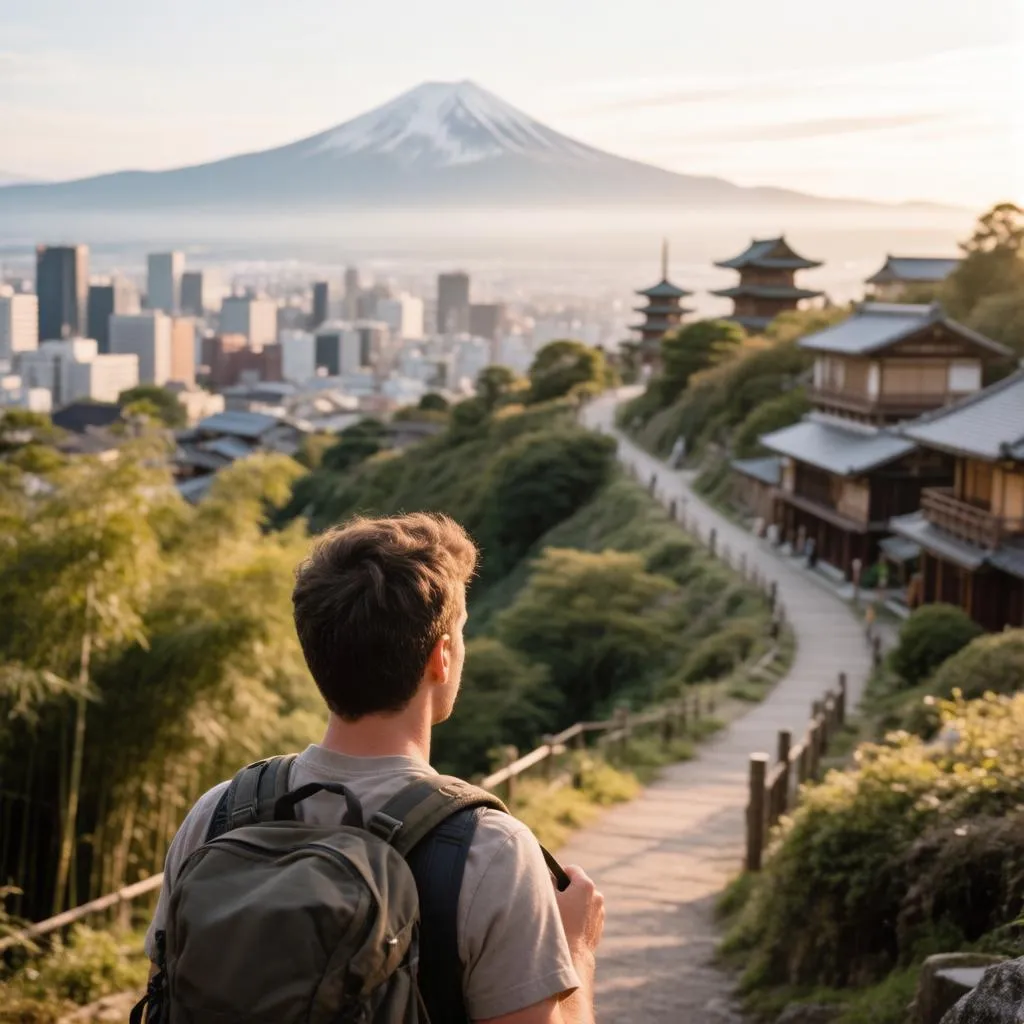
Most first-time visitors to Japan follow a route so well-trodden it has earned its own nickname: Tokyo, Fuji, Kyoto, Osaka. And there is a good reason for it — this corridor holds the country’s loudest city, its most photographed mountain, its imperial capital and its kitchen. But there is a quieter story running parallel to the shinkansen tracks, and hardly anyone takes the time to hear it. A few hours’ detour from the bullet train lies the Nakasendo, the old feudal highway whose stone paths still connect post towns where samurai once rested. Adding just two days of walking transforms a checklist trip into something that feels like two different journeys fused into one — the electric Japan and the Edo-period Japan, joined by a single rail line.
Why this route works for a first trip
The Golden Route survives its popularity for structural reasons: the distances are manageable, the transport is flawless, and every stop offers a different face of the country. Tokyo delivers scale and neon; Hakone delivers views of Fuji from onsen baths; Kyoto delivers temples, gardens and geisha districts; Osaka delivers food culture at full volume. Squeezed between these anchors, the Nakasendo trail offers what the cities cannot — silence, cedar forests, and villages that have changed little since the seventeenth century.
The route also scales beautifully. With a week, it is a comfortable sampler; with ten days, each stop gets breathing room; with two weeks, side trips like Nara, Himeji and Kanazawa fold in naturally. The core journey between Tokyo and Kyoto by train takes roughly two and a half hours on the fastest Tokaido shinkansen, which means the whole country’s spine can be crossed in a single morning.
Tokyo: three days that cover the essentials
Japan’s capital rewards walkers, because its neighbourhoods are best understood at street level. A sensible first visit splits the city into zones rather than chasing individual attractions:
- Asakusa and the Sumida riverfront — Senso-ji temple at opening hour, before the crowds, followed by the quiet back streets of the district.
- Shibuya and Harajuku — the famous crossing, the youth fashion streets of Takeshita-dori, and the elevated paths of Meiji Jingu shrine where the city noise falls away within fifty steps.
- Shinjuku and the east side — the observation decks of the Metropolitan Government Building, Golden Gai’s tiny bars, and the department store food halls that double as dinner.
- Akihabara and Ginza — the electronics-and-anime heart of the city, then the flagship stores and department basements of the capital’s most polished district.
- TeamLab and the bay area — the digital art museums that have become a fixture of Tokyo itineraries, paired with the waterfront around Odaiba or Toyosu.
Two days is the practical minimum, three is the sweet spot, four only if day trips to Kamakura or Nikko appeal. Tokyo is also where the Japan Rail Pass decision gets made, and the choice deserves a moment of arithmetic: with the pass price raised in recent years, the classic Tokyo–Kyoto–Osaka triangle often costs less with individual tickets, while longer itineraries stretching to Hiroshima or Kanazawa tip the balance back toward the pass.
The Nakasendo: two days between post towns
Between Tokyo and Kyoto lies the Kiso Valley, a mountain corridor where one segment of the old Nakasendo highway survives as a walking trail. The classic walk runs 7.7 kilometres between the post towns of Magome and Tsumago, and it is the most accessible piece of Edo-period infrastructure open to travellers today. Stone-paved paths climb through cedar forest, pass waterfalls and farmhouses, and end in towns where wooden buildings line a single main street, exactly as they did when the highway carried daimyo processions.
The walk takes two to three hours at a gentle pace, and the practical details matter more than fitness. Luggage forwarding services — ubiquitous in Japan — let travellers send suitcases ahead to Kyoto while they walk with a daypack; both Magome and Tsumago operate regular shuttle buses for tired hikers. Overnight stays in the post towns’ minshuku and ryokan, with tatami rooms and kaiseki dinners, book out weeks in advance during autumn and spring, so reservations belong at the top of the planning list.
A slightly longer version extends the walk one more stage to Nojiri, adding another 8.3 kilometres and a second quiet valley, before rejoining the rail network at Nagiso station. Either way, the logistics collapse to one train from Tokyo to Nakatsugawa, a bus to Magome, and a train from Nagiso onward — no car required.
Fitting it all together
A sample ten-day itinerary shows how the pieces interlock without rushing:
- Days 1–3 — Tokyo: three neighbourhoods per day, one bay-area afternoon for TeamLab.
- Day 4 — shinkansen to Odawara, Hakone loop with an overnight ryokan stay.
- Day 5 — Mount Fuji views in the morning, train onward to Nakatsugawa by evening.
- Day 6 — the Magome–Tsumago walk, overnight in Tsumago.
- Day 7 — transfer day: train to Kyoto, evening walk through Gion.
- Days 8–9 — Kyoto: Fushimi Inari at dawn, Arashiyama bamboo grove, Kinkaku-ji, Higashiyama lanes.
- Day 10 — Nara half-day trip or Osaka food evening before departure.
The elegant part of this structure is the Hakone-to-Kiso connection: both sit on the same rail corridor, so the mountain stages stack without backtracking. Travellers who skip Fuji or Hakone can slot the Nakasendo into a straight Tokyo–Kyoto run with barely any extra days.
What it costs, and when to go
Budgeting the route is refreshingly predictable, because Japan’s costs cluster in narrow bands. The figures below reflect typical mid-range spending for a solo traveller; couples split accommodation costs and usually save 20–25 per cent per person:
| Expense category | Budget daily figure | Mid-range daily figure | Notes |
|---|---|---|---|
| Accommodation | ¥6,000–9,000 | ¥18,000–35,000 | Business hotels versus ryokan with dinner |
| Food | ¥3,500–5,000 | ¥7,000–12,000 | Convenience-store meals versus izakaya evenings |
| Transport within the route | ¥1,500–3,000 | ¥2,500–5,000 | IC cards, local buses, one shinkansen segment included |
| Activities and entries | ¥1,000–2,500 | ¥2,000–4,000 | Temples, museums, onsen entry fees |
| Daily total | ¥12,000–19,500 | ¥29,500–56,000 | Roughly $80–130 versus $200–380 |
Two notes refine these numbers. First, the big fixed costs — the shinkansen legs, the JR Pass if chosen, and any ryokan splurges — come off the top before daily spending starts. Second, Japan Rewards travellers by season: cherry blossom weeks in early April and autumn foliage in late October to mid-November carry premium prices and crowds, while June’s rainy season and February’s cold snap drop hotel rates by a third without dulling the experience much.
The seasonal question also touches the Nakasendo directly. The trail is walkable year-round, but November’s maples and the snow-dusted paths of January both change the character of the walk — the former is spectacular and busy, the latter requires traction gear and shorter ambitions.
Beyond the Golden Route: the natural extensions
The corridor’s strength is how easily it branches. Travellers with extra days consistently report the same handful of extensions worth the detour:
- Kanazawa — the preserved samurai and geisha districts, Kenrokuen garden, and the 21st Century Museum, reachable in two and a half hours from Kyoto by thunderbird express.
- Nara — the giant Buddha of Todai-ji and the free-roaming deer of Nara Park, forty minutes from Kyoto and an easy day trip.
- Hiroshima and Miyajima — the A-bomb Dome, the Peace Memorial and the floating torii of Itsukushima, adding two days and connecting westward on the same shinkansen line.
- Takayama and Shirakawa-go — the alpine towns and gassho-zukuri farmhouses, best reached from Nagoya after the Kiso Valley stage.
- Koyasan — the mountaintop monastery complex where temple lodgings serve vegetarian shojin ryori and monks chant at dawn.
None of these requires a car. Japan’s rail network threads all of them, and the regional passes — the Kansai Wide Area Pass, the JR Alpine-Takayama-Matsumoto pass — price out better than full national passes when the itinerary stays regional.
Practical notes that change the trip
A few details, learned the hard way by generations of visitors, smooth the whole journey. Cash still matters more than in most developed countries: rural post towns, small restaurants and shrines operate on cash or limited card acceptance, so an IC card topped up plus a reserve of banknotes covers every situation. Pocket wifi or eSIM data keeps navigation effortless on the trail and in the cities alike. Luggage forwarding, bookable through hotels and convenience stores, is the single service most responsible for stress-free walking days. And learning the onsen etiquette — wash before entering, leave towels poolside — turns the bathing culture from a source of anxiety into the highlight it deserves to be.
Reservations are the other half of the equation. The Magome–Tsumago minshuku, Hakone’s popular ryokan, and Kyoto’s best-value boutique hotels all fill early for peak seasons, while big-city business hotels remain bookable days in advance. Building the itinerary around the hard-to-book nights first, then filling in the easy ones, is the sequencing trick that keeps options open.
The journey that teaches Japan
The Golden Route with the Nakasendo woven in does something a pure city tour cannot: it lets the traveller feel the country’s contrasts instead of just observing them. Standing on a stone path in the Kiso Valley, hearing nothing but wind and a distant stream, then stepping off a shinkansen in Shinjuku an hour later puts the two Japans — the contemplative and the kinetic — into a single frame. The route asks for little: ten days, a rail pass or its ticket equivalent, a pair of walking shoes and the discipline to book the post towns early. In exchange it delivers what most trips chase and few find — a country understood not through its landmarks alone, but through the road that once connected them.