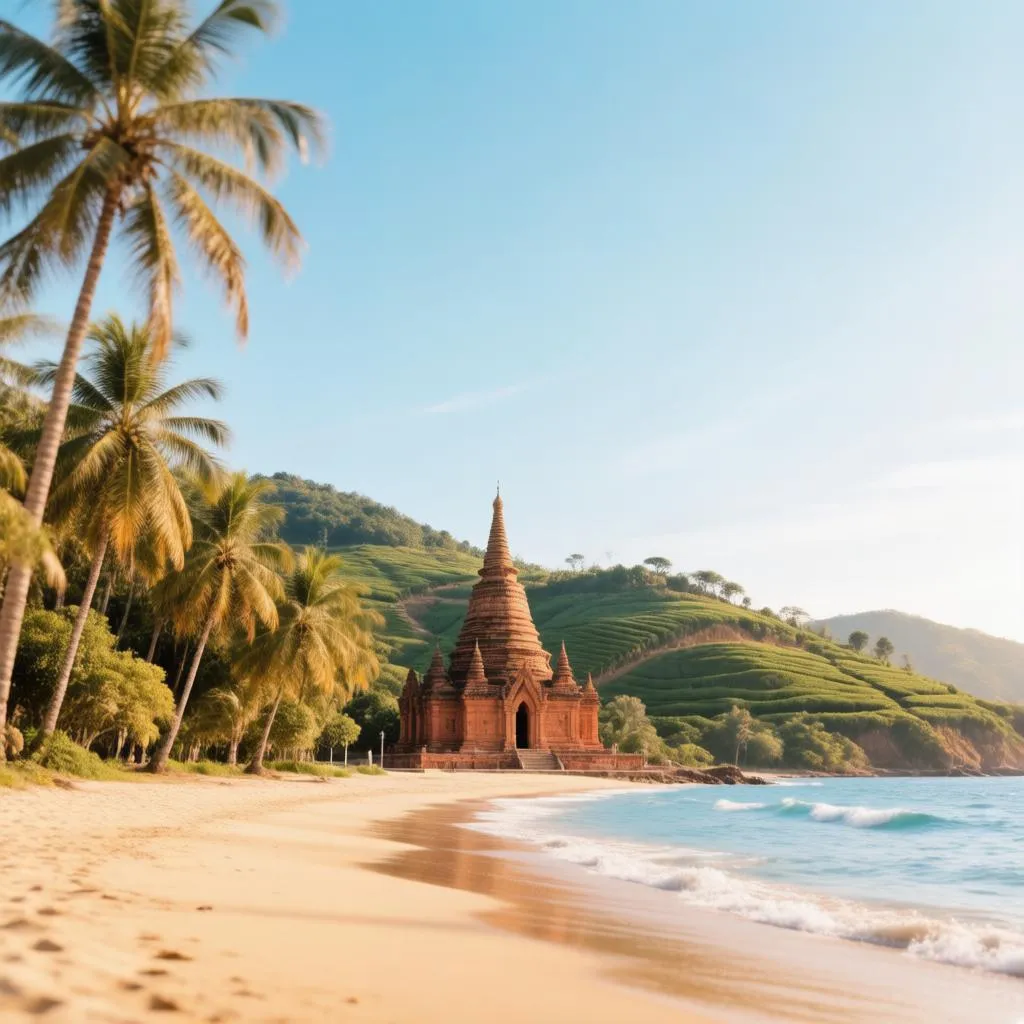
Sri Lanka is the size of a European country you could drive across in a single morning, and that fact quietly shapes everything about planning a trip here. In fourteen days you can watch whales off the southern coast, stand above the clouds at sunrise on a hilltop in Ella, hear monks chanting in a cave temple built two thousand years ago, and end the trip with your feet in the Indian Ocean again. The island compresses experiences that would take weeks of travel elsewhere. But compression cuts both ways: fourteen days is enough to see a great deal, and just enough to ruin the trip by trying to see all of it. The itineraries that work best make peace with the island’s rhythm — one direction, no backtracking, and a deliberate pause somewhere in the hills.
How the island is shaped, and why it matters
Sri Lanka’s geography is a triangle with three distinct corners, and almost every itinerary is a circuit around them. The southwest and southern coasts hold the beaches: golden sand, surf towns, stilt fishermen at sunset and whale-watching waters. The hill country in the centre rises through tea plantations to cool-air towns where the temperature drops ten degrees and the landscape turns a hundred shades of green. The cultural triangle in the north-centre holds the ancient capitals — five UNESCO sites clustered within a few hours of each other, including rock fortresses and painted caves older than most European cathedrals.
A logical loop connects all three without doubling back. The classic direction runs either clockwise or anticlockwise; the choice depends mostly on season and surf conditions, discussed later. Distances look small on the map and behave differently on the road: the island’s traffic, winding hill roads and single-track bridges mean a 150-kilometre journey routinely takes four hours. Planning around real travel times, rather than map distances, is the single biggest fix for overambitious itineraries.
The day-by-day plan
Fourteen days allow the full circuit at a humane pace, with built-in rest days that most first-timers wrongly cut. One workable structure looks like this:
- Days 1–2 — arrive in Colombo, overnight transfer down to Galle or the southern coast.
- Days 3–5 — the southern beaches: Mirissa for whale watching and surf, Unawatuna and the Galle fort, a day trip to the turtle hatcheries of Kosgoda.
- Days 6–7 — inland ascent: Tissamaharama for a Yala National Park safari, leopards, elephants and crocodiles.
- Days 8–9 — Ella: the Nine Arch Bridge at train time, Little Adam’s Peak at sunrise, a tea factory visit and waterfalls.
- Day 10 — the famous hill-country train to Kandy, one of the world’s great scenic rail journeys.
- Days 11–12 — Kandy’s temple of the tooth, the Peradeniya gardens, then on to Sigiriya and Dambulla.
- Day 13 — the cultural triangle: climb Sigiriya rock fortress at dawn, the Dambulla cave temples, optional Polonnaruwa or Anuradhapura.
- Day 14 — return to Colombo for the flight home, or a final afternoon at a west-coast beach near the airport.
The sequencing has one built-in advantage: the hardest physical days — the Yala safari before dawn, the Sigiriya climb before the heat — land mid-trip, when travellers are rested and acclimatised, rather than in the jet-lagged first days or the exhausted final ones.
The southern coast: beaches with a purpose
The stretch of coast from Galle to Tangalle offers a different town every twenty kilometres, and each has a distinct personality. Galle Fort itself deserves a full day: a walled Dutch colonial quarter of boutique hotels, cafés and rampart walks where the Indian Ocean pounds the walls a metre below. Mirissa, further east, is the whale-watching capital — blue whales and spinner dolphins pass offshore between November and April, and boats leave the harbour before six in the morning to beat both the wind and the crowds.
Choosing where to base yourself matters more than the number of stops. The practical options cluster into recognisable profiles:
- Galle Fort — history, food, boutique shopping; best for travellers who want atmosphere over pure beach time.
- Unawatuna — a lively beach bay with swimming and reef snorkelling, thirty minutes from Galle.
- Mirissa — the classic beach-and-whales base, with a small bay, palm-lined bars and a relaxed surf scene.
- Weligama — the learn-to-surf capital, with gentle beginner waves and board rentals on every corner.
- Tangalle — quieter, longer beaches and higher-end villas, best for travellers finishing the coast heading inland to Yala.
Most two-week itineraries pick two of these rather than hopping nightly between all five. Nightly moves double the packing, halve the relaxation, and save almost no travel time on a coast this compact.
Ella and the tea hills: the trip’s cool green heart
Ella sits at a thousand metres, and arriving there after the coastal heat feels like stepping into a different country. Mornings are cool enough for a jacket, the air smells of tea and eucalyptus, and the town’s attractions cluster around two walks: Little Adam’s Peak, an easy forty-five-minute climb with a valley panorama, and Ella Rock, a steeper two-hour hike through tea fields and forest paths. Between them sits the Nine Arch Bridge, the colonial-era railway viaduct that has become the island’s most photographed structure — best seen when a blue train crosses it, and best reached on foot through the jungle path rather than by tuk-tuk.
Ella’s surroundings supply the tea-country experiences: factory tours where the leaf’s journey from plucking to grading unfolds in a single building, tea-estate walks between endless green rows, and waterfalls such as Ravana Falls within tuk-tuk distance. The town itself has grown into a traveller hub of rooftop cafés and curry restaurants, and two nights here — with one full day — is the minimum that lets the pace breathe.
The train onward to Kandy is the itinerary’s centrepiece and its most competitive ticket. The Kandy–Ella segment sells out weeks ahead in high season, and travellers who miss it face the bus, a scenic but cramped alternative. Booking the reserved second-class or first-class observation car early is one of the few genuinely time-sensitive logistics of the whole trip.
The cultural triangle: two thousand years in two days
North of Kandy the island flattens into the dry zone, where the ancient capitals rose between the third century BC and the twelfth century AD. The region’s sites reward early starts above almost everything else on the island, because the climbing and walking are best done before the midday heat. The two essential stops are universally agreed:
- Sigiriya — a 200-metre rock column crowned by a fifth-century palace, climbed by a staircase past the famous frescoes and mirror wall, with summit views over the jungle canopy. Sunrise entry beats both the heat and the tour groups.
- Dambulla — a monastery complex inside five natural cave chambers, their ceilings covered in murals and sheltering more than a hundred seated Buddha statues, continuously in use for over two thousand years.
Beyond these two, the triangle deepens with Polonnaruwa, the medieval capital of ruined temples and the famous stone Buddhas of Gal Vihara, and Anuradhapura, the oldest and most sacred of the ancient cities. Travellers with energy for one of them usually choose Polonnaruwa for its compactness; both pair naturally with a morning safari in nearby Minneriya National Park, where herds of up to a hundred elephants gather around the reservoir in the dry months.
Kandy itself, the gateway to the hills, anchors the triangle’s southern edge. The Temple of the Sacred Tooth Relic, set beside the artificial lake, draws pilgrims in the evenings when the ceremony halls fill with drummers and lotus offerings; the Peradeniya botanical gardens, with their avenue of giant palms and orchid houses, make the easy morning contrast.
Costs and timing
Sri Lanka remains one of the more affordable long-haul destinations, but prices have risen noticeably in recent years, and budgeting with outdated figures leads to surprises. A realistic daily picture for two travellers sharing a room:
| Expense category | Budget (per person/day) | Comfort (per person/day) | What changes |
|---|---|---|---|
| Accommodation | $15–25 | $50–120 | Guesthouses versus boutique hotels and villas |
| Food | $8–15 | $25–45 | Local rice-and-curry spots versus resort dining |
| Transport | $10–20 | $25–60 | Buses and tuk-tuks versus a private driver for the circuit |
| Activities | $5–15 | $20–40 | Yala safari jeeps, Sigiriya and cave-temple tickets |
| Daily total | $40–75 | $120–265 | Roughly one driver share and one safari per week in comfort |
The single most efficient upgrade is hiring a driver-guide for part or all of the circuit. Rates run around $50–70 per day including fuel, and the driver handles navigation, ticket queues and hotel contacts — valuable on hill roads where buses crawl and tuk-tuk drivers charge by the kilometre. Many travellers split the difference: a driver for the hill country and cultural triangle, self-managed tuk-tuks and buses on the coast.
Season shapes the plan more than anything else. The southwest coast and the hill country share a dry season from December to March, which is why the anticlockwise loop starting with the beaches works best in that window. From May to September the rains move to the southwest, while the east coast — Trincomalee, Pasikuda, Arugam Bay — enters its dry, surfable season, and hill-country weather stays pleasant year-round. The cultural triangle sits in the dry zone and stays visitable throughout, though the heat peaks in April and September.
Practical notes that smooth the journey
A handful of local details separate smooth trips from stressful ones, and they cost nothing to learn in advance:
- Dress codes at temples — shoulders and knees covered, shoes off at entrances, and a sarong or scarf packed permanently in the day bag.
- Tuk-tuk pricing — agree the fare before setting off or insist on the meter; the metered apps that have arrived in the cities take the negotiation out entirely.
- Water and food habits — sealed bottled water everywhere, and the country’s rice-and-curry eaten with the right hand in the local style, or with cutlery on request.
- Currency and cash — the rupee is a cash-heavy currency outside cities, and ATMs cluster in towns; withdrawing once in Colombo covers most of the trip.
- Sunrise discipline — Sigiriya, Little Adam’s Peak and the whale boats all start before dawn, and the trip’s best hours belong to the early riser.
None of these requires preparation beyond a light bag and an open schedule. The island’s friendliness does most of the rest: strangers offer directions, homestay hosts feed guests until surrender, and even the traffic chaos resolves into an unhurried rhythm once you stop fighting it.
The fortnight that covers an island
Two weeks in Sri Lanka is a strange equation: barely enough time to see the famous sites, yet enough to leave with the feeling of having really travelled somewhere. The circuit that works — coast, safari, hills, train, triangle, city — delivers the island’s full range without a single wasted backtrack, and the days built into Ella and the southern beaches are not slack but essential, the padding that keeps the other twelve from blurring together. Travellers leave the island with sand between their toes, tea in their luggage and a hundred-year-old mural fresh in memory, and most leave with something harder to name: the sense that this small teardrop of land somehow contains a continent’s worth of variety, packed tightly enough to be seen, loosely enough to be felt.