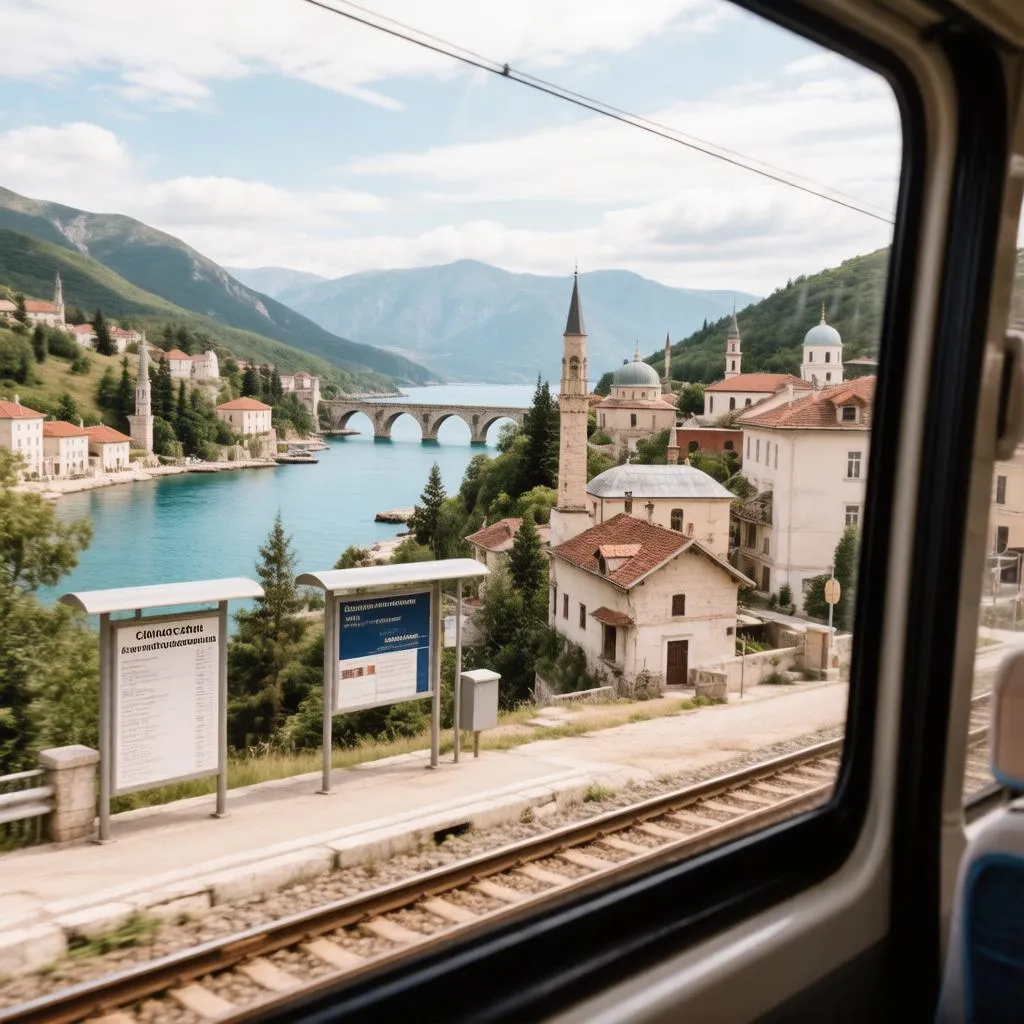
There is a particular pleasure in crossing the Balkans slowly. From the window of a bus climbing out of Belgrade, the landscape changes in a way no flight reveals: flat Vojvodina wheat fields give way to the Drina river gorge, then to Ottoman stone roofs and minarets of Bosnia, and finally to Montenegro’s mountains dropping straight into the Adriatic. Three countries, three currencies, three historical layers — and yet one continuous journey that costs a fraction of a Western European rail pass. Public transport here is not a compromise but the right way to travel the region: buses go everywhere, trains cover the beautiful parts, and borders between the three states are crossed on foot with a passport stamp, often in twenty minutes. What follows is the full map of how to do it well — routes, timetables, costs and the small decisions that make the difference between a rushed transit and a proper journey.
Why overland beats flying in this region
The Balkans reward overland travel for reasons that are practical before they are romantic. Flying between Belgrade, Sarajevo and Podgorica means airports far from city centres, thin schedules and fares that climb steeply in summer. Meanwhile the bus companies and railways fill the same gaps at prices that rarely exceed the cost of a restaurant dinner. The routes themselves are the attraction: the Belgrade–Bar railway is routinely described as one of Europe’s great scenic train journeys, and the Sarajevo–Mostar ride traces the Neretva canyon through tunnels and viaducts that no highway follows.
Overland travel also mirrors the region’s history. The routes were built across empires — Austro-Hungarian, Ottoman, Yugoslav — and each stretch carries the stamp of whoever laid it. Travelling by land, border crossings become part of the story rather than interruptions to it.
The network’s logic, once understood, is simple. Three hubs anchor everything:
- Belgrade — the eastern gateway, with the region’s largest bus station and rail connections north to Hungary and east to Romania.
- Sarajevo — the central pivot between east and west, connected daily to Belgrade, Mostar and Zagreb.
- Podgorica and the Montenegrin coast — the southern anchor, from which buses radiate to Kotor, Budva, Bar and Dubrovnik.
Between these hubs, minibuses and intercity buses fill every corridor, and the traveller’s job is mostly to string them together in the right order.
The classic two-week route
The most satisfying circuit runs north to south and ends at the sea. Two weeks allows it without rushing; twelve days compresses it with a couple of sacrifices. A proven structure:
- Days 1–3 — Belgrade: the Kalemegdan fortress, Skadarlija’s bohemian quarter, the Danube bank at Zemun, and a day trip to Novi Sad and the Petrovaradin fortress.
- Day 4 — the bus or train to Sarajevo, crossing the Drina river and the border at Trbovlje; the ride takes six to seven hours and the scenery justifies every minute.
- Days 5–6 — Sarajevo: Baščaršija’s coppersmith lanes, the Latin Bridge, the Tunnel of Hope museum, and the Austro-Hungarian quarter built during the city’s brief imperial golden age.
- Day 7 — the two-hour train or bus south to Mostar, arguably the prettiest rail ride in the region.
- Day 8 — Mostar: the Stari Most bridge, the old bazaar quarter, and the early-morning moments before the day’s crowds arrive; an optional side trip to the Kravica waterfalls.
- Days 9–10 — the bus across the border to Montenegro, via Trebinje or direct to Kotor; two days in the Bay of Kotor’s walled towns and beaches.
- Days 11–12 — Budva, Sveti Stefan and the coastal villages, with an optional boat day around the bay.
- Days 13–14 — the Belgrade–Bar railway north from Podgorica or Bar: a nine-hour journey through 250 bridges and tunnels that doubles as the trip’s scenic finale, arriving back in Belgrade for departure.
The direction matters. Running southward ends the trip with the grand mountain-and-coast finish of the Belgrade–Bar line, saving the best scenic journey for last; running northward puts the sea first and saves the history, which some travellers prefer for a different emotional arc.
Serbia: the plains, the fortress and the river
Belgrade announces itself loudly: a city of trams rattling through Belle Époque streets, rafts moored on the Sava serving grilled meat and live music, and the confluence of two great rivers watched from a fortress that has changed hands more than any structure in Europe. Three days covers it comfortably, and the city’s prices make even short stays feel generous. The Belgrade–Sarajevo corridor, reopened to passenger trains in recent years after decades of suspension, now runs twice daily in each direction, cutting the journey to around five and a half hours.
Beyond the capital, Novi Sad earns its reputation as Serbia’s most liveable city: a pedestrian centre, a citadel over the Danube and the site of the EXIT festival each July. Subotica, in the far north, shows a Hungarian art nouveau face that surprises most visitors. The train network connects these northern cities well; heading south or east, the bus is king.
Bosnia: from Ottoman quarters to the Neretva gorge
Sarajevo remains the region’s emotional centre, a city where East and West meet within a single street: one end of Ferhadija has Ottoman coppersmiths and mosques, the other end has Austro-Hungarian facades and Catholic cathedrals, and the boundary between them is marked by a painted line on the pavement. The city’s layered history — Ottoman, imperial, Yugoslav, siege-era — is readable in a few days of walking, and the museums around the siege years reward a full morning each.
Mostar, two hours south, is smaller and more concentrated: a sixteenth-century stone bridge, an old bazaar, and a river canyon framed by minarets. The bridge’s story is the city’s story — destroyed in the war and rebuilt in 2004 as a UNESCO site, now jumped from by local divers twice a day in summer. South of Mostar, the Kravica falls, a horseshoe-shaped cascade in a green amphitheatre, make the most popular half-day excursion.
The country’s rail lines deserve a specific mention, because they punch above their length:
- Sarajevo–Mostar — two hours of canyon views through tunnels and over viaducts along the Neretva; the most beautiful short train ride in the region.
- Sarajevo–Belgrade — reopened in recent years, running through the Drina valley; slow by international standards, spectacular by any standard.
- Sarajevo–Zenica–Doboj — the industrial spine of the country, useful for connections north toward Hungary.
Everything else in Bosnia moves by bus, and the bus network is dense, cheap and reliable. The country’s geography — a bowl of mountains around a capital — makes roads winding and journeys slow; what looks like two hours on the map routinely takes four.
Montenegro: the bay, the beaches and the great railway
Montenegro compresses a fjord, a desert, a mountain plateau and a coastline into a country the size of a small English county. The Bay of Kotor, in the northwest, is the headline: a drowned river valley ringed by mountains, with the walled towns of Kotor and Perast clinging to its shores. Kotor itself, with its labyrinth of lanes and a fortress climb of 1,350 steps above the rooftops, deserves at least two nights — the town empties beautifully after the day-cruise crowds leave.
The coast south of the bay runs through Budva, with its old town and long beaches, and the peninsula of Sveti Stefan, whose silhouette has become Montenegro’s postcard. Beyond the coast, the interior climbs to national parks — Durmitor’s glacial lakes, the Tara canyon, Biogradska Gora’s primeval forest — reachable by bus or by renting a car for two days.
The trip’s crowning transport experience, however, is the Belgrade–Bar railway, the line that gave this article its premise. Opened in stages from the 1970s, it crosses 435 bridges and 254 tunnels between the Adriatic and the Serbian plains, including the Mala Rijeka viaduct, at 198 metres high one of the tallest in the world. The full journey takes around nine to ten hours; many travellers ride only the southern half, from Bar or Podgorica to Kolašin, and claim the best of it.
Costs and practicalities
Budgeting this route is one of its quiet pleasures: the three countries rank among Europe’s cheapest, and the differences between them are small. A realistic daily picture for one traveller:
| Expense category | Serbia | Bosnia | Montenegro |
|---|---|---|---|
| Accommodation (mid-range) | €30–45 | €25–40 | €40–70 |
| Food (eating out daily) | €15–25 | €12–20 | €18–30 |
| Transport between cities | €8–20 | €8–18 | €10–25 |
| Activities and entries | €5–15 | €8–20 | €10–25 |
| Daily total | €58–105 | €53–98 | €78–150 |
The pattern reads clearly: Bosnia costs the least, Montenegro the most, and Serbia sits in between. The coastal towns of Montenegro in July and August add a seasonal premium of 30–50 per cent on accommodation, which is the single strongest argument for travelling in May, June or September — warm sea, quiet bays, and prices at the lower end of the ranges above.
Currency is the main practical friction. Serbia uses the dinar, Bosnia the convertible mark, Montenegro the euro. Exchanging at borders and city exchanges is straightforward; the last country visited, Montenegro, takes euros directly and simplifies the final days.
The details that make or break the journey
A handful of local habits and booking practices separate smooth trips from frustrating ones. These are the notes experienced Balkan travellers pass on:
- Book buses in advance only for summer peak routes — Kotor–Budva–Podgorica in July and the Belgrade–Sarajevo corridor fill up; everything else is a walk-up affair.
- Carry small notes in each currency — border towns and rural buses rarely give change for large denominations.
- Check departure times a day before — timetables shift seasonally and websites are not always updated; the bus station notice boards and ticket windows are the final word.
- Border crossing documentation — EU and most Western passports need no visas; national ID cards alone are not sufficient for the region’s borders.
- Cash at cafes and small shops — cards work in cities and hotels, but the bus stations, mountain villages and small restaurants remain cash-first.
- Sea and mountain weather — the Bay of Kotor can be twenty degrees warmer than the Durmitor plateau an hour’s drive away; packing layers is not optional.
None of these adds cost; each adds hours of comfort. The region’s unpredictability is also its charm — timetables bend, buses leave a few minutes late, hosts offer coffee that turns into an hour — and the traveller who builds slack into each day enjoys it far more than the one chasing a schedule.
The slow road through three countries
Travelling Serbia, Bosnia and Montenegro by land does something no flying itinerary can: it turns geography into a single continuous narrative. The journey begins on Serbia’s flat riverside plains, rises through Bosnia’s Ottoman valleys and Austro-Hungarian quarters, and ends where Montenegro’s mountains plunge into the Adriatic — and the transport itself, from the Drina gorge bus to the Neretva train to the Belgrade–Bar line’s viaducts, is the thread that binds the story. Two weeks, three currencies and a handful of bus tickets later, the traveller leaves with the region understood not as a collection of postcards but as one road, walked at walking pace through three countries that were once, and in many ways still are, a single landscape.