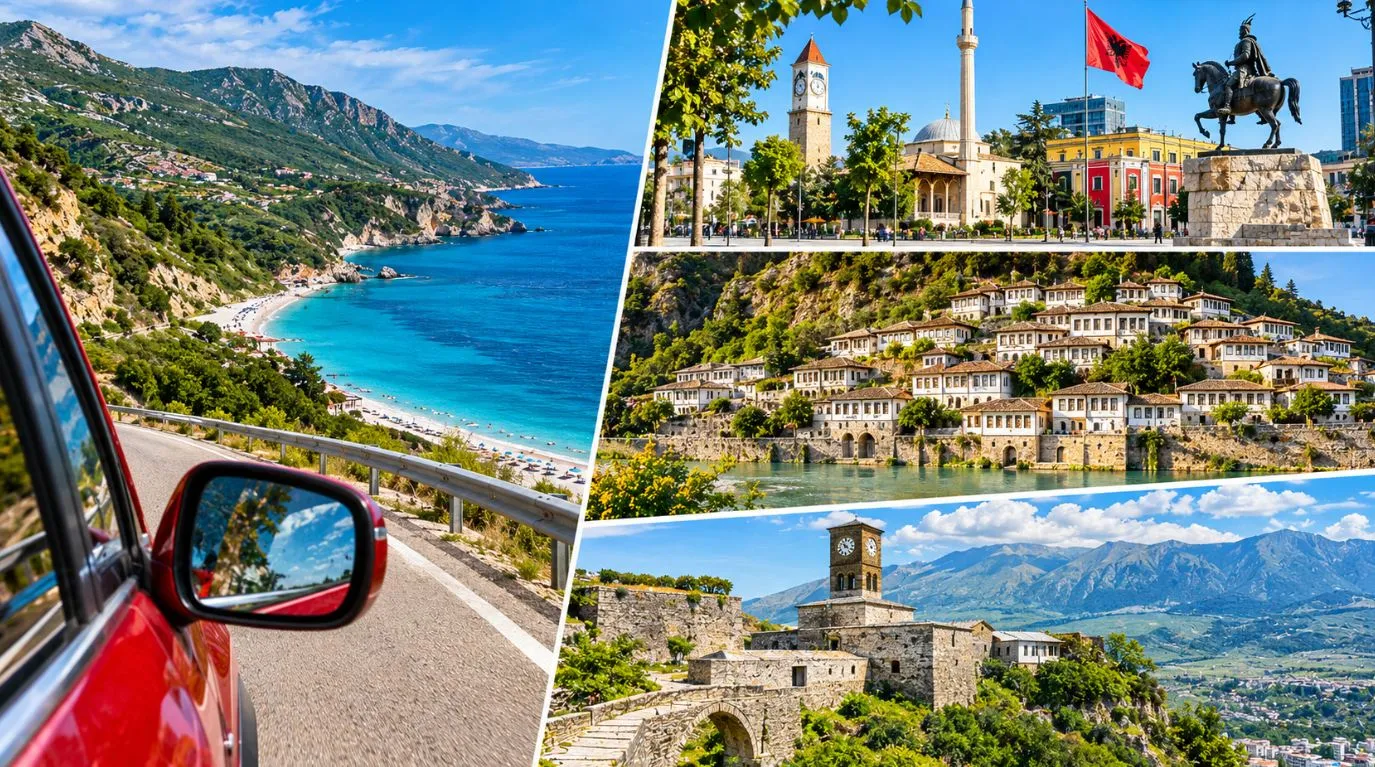
A road trip is the only honest way to see Albania. The country’s greatest treasures refuse to sit neatly on a rail line: they hide behind horseshoe bays only reachable by gravel turn-offs, inside valley towns split by rivers, and along a coastline where every curve reveals another empty beach. Renting a car gives you all of it, on your own schedule, for a fraction of what similar freedom costs in Croatia or Italy. Ten days is the ideal length — long enough to cover the south properly, short enough that the trip stays a holiday rather than a logistics exercise.
This route runs a loop: Tirana in the center, west into the UNESCO town of Berat, south through Gjirokastër to the Albanian Riviera, then back along the coast through Vlorë and Durrës. You will never drive more than four hours in a day, which matters more here than you might think, because Albanian roads reward slowness — they pass through scenery that deserves a coffee stop, not a glance through the window.
How the days break down
The itinerary balances culture, driving and beach time, so no single stretch of the trip feels like hard work. Note that day counts below assume you land and collect the car in Tirana on day one.
| Days | Base | Focus of the stay | Driving distance to the next stop |
|---|---|---|---|
| 1–2 | Tirana | Bunk’Art museum, Skanderbeg Square, Dajti cable car, lake walks | About 100 km to Berat |
| 3–4 | Berat | The thousand-window old town, Onufri icons, castle sunset | About 120 km to Gjirokastër |
| 5–6 | Gjirokastër | Stone-roofed old town, fortress, Blue Eye spring, Syri i Kalter | About 55 km to Sarandë |
| 7–8 | Himarë and the Riviera | Beaches of Drymades and Jala, Llogara pass, boat coves | About 190 km to Durrës |
| 9–10 | Durrës or Tirana | Roman amphitheater, Adriatic seafood, return flight | Under 40 km to the airport |
Two nights in each base keeps the pace humane, and the shortest hop — Gjirokastër to Sarandë — conveniently lands you on the coast right when you will be craving it. If your flight leaves from Tirana, the final drive north can be split with a night in Durrës, which turns the last day into a relaxed beach-and-romans finish instead of a highway slog.
Days 1–2: Tirana, the loud, green, contradictory capital
Albania’s capital greets you with color. Buildings painted in candy stripes, cafés spilling across every square, and a skyline suddenly growing towers — Tirana has changed faster in the last decade than in the previous fifty. Start at Skanderbeg Square, the vast granite heart of the city, then walk south along the boulevard toward the Blloku district, where the communist leadership once lived behind fences and where the bars and restaurants now pack the very streets they were forbidden to enter.
Do not skip the Bunk’Art museums. Hoxha’s paranoia left the country with tens of thousands of concrete bunkers, and the largest of them, tunneling deep into a hillside on the city’s edge, now houses an immersive museum of the communist decades. It is sobering, well-curated and gives everything else you see on the trip a backstory. For contrast, ride the Dajti Ekspres cable car up the mountain in the afternoon: the panorama stretches to the Adriatic, and the summit restaurants serve roasted lamb under pine trees.
Tirana rewards eating, too. The New Bazaar area has become the city’s food quarter, where raki flights, grilled qofte and byrek stuffed with pumpkin or cheese come cheap and cheerful. Sleep well, because day three starts the real journey.
Days 3–4: Berat, the town of a thousand windows
The drive from Tirana to Berat takes barely two hours, crossing a landscape of olive groves and roadside melon stands. Berat, a UNESCO World Heritage site, spreads across both banks of the Osum river, its white Ottoman houses stacked up the hillside like a staircase of windows — hence the nickname “the town of a thousand windows.” The Mangalem quarter on the south bank and Gorica on the north are connected by a stone bridge, and both reward aimless wandering over any schedule.
The castle crowns the hill above, and it is not a ruin roped off from life: families still live inside the walls, chickens cross the cobbles, and the churches hold original icons. The Onufri Museum, inside the Church of the Dormition, displays 16th-century icons famous for a red pigment the master allegedly refused to share the recipe for. Stay for sunset from the ramparts, when the valley turns gold and the call to prayer drifts up from the mosques below.
Berat is also a good base for the countryside. Local guides run rafting trips on the Osum canyon in spring, the Bogovë waterfall cools things down in summer, and the surrounding hills hide some of the country’s best family wineries, where tasting means being poured glasses by the owner’s mother and arguing about which vintage is best.
Days 5–6: Gjirokastër, the city of stone
The road south to Gjirokastër climbs over hills before dropping into the Drino valley, and the town announces itself from far away: a cascade of slate-roofed stone houses clinging to a steep slope beneath a fortress. Another UNESCO site, Gjirokastër feels stricter and quieter than Berat, all grey stone and heavy wooden shutters, as if the town were carved from the mountainside in one piece.
The castle hosts a wrecked American-era aircraft on its terrace and a gallery of captured weapons inside, but the real pleasure is the old town lanes, where guesthouses hide behind carved doors and a fortune-teller’s courtyard doubles as a museum. Seek out a restaurant serving qifqi, the town’s signature rice balls, and the region’s thick, buttery gliko preserves. Most visitors stay only hours; staying a night lets you own the stone streets after the tour buses leave.
Keep the second day for two short excursions. First, the Blue Eye spring, a natural phenomenon an hour south where water surges up from a cave so intensely turquoise that the pool looks lit from below. Arrive before ten to beat the crowds and swim in the cold outflow. Second, if time allows, the ruins of Butrint further south near the Greek border — a city layered from Greek to Venetian times, shaded by forest and ringed by wetlands where flamingos sometimes appear.
Days 7–8: The Albanian Riviera, beaches between mountains and sea
From Gjirokastër the road drops to the sea at Sarandë, and the character of the trip changes completely. The Albanian Riviera runs north from here along the Ionian coast, and its best stretch lies beyond the busy port town: a sequence of coves and beach villages where mountains fall straight into water of impossible clarity. Himarë makes the perfect base, a low-key town of tavernas and olive groves with beaches within walking distance and more hidden in either direction.
Give yourself a full beach day and use it well. A boat trip from Himarë harbor reaches the sea caves and the closed-off Gjipe canyon, where a pirate’s cave opens onto a pebble beach reachable by no road. On land, the Llogara pass — where the road climbs over a thousand meters with the sea glittering far below — deserves a stop for paragliding launches and the trailhead to Caesar’s Pass. Ask any local where to swim and they will argue passionately between Jala, Livadhi and Borsh; the argument is half the fun.
Seafood drives the region’s tables, from grilled octopus to risotto black with cuttlefish ink, usually caught that morning by someone you might be sitting next to. Prices run higher than inland Albania but still far below Italian or Croatian counterparts for the same views.
Days 9–10: Durrës and the road home
The drive north from the Riviera is the trip’s longest, roughly three hours along the new coastal highway through Vlorë, and it is worth pausing at the Vlorë waterfront, where Albania declared independence in 1912. Durrës, the ancient port of Dyrrachium, offers the country’s largest Roman amphitheater hidden improbably inside the modern town, a decent archaeological museum and a long Adriatic promenade lined with fish restaurants.
From Durrës it is a short hop back to Tirana airport, or you can spend the final night in the capital for one more round of Blloku dinners. If your schedule allows a morning flight, the airport’s position between the two cities makes either choice painless.
Driving in Albania: what to expect behind the wheel
First-time visitors often arrive nervous about Albanian roads and leave wondering what the fuss was about. Conditions have improved dramatically, and the main national roads are in good shape, though mountain stretches still demand patience. A few habits will make every drive easier:
- Fill the tank when it drops below half, because fuel stations thin out in the mountains even on popular routes.
- Watch for speed bumps and stray livestock entering villages, and expect drivers to overtake on blind curves — stay right and let them.
- Use the new SH4 and SH8 highways where possible, and treat navigation apps’ estimated times as optimistic on winding sections.
- Park in marked lots in Berat and Gjirokastër, since old-town streets are narrow and locals park with creative interpretations of the rules.
- Keep your passport, rental papers and green card in the glovebox, as police checks are routine and polite.
An SUV is unnecessary unless you plan the rougher beach tracks in high summer; a small economy car handles the entire loop well and is cheaper to rent and park. Book rental cars ahead for July and August, when demand from returning diaspora visitors pushes prices up sharply.
Food, money and costs on the road
Albania remains one of Europe’s cheapest destinations, and the road trip format lets you spend that advantage where it counts. Restaurant meals with wine rarely exceed 20 euros per person, guesthouses run from 30 to 60 euros a night, and fuel, while not cheap, is offset by short driving distances. The lek is the local currency; euros are widely accepted in tourist areas but you get better rates exchanging cash in city exchange offices. Cards work in towns, but keep notes for village bakeries and beach kiosks.
Certain dishes and drinks trace the whole route and deserve a place in your memory as much as any monument:
- Byrek — the flaky layered pie that fuels Albanian mornings, best warm from bakery trays.
- Tavë kosi — baked lamb with yogurt and rice, Elbasan’s gift to the national table.
- Fërgesë — a bubbling pan of peppers, tomatoes and curd, perfect with fresh bread.
- Raki — the grape or plum spirit poured at every hospitable table; sipping politely is a social skill.
- Trout from mountain streams — a specialty of the inland stretches between Berat and Gjirokastër.
Coffee culture deserves its own line item: Albanians linger over espresso and macchiato for hours, and joining the ritual at a street café is as much a sightseeing activity as any castle.
Best time to go and how to tweak the route
June and September are the sweet spots: the sea is warm, the roads are quiet, and accommodation prices sit at shoulder-season levels. July and August bring heat, crowds and the annual return of Albanians working abroad, which fills the coast — charming in its way, but book everything early. May offers green hills and empty roads with cool sea, while October closes the season with mild days perfect for the inland towns.
With fewer days, cut Durrës and drive straight from the Riviera to Tirana airport. With more, detour north to Shkodër and the Albanian Alps at the end of the trip, or cross into North Macedonia at Lake Ohrid. Either way, the southern loop of Tirana, Berat, Gjirokastër and the Riviera is the version of Albania that turns first-time visitors into repeat ones — the kind who start planning the return drive before they have left the country.