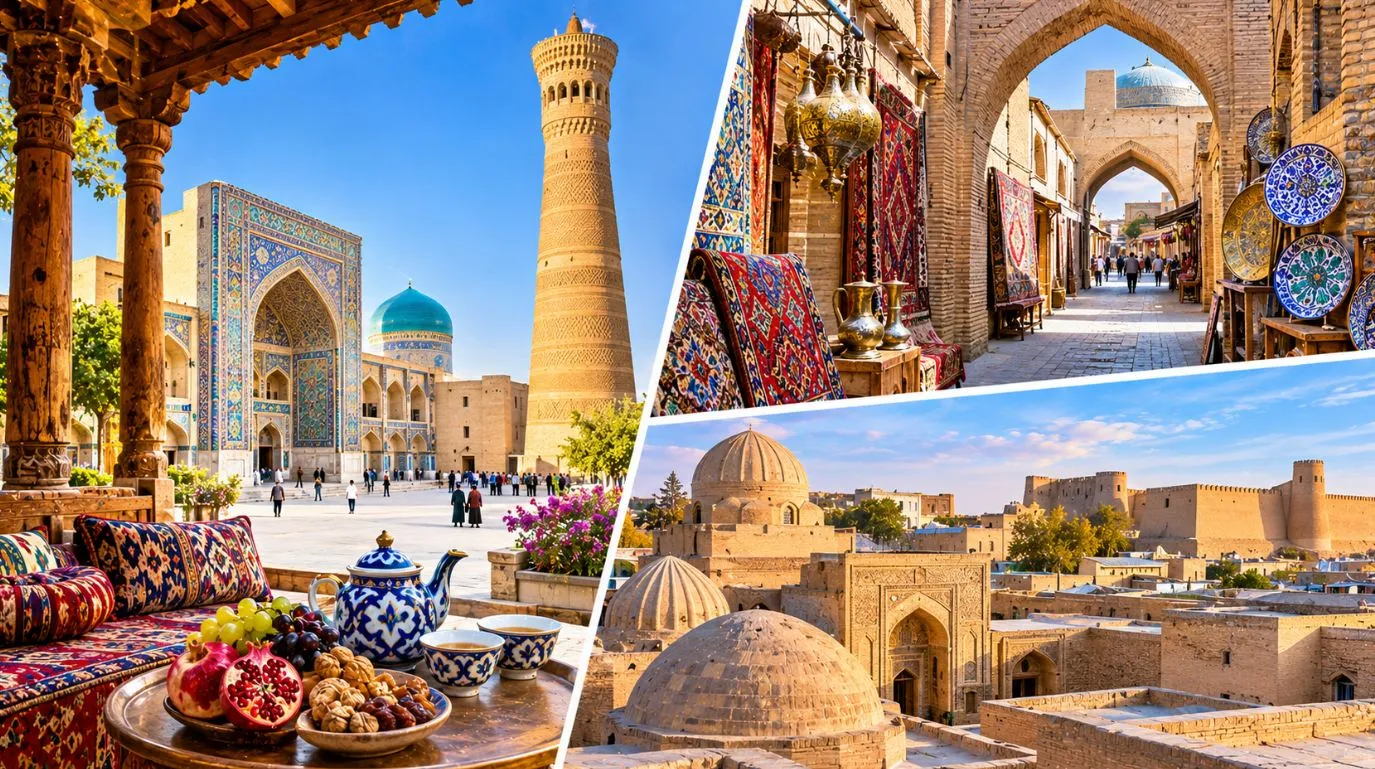
Some cities you visit; Bukhara you inhabit. For a thousand years this oasis town was a prize every empire on the Silk Road fought over, and today its old city survives as one continuous medieval fabric — mud-brick walls, turquoise domes, caravanserais and minarets all within a ten-minute walk of one another. Unlike Samarkand, where monuments stand apart as separate ensembles, Bukhara asks nothing of you except to wander. That is both its charm and the reason a little inside knowledge goes a long way: behind the obvious postcards hide quiet courtyards, hidden rooftops and working craft workshops that most day-trippers walk straight past.
This guide gathers the experiences that make Bukhara worth more than a rushed afternoon, arranged the way you will actually encounter them — by mood and by neighborhood rather than as a rigid list. Two or three days is the sweet spot. Long enough to see every major monument without fatigue, short enough to keep the trip moving toward Khiva or Samarkand afterward.
Why Bukhara feels different
The old city, listed by UNESCO as a World Heritage site, holds over a hundred surviving monuments, many of them still in daily use. Mosques fill at prayer time, madrasah courtyards host wedding parties, and the trading domes still sell the silks, spices and knives they have sold for centuries. This is the city’s central appeal: in Bukhara, you are not looking at the Silk Road through glass. You are standing in it.
The other advantage is practical. Nearly everything worth seeing sits inside a compact rectangle bounded by the old walls, and the atmosphere changes with the hours. Dawn belongs to photographers and鸽子-fanciers around Lyab-i Hauz, midday to shaded teahouses, evenings to floodlit squares and rooftop dinners. Planning around light and temperature, rather than around a checklist, is how the city rewards patient visitors.
The monuments that define the city
A handful of structures anchor any visit, and each tells a different chapter of Bukhara’s story. Here is how the essentials compare in time, cost and character:
| Monument | What makes it special | Time needed | Entrance fee (approx.) |
|---|---|---|---|
| Kalyan minaret and mosque | 47-meter brick tower that survived Genghis Khan; vast Friday mosque behind it | 1–1.5 hours | Around 40,000 som |
| Ark fortress | Royal citadel for over a millennium, now museums over royal courtyards | 1–2 hours | Around 40,000 som |
| Ismail Samani mausoleum | 9th-century brickwork masterpiece, the oldest building in the city | 30 minutes | Free |
| Chor Minor | Four small blue-domed towers of uncertain origin, charming and photogenic | 20 minutes | Around 20,000 som |
| Bolo Hauz mosque | Gravestone of Emir’s mosque with painted wooden columns and mirrored ceilings | 30 minutes | Free exterior, small fee inside |
| Sitorai Mokhi-Khosa | Summer palace of the last emirs, mixing Russian and Bukharian styles | 1.5 hours | Around 30,000 som |
One story ties the list together. The Kalyan minaret earned the grim nickname “tower of death” because condemned men were thrown from its top for nearly nine centuries, yet it also became the reason the Mongols spared the city’s core — Genghis Khan, legend says, looked up at its height and declared the mosque itself spared. Whether or not the anecdote is true, the tower’s endurance is not: it has watched over Bukhara since 1127, and its unadorned brick pattern still reads as pure architecture at a distance where newer monuments show their repairs.
Wander the trading domes and bazaars
Between the major monuments runs a chain of covered bazaar domes — Toki Zargaron, Telpak Furushon and Toki Sarrafon — built in the 16th century as specialized markets for jewelers, hatmakers and money-changers. They still function as markets, and their dim brick vaults offer the most atmospheric shopping in Central Asia. Look for suzani embroidery, hand-painted ceramics from the neighboring village of Gijduvan, and knives forged in workshops where the smiths will happily demonstrate their craft.
Bargaining is expected and performed with goodwill: begin around half the opening price and settle somewhere friendly in between. The bazaars also make the best places to taste the city. Vendors sell sun-dried apricots, walnut-stuffed pastries, and the famous Bukhara melons, sweet enough to be worth planning an August visit around.
Seek out the quiet corners
Beyond the headliners, Bukhara’s real texture lives in its lesser spots, most of which cost nothing or almost nothing. Consider adding these to your wanderings:
- Magoki Attari mosque — a sunken 12th-century mosque partly buried by centuries of rising streets, now a small carpet museum.
- The hidden hauz pools — old water reservoirs where locals play chess and feed pigeons in the late afternoon.
- Zindon prison pit — a chilling underground cell near the Ark where captives were lowered by rope; the famous “bug pit” that imprisoned British officers in the 1840s.
- Doll and instrument workshops — family studios in the old lanes where miniature painting, pottery and puppets are made before your eyes.
- The Baha-ud-Din Naqshband complex — a Sufi pilgrimage site a short drive out of town, quiet and shaded by ancient plane trees.
Each of these rewards a slower pace than the big squares allow. The prison pit, in particular, benefits from hiring a local guide for an hour, because its story — diplomatic intrigue, executions by the emir, a daring escape — is one of the strangest chapters in the city’s history.
Where Bukhara’s light works for you
The old city is famously photogenic, but the light makes the difference between a nice photo and a great one. Aim your days around these windows:
- Sunrise at Lyab-i Hauz — the pond mirrors the mulberry trees before the crowds arrive, and breakfast cafés open along its edge.
- Late afternoon at the Ark walls — warm side-light rakes across the ramparts facing west.
- Sunset from a rooftop café — the towers and domes of the old city catch the last pink light, best watched with green tea in hand.
- Night at the Kalyan complex — floodlit facades around the mosque square, with far fewer people than daytime.
Street photographers should note that most locals are friendly about portraits when asked, and that bazaars in late morning offer the richest human scenes. Weddings frequently photograph around the trading domes on Fridays; guests usually welcome congratulations and will often invite you to join a toast.
Sleeping inside the history
Bukhara’s boutique hotels are a destination in themselves. Many are converted merchant houses and madrasah cells arranged around courtyards, where breakfast arrives under a vine pergola and the evening call to prayer echoes across the roofline. Prices run from modest guesthouse rates to mid-range boutique comfort, and the best properties sell out from April through October — book ahead, especially around weekends and national holidays.
Location beats amenities here. A hotel inside the walls puts the entire old city within a ten-minute walk, and eliminates the need for taxis entirely. If you prefer modern comfort, newer hotels cluster just outside the walls near the main road, a five-minute walk from the monuments but a world away in atmosphere.
What to eat in Bukhara
Bukharian cuisine has a distinct personality within Uzbek food — heavier on rice, skewers and braised dishes, with its own famous plov variety. The city’s restaurants range from courtyard establishments in converted caravanserais to simple teahouses by the Lyab-i Hauz pond. Certain dishes appear on nearly every good table:
- Bukharian plov — served with garlic, chickpeas and local rice, at its best before early afternoon when cauldrons empty out.
- Shurpa — a clear lamb broth with root vegetables, the classic slow-evening meal.
- Mastava — rice soup with herbs, ideal after a long day on hot cobblestones.
- Guzhni noodles — hand-pulled noodles with meat and pepper sauce, a local favorite at bazaar stalls.
- Bukhara melon and dried apricots — sold by weight at the bazaars, perfect picnic food between monuments.
Tea culture sets the rhythm of the day. Small bowls of green tea appear wherever you sit, often before you have ordered anything, and refusing one is nearly impossible. Carry small notes: teahouses and bazaar stalls remain cash-first, while hotels and larger restaurants take cards without complaint.
Practical advice for the visit
Bukhara is easy to visit independently, but a few habits save time and friction. Keep these in mind before you arrive:
- Take a taxi from the train station for a fixed agreed price, or use a ride app, since drivers outside the station open high.
- Book train seats from Samarkand or Tashkent several days ahead in high season, as Bukhara is a popular stop.
- Carry a light scarf or long shirt, since mosque interiors and active pilgrimage sites require covered shoulders and knees.
- Bring cash in som for markets, teahouses and taxis; ATMs sit near the main square and restock in the morning.
- Hire a local guide for half a day if history is your priority, as Bukhara’s stories are layered and not fully explained on plaques.
Weather shapes the visit more than anything else. Summer afternoons push past 40 degrees, so sightseeing belongs to the morning and evening, while spring and autumn offer perfect walking weather and the melon season in late summer. Winter is quiet and atmospheric, with occasional frost on the domes and hotel prices at their lowest.
How long to stay, and what comes next
Two nights is the minimum to feel Bukhara properly; three is better, especially if the Sitorai Mokhi-Khosa palace and the Naqshband complex make your list. From here, the journey continues naturally westward toward Khiva by train or shared taxi, or eastward back to Samarkand for the Timurid grandeur that Bukhara’s quieter streets make all the more striking by contrast.
Leave at least one hour unplanned. Bukhara’s charm has always been accidental — a tea shared with a stranger, a doorway opening onto a courtyard, a sunset arriving earlier than expected from a rooftop you climbed on a whim. The monuments will still be there tomorrow; the unplanned hour is the part you will remember, and it is the reason travelers who come for a day so often leave wishing they had stayed a week.