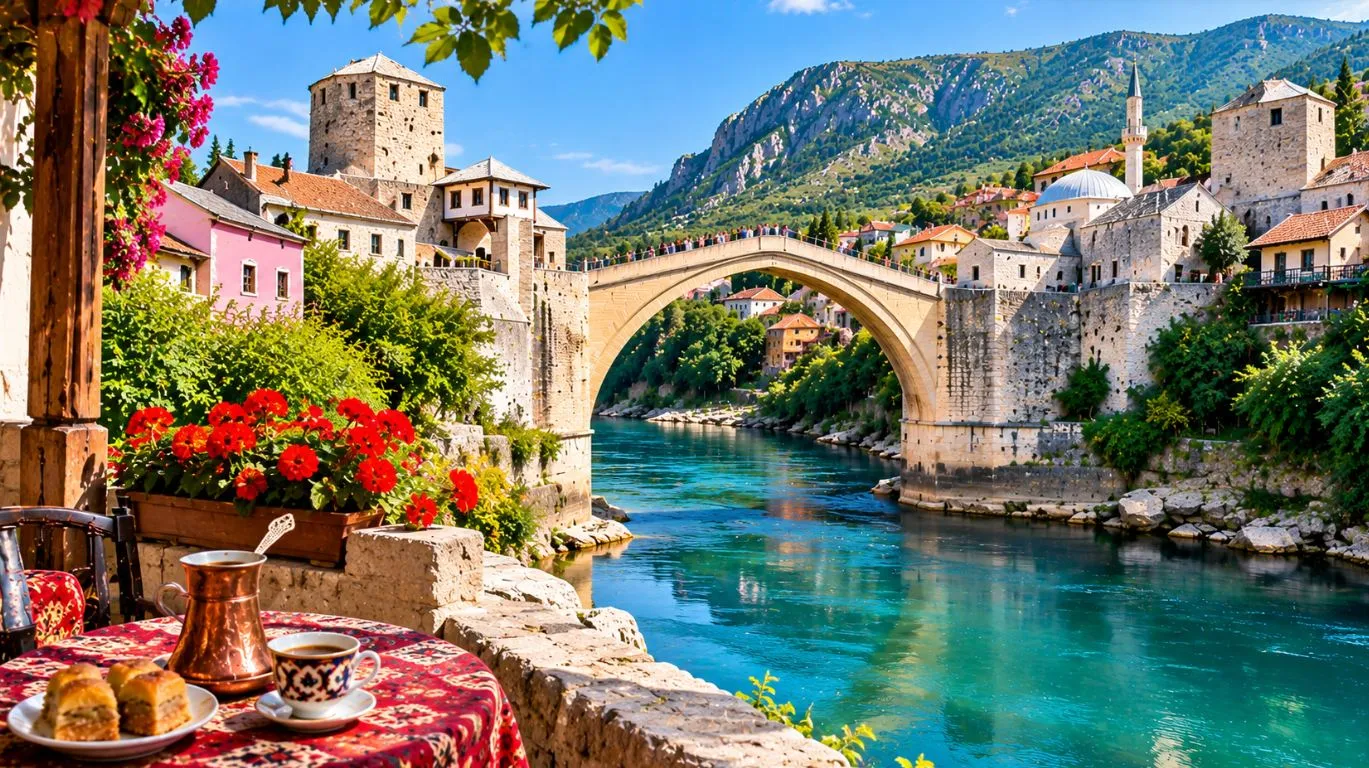
Mostar works as a day trip for a reason. The town’s defining sight — the Old Bridge arching over the emerald Neretva — can be admired in an hour, but Mostar rewards those who stay for the day: the coppersmith lanes, the riverside cafés, the snipers’ alley streets still bearing war scars, and the swimming spots where locals dive from the rocks into impossibly green water. Coming from either Sarajevo or Dubrovnik, the logistics matter more than usual, because buses and trains leave at fixed times and the town’s charm evaporates somewhat between the tour buses of late morning and late afternoon.
This guide covers both approaches in full: how to get there from each city, when to arrive for the best experience, what to see beyond the bridge, and how to time your return. Whether you start from the Bosnian capital or the Croatian coast, the goal is the same — catch Mostar in its best hours, eat well, cross the bridge on foot and leave before the crowds wear you down or the last bus slips away.
Getting there from Sarajevo
The journey from Sarajevo to Mostar takes about two hours by bus or train, and the route itself is part of the pleasure: the road follows the Neretva canyon past Jablanica, where the river widens under dramatic mountains, and the railway makes the same journey through tunnels and along the river in conditions buses cannot match. Buses run frequently through the day from the Sarajevo bus station near the railway station complex, and trains depart a few times daily from the station on the western edge of the city center.
Morning departures between 7 and 9 a.m. are the smartest choice. They put you in Mostar before ten, which matters because the town fills with tour groups from around eleven onward. Return buses run through the evening, with departures roughly every hour until nine or ten, and trains make the journey back twice daily. Buy return tickets in advance during summer weekends, when the Sarajevo–Mostar route carries locals and visitors alike, and check whether your bus stops at Konjic along the way — the town’s old wooden bridge and rafting base make it a worthwhile pause if your schedule allows.
Getting there from Dubrovnik
From Dubrovnik, Mostar sits about two and a half to three hours away by road, crossing the border at Klek-Imotski into Bosnia and Herzegovina. Regular buses run from Dubrovnik’s main station through the day, with morning departures around 7 to 8 a.m. delivering you to Mostar around ten. The route passes the Neum corridor, the narrow Bosnian coastline, and vineyard landscapes that change character once the road turns inland and the Neretva valley opens up.
Border crossings add unpredictable time to the journey, especially on summer weekends when queues at the Croatian side stretch long. Build a buffer of an hour into your plans, carry your passport for the crossing, and book return seats in advance if your visit falls between June and September. Alternatively, organized day tours from Dubrovnik handle all logistics, at a higher price but with the border queue taken care of by someone else. Independent travelers with rental cars should check whether their insurance covers Bosnia and Herzegovina, as the green card border documents are sometimes sold separately.
Arrival timing: the single most important decision
Mostar’s charm is time-sensitive. Between 11 a.m. and 4 p.m., the Old Bridge area fills with tour groups, the cobbled lanes clog with slow-moving lines, and the famous jumpers at the bridge start collecting donations from audiences that grow thick as the day warms. Come before ten or after four, and the town changes character entirely: light falls softly on the minarets, locals outnumber visitors, and the cafés by the river belong to those who know how to linger.
The practical plan looks like this: arrive by 10 a.m., see the bridge from the Hlebina platform before the buses unload, have lunch at a riverside restaurant beneath the arch, then spend the afternoon in the quieter neighborhoods most tours skip. By 5 or 6 p.m., when the crowds thin, the bridge regains its dignity, and the sunset light on the minarets is worth staying for — even if it means taking the last bus back and arriving home late.
The Old Bridge and its surroundings
The Old Bridge, Stari Most, is the reason Mostar exists. Built in 1566 by the Ottoman architect Mimar Hayruddin, it stood for 427 years before being destroyed in November 1993, during the war, and rebuilt with international funding — reopened in 2004 as a symbol of reconciliation. The arch is 28.7 meters long and stands 24 meters above the river, and its improbable slenderness still stops first-time viewers mid-stride. Crossing it costs nothing; standing beneath it, watching the green water slide under the pale stone, is one of the Balkans’ essential experiences.
Professional divers perform from the bridge in summer for tips collected from spectators on the banks, a tradition centuries old and officially sanctioned now through an annual competition held each summer. Do not attempt the jump yourself without training; the water is cold and the fall is real, and rescue services charge divers who need pulling out.
The bridge’s surroundings reward exploration. The cobbled Kujundžiluk street climbs from the bridge up through coppersmith shops and souvenir stalls, and the Koski Mehmed Pasha mosque nearby sells entrance tickets that include minaret access — the best elevated view of the bridge from the water below. On the Croatian side, the Mirrey “Hlebina” viewpoint… on the Croatian side… hmm, actually both banks. Both banks of the river hold viewpoints along the Neretva below the bridge, where swimmers gather on rocks and the water turns jade in the middle. Descend to the water level and you understand why generations of Mostar youths have thrown themselves from the arch: from below, the bridge is even more improbable than from above.
Beyond the bridge: the town Mostar actually is
Most of the day visitors see the bridge and leave, which is precisely why staying longer pays. Walk the Spanish Square and the boulevard that divided the city during the war, still visibly patched and rebuilt, and you grasp the town’s real story in a way no monument can explain. The Snipers’ Nest building, a former bank ruin on the boulevard, and the bombed-out former bank on the west side — both stand as raw reminders that the fighting ended within living memory. Locals cross this boulevard daily without ceremony, and visitors should treat the area with the same matter-of-fact respect they would show any living street.
Music and food complete the picture. The shaded lanes around the old town hold traditional restaurants serving grilled meat and river fish, and on summer evenings live sevdah music — the melancholic folk songs of Bosnia — drifts from the courtyards. Certain dishes deserve a spot on your table:
- Grilled river trout — Neretva fish grilled whole with lemon and herbs, a Mostar specialty worth ordering riverside.
- Ćevapi or pljeskavica — the Balkan grilled meat plates, served with somun bread, kajmak and raw onion.
- Burek — layered pastry with meat or cheese, sold in the bakeries off the old town lanes.
- Baklava and Bosnian coffee — the Ottoman dessert-and-coffee pairing, best in the courtyards off Kujundžiluk.
Riverside restaurants under the bridge offer the best views but run tourist prices; walking five minutes in any direction drops the bill by a third and usually improves the food. The old town’s side lanes hide family-run konobas where the trout comes from the river and the wine from the hillside vineyards above town.
Getting around and paying
Mostar is walkable in full, and the town’s compact size makes transport the easiest part of the day. Taxis from the bus and train station to the old town cost a few euros, or the walk takes twenty-five minutes along the boulevard. Cards work in shops and restaurants, but bakeries, markets and some cafés remain cash-first, so carry convertible marks in small notes. Euros are accepted in tourist shops but at unfavorable rates, so exchange a small amount or withdraw from ATMs in the center.
Entrance fees are modest. The Old Bridge itself is free, the mosque with minaret access charges a few euros, and the small museums around the old town stay cheap. Budget travelers can do Mostar on 30 euros a day comfortably, and mid-range visitors eat and drink lavishly for under 60.
Side trips and extensions from Mostar
If you have extra hours or decide to stay overnight, Mostar sits within reach of several worthwhile destinations. These are the easiest to organize:
- Blagaj and the Buna spring — a 15th-century dervish house set against a cliff beside one of Europe’s largest karst springs, fifteen minutes by local bus or taxi.
- Počitelj — an Ottoman hillside village of stone houses and a fortress, half an hour toward the coast.
- Kravica waterfalls — a wide horseshoe cascade with swimming basins, 40 minutes south by car or tour.
- Medugorje — a major Catholic pilgrimage site, west of Mostar, for travelers interested in religious history.
Overnight stays make the biggest difference. After the buses leave around five, Mostar belongs to the locals: evening light on the bridge, children swimming below, restaurants filling with families. A single night converts the town from a photo stop into a place, and rooms in the old town’s guesthouses cost little more than a day trip’s total transport.
Practical checklist for the day
A few habits separate smooth visits from frustrating ones, most of them tied to timing and money. Before setting out, keep these points in mind:
- Carry your passport, required for the border crossing from Croatia and useful at some ticket offices.
- Wear shoes with grip: the bridge’s polished stone and the riverside rocks are slippery, especially when wet.
- Bring swimwear in summer, since the rocks below the bridge and the Kravica falls offer genuine swimming.
- Book return bus seats in July and August, when the coastal route carries beach traffic north and south.
- Set an alarm for the return journey, as Mostar’s relaxed pace can swallow an afternoon without warning.
When to come and what to remember
May, June and September offer the best balance of warm weather, swimmable water and manageable crowds, while July and August bring heat, peak tour volume and the famous summer diving competition. Spring brings high water and dramatic river views, and winter, though cold, gives the bridge a melancholic beauty with almost no one around.
Whatever your starting point, the essential advice stays the same: arrive early, walk beyond the bridge, eat where locals eat, and stay for the light of late afternoon if the schedule allows. Mostar is small enough to see in hours but layered enough to remember for years, and travelers who treat it as more than a photo stop almost always plan to return — ideally with more time, and preferably out of season.