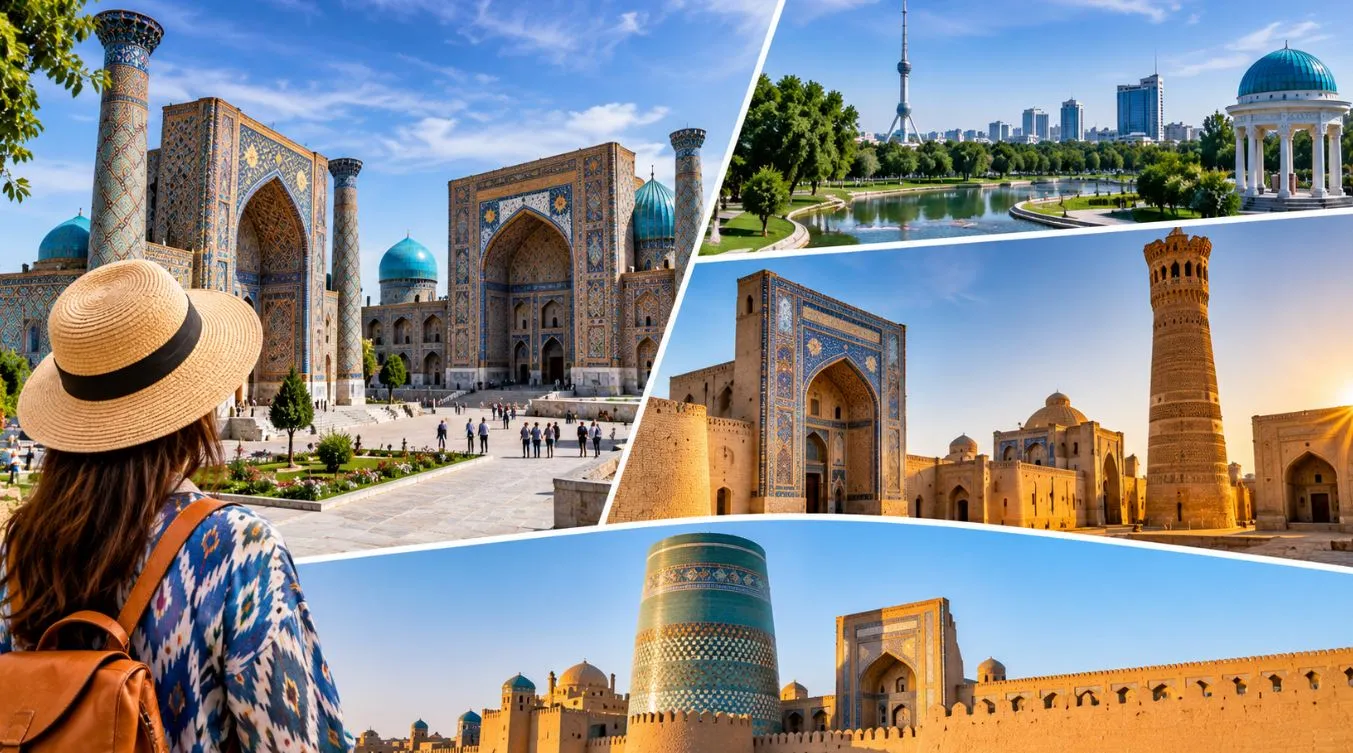
Ten days is the sweet spot for Uzbekistan. It is enough time to see the four great Silk Road cities without rushing, yet short enough to fit into a single trip without exhaustion. The country is more compact than most first-time visitors expect: modern high-speed trains connect Tashkent, Samarkand and Bukhara in a few hours, and Khiva, the farthest outlier, rewards the extra effort with the most atmospheric old town of them all. This itinerary follows a classic westbound route, moving from the capital through the two legendary trade hubs of Samarkand and Bukhara before finishing at the desert oasis of Khiva.
The route works well in this order because it builds up. You start in a lively modern city, ease into the architecture of Samarkand, find your rhythm in Bukhara’s old town, and end in Khiva, where the entire historic center fits inside a single walled city. By the time you reach Khiva, you will be able to tell the difference between a khanate minaret and a Timurid dome, which makes the journey feel like a story rather than a checklist.
Route overview at a glance
Before diving into city-by-city details, it helps to see the whole trip laid out. The itinerary alternates between sightseeing days and slower days, so you are never running between monuments with a suitcase in hand. Nights are spent in Tashkent, Samarkand, Bukhara and Khiva, with trains doing the long-distance work.
| Days | Base city | Highlights | Connection to the next stop |
|---|---|---|---|
| 1–2 | Tashkent | Chorsu Bazaar, metro stations, Khast Imam complex, museums | Morning high-speed train, about 2 hours |
| 3–5 | Samarkand | Registan, Gur-e Amir, Shah-i-Zinda, Ulugh Beg observatory | Fast train or shared taxi, about 1.5 hours |
| 6–8 | Bukhara | Lyab-i Hauz, Kalyan minaret, Ark fortress, trading domes | Train to Urgench plus short taxi ride, most of a day |
| 9–10 | Khiva | Ichan Kala walls, Juma mosque, Kunya Ark, sunset viewpoints | Return flight or long train back to Tashkent |
The rhythm is deliberately front-loaded: the first half covers the famous monuments, while the final days in Khiva slow down into evening walks along the ramparts and lazy lunches in caravanserai courtyards. If your flight home leaves from Tashkent, day 10 is a travel day, so plan to fly or take the overnight train rather than trying to squeeze in one more sight.
Days 1–2: Tashkent, the surprising capital
Most visitors arrive in Tashkent expecting a transit city and leave pleasantly surprised. Soviet-era avenues, glistening new glass towers and timber-fronted old madrasahs sit side by side, and the city has an easy, unpolished energy. Start in the center: the Mustaqillik and Amir Temur squares frame the government district, while the fountains and flowerbeds around Broadway Street (Sayilgoh) make for a relaxed first evening stroll.
Tashkent’s metro deserves a half-day in its own right. Some of the stations, like Kosmonavtlar with its deep-blue space murals and Alisher Navoi with its blue-and-white tilework, are among the most beautiful in Central Asia. A single ride costs a few thousand som, and photography is now allowed, so bring your camera.
On day two, head to Chorsu Bazaar under its vast turquoise dome, then walk to the Khast Imam complex, home to the world’s oldest surviving Quran, the 8th-century Uthman manuscript. If you have spare time, the Museum of Applied Arts and the Tashkent City park area show the two very different faces of the capital.
Days 3–5: Samarkand, the crown of the Silk Road
The high-speed Afrosiyob train from Tashkent covers the 350 kilometers to Samarkand in about two hours, which feels almost unfair given how far travelers once had to go to reach it. Book seats a few days ahead in high season, as the comfortable first-class carriages sell out quickly.
Samarkand needs no introduction for history lovers, but nothing quite prepares you for the Registan. Three immense madrasahs frame a square that glows deep blue at dusk, when the facade lights come on. Visit twice: once during the day for the details, once at night for the atmosphere. Gur-e Amir, the domed mausoleum of Timur himself, is best in the late afternoon when the turquoise tiles turn almost purple.
Reserve at least one full day for Shah-i-Zinda, the narrow lane of Mausoleums climbing a slope in brilliant glazed tiles. It is the most photogenic site in the country, and early morning light before nine is the perfect time. Add the Ulugh Beg observatory and the bustling Siyob bazaar, then spend your third day on slower pleasures: a plov lunch in a traditional choykhona, a walk along the canal, or a day trip to the paper-making village of Koni Ghil.
Days 6–8: Bukhara, the museum city you can live in
From Samarkand, fast trains continue west to Bukhara in roughly an hour and a half, dropping you within a short taxi ride of the old town. Unlike Samarkand, where the monuments stand in separate grand ensembles, Bukhara is one continuous historic fabric. Wander the streets around Lyab-i Hauz and you will pass caravanserais, meditative madrasah courtyards and centuries-old trading domes still selling silks, spice mountains and hand-beaten copper.
The Kalyan minaret, once called the Tower of Death because condemned men met their end from its top, rises 47 meters above the Friday mosque complex. Climb the neighboring viewpoints for a rooftop panorama, then descend into the Ark fortress, the ancient royal citadel. In the evening, the square in front of the Kalyan mosque fills with families strolling under floodlights, and the courtyard teahouses start serving green tea in porcelain bowls.
Keep day seven or eight flexible for the smaller pleasures that make Bukhara memorable: the Bolo Hauz mosque with its carved wooden columns, the hidden pools where locals play chess, and the famous carpet shops where bargaining is half conversation, half performance.
Days 9–10: Khiva, the desert finale
Getting to Khiva takes commitment, and that is part of its charm. Trains run from Bukhara toward Urgench, the nearest large city, taking most of the day; from there a shared taxi covers the last 30 kilometers. Alternatively, direct Afrosiyob services between Tashkent and Khiva operate on selected days. Check schedules on arrival in Uzbekistan rather than months ahead, as timetables shift with the seasons.
Once you arrive, everything changes. Ichan Kala, the walled inner city of Khiva, is essentially a single architectural monument: minarets, palaces, madrasahs and harem courtyards packed inside mud-brick ramparts. Climb the Islam Khoja minaret for the best view over flat rooftops and desert beyond the walls, and time your visit to the Juma mosque for its forest of 200-plus carved wooden columns.
On day ten, save the evening. The battlements at sunset, when the clay walls turn honey-colored and the crowds thin out, are the single most beautiful moment of the trip. From Khiva, most travelers fly back to Tashkent from Urgench airport or take the overnight train, both of which connect cleanly with international departures the next morning.
What to eat along the way
Food is a genuine highlight of Uzbekistan, and each region has its own proud variations on the same hearty canon. Plov, the national rice dish cooked with carrots, lamb and cumin, is almost a religion here, and Samarkand’s version, served on a communal plate from a cauldron, is considered the country’s best. Beyond that, keep these on your list:
- Samsa — flaky tandoor-baked pastries with lamb, pumpkin or potato, best eaten hot from the oven.
- Lagman — hand-pulled noodles in a rich meat broth, the Central Asian answer to comfort food.
- Shashlik — skewers of lamb cooked over coals and dusted with sumac and onion.
- Manti — steamed dumplings the size of your palm, served with sour cream.
- Shurpa — a clear, deeply savory lamb and vegetable soup that usually ends a feast.
Do not leave without trying green tea the local way, poured from a high spout into small bowls, ideally in a shaded choykhona after a long morning of sightseeing. Non, the round flatbread stamped with patterns before baking, is sold from street stalls in every city and makes an essential breakfast with kaymak cream.
Practical tips before you go
A little preparation smooths the journey considerably, especially around transport and money. Keep this short checklist in mind:
- Download offline maps and the national train booking app before departure, since mobile data in remote areas can be patchy.
- Carry cash in US dollars or euros to exchange in city banks, as cards are widely accepted in Tashkent but less so in Bukhara and Khiva.
- Learn a few Uzbek phrases like “rahmat” for thank you, which locals genuinely appreciate.
- Pack modest clothing for mosque visits: shoulders and knees covered, plus easy-to-remove shoes.
- Carry a small bottle of water and sun protection in summer, when daytime temperatures regularly exceed 35 degrees.
One more note on money: prices for taxis, food and entrance tickets are strikingly low by European standards, and a mid-range traveler typically spends between 40 and 70 dollars a day including comfortable hotels, meals and transport. Book Afrosiyob train tickets as soon as your dates are fixed, since they are the only genuinely scarce resource on this route.
When to go and how to adjust the plan
Spring, from April to early June, and autumn, from September to early November, offer the best weather: warm days, cool evenings and bazaars full of fresh fruit. Summer is hot but manageable if you shift sightseeing to mornings and evenings, while winter is quiet, cheap and surprisingly atmospheric, with snow dusting Samarkand’s domes.
If you have only a week, drop Bukhara’s extra day and travel Samarkand to Bukhara in one hop. If you have two weeks, add the Fergana Valley in the east or a desert detour to the fortress ruins near Nukus in the west. Either way, the ten-day skeleton above holds: capital, Samarkand, Bukhara, Khiva, in that order, with trains and one evening flight doing the heavy lifting while you do the enjoyable part.