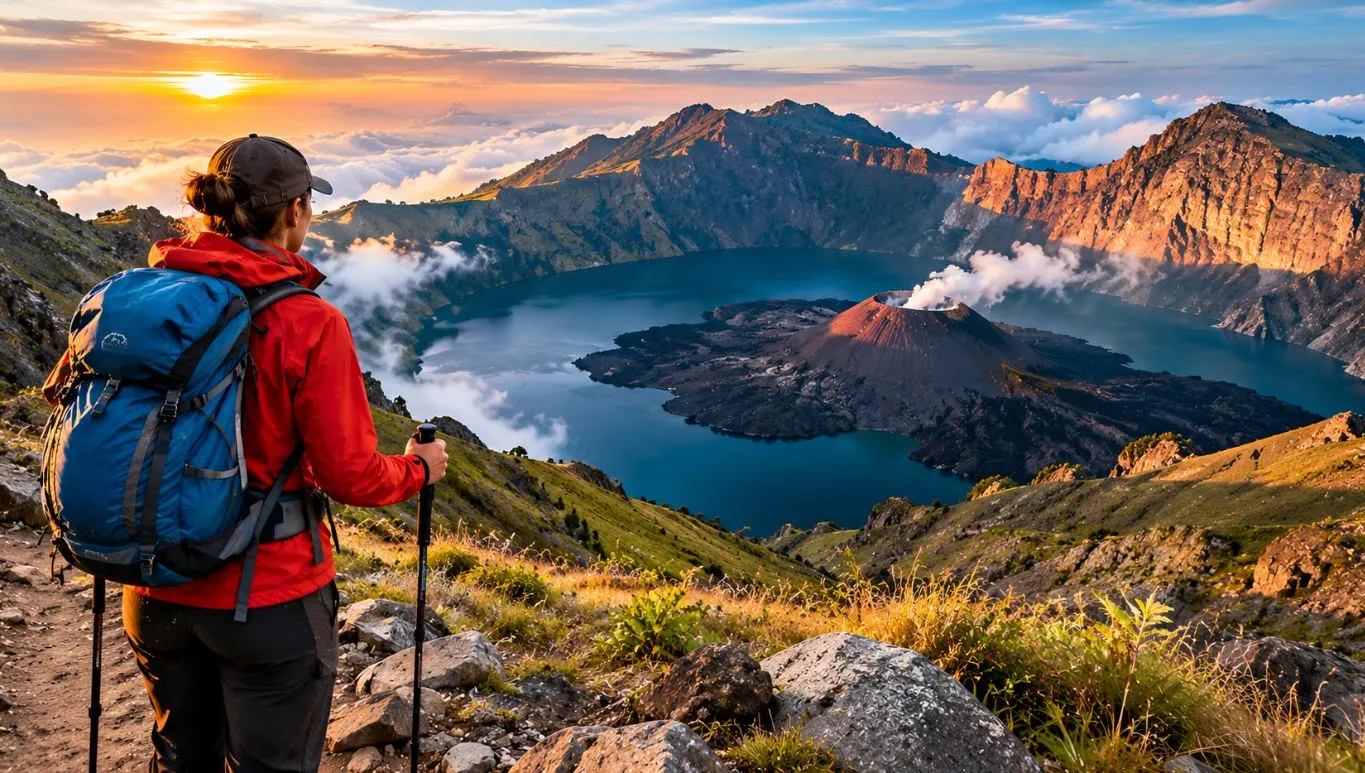
Rinjani does not negotiate. At 3,726 meters, the volcano on Lombok is Indonesia’s second-highest mountain, and its summit push is the reason trekkers leave their hotels at two in the morning: an ascent over loose volcanic scree to a crater rim where the sun rises across a steaming caldera lake and the smoking cone of a new peak within the old one. It is one of Asia’s great trekking experiences — and also one of its most underestimated, because the mountain’s difficulty hides not in its height but in its surfaces: deep volcanic sand, steep gravel slopes and descents that punish knees for hours.
Planning Rinjani properly changes everything. The trek requires mandatory guides, permits and porters, the routes differ sharply in character, and the season window is narrow — the mountain closes entirely during the wet months. This guide covers the whole picture: which route suits your fitness, what the permits and costs involve, how hard the climb really is, and how to prepare so the summit sunrise feels like a triumph rather than an ordeal.
Choosing your route
Three main routes serve the mountain, and the choice shapes your entire experience. All require registration at the national park gates and travel with a licensed guide, but the routes differ in duration, scenery and the kind of effort they demand. Here is how they compare:
| Route | Typical duration | Starting point | Character of the climb |
|---|---|---|---|
| Sembalun route | 3 days, 2 nights | Sembalun village, northeast side | Gradual grassland ascent, then steep summit scree |
| Senaru route | 2–3 days, 1–2 nights | Senaru village, north side | Steeper rainforest climb to the crater rim |
| Full crossing | 4 days or more | Sembalun to Senaru, or reverse | Both routes combined, lake included |
The Sembalun route is the most popular and the one most summit-focused trekkers choose, because the gentler first day leaves energy for the midnight summit attempt. Senaru is shorter but steeper, ideal for trekkers targeting the crater rim rather than the peak. The full crossing, combining both routes with the lake camp between them, is the version for those who want the complete experience and have the time; it saves you having to descend the same way you came up, which your knees will thank you for.
The permits, guides and rules
Rinjani is not a mountain you can climb alone. National park regulations require all trekkers to register, hire a licensed guide and pay entrance and insurance fees at the gate, and in practice virtually everyone books a package that bundles guide, porter, meals, tents and transport. A few principles define how the system works:
- Book with a licensed trekking operator based in Senaru or Sembalun, since only registered operators can arrange the mandatory guide and insurance.
- Expect the package to include park entrance fees, guide and porter wages, food, tents and sleeping bags, while excluding personal gear, tips and drinks beyond tea and coffee.
- Carry your passport on the trek, as registration checkpoints verify identities at the gates and along the route.
- Check the official status of trail openings before booking, because the park closes during heavy rain, volcanic activity or after landslides without much advance notice.
Prices for organized treks run from budget group packages to premium private tours, typically ranging from 100 to 300 US dollars per person depending on group size, route and duration. Cheaper is not always better: the difference between operators shows in food quality, guide knowledge and, crucially, the ratio of porters to trekkers. Porter work on Rinjani is brutally hard — men carrying 20-kilogram loads of tents and food up the scree in sandals — and tipping them generously is both customary and deserved.
How hard is the climb, really?
Honesty serves future trekkers best here. Rinjani’s summit day is the most demanding section, and it breaks more plans than altitude ever does. The midnight push from the Sembalun rim camp covers around 1,000 meters of elevation in four hours, much of it on loose scree and volcanic sand where every step slides half a step back. Combine that with pre-dawn cold, thin air and a start time most people find inhuman, and the summit becomes a genuine test of will as much as legs.
The rest of the trek is moderate rather than extreme. Day one on the Sembalun route climbs gently through savanna grassland, and the crater rim camp sits at about 2,639 meters, where the first-night campsite offers sunset views across the caldera. Altitude here is real but manageable — mild headaches are common above 2,500 meters, and drinking water, pacing and a slow summit pace keep it in check. No technical skills are required at any point, and the mountain’s dangers come from weather, loose footing and exhaustion rather than from exposure or climbing moves.
Fitness preparation pays dividends. Trekkers who arrive with strong legs — built through months of regular hill walking, stair climbing or running — find the climb demanding but rewarding. Those who arrive cold from desk jobs struggle visibly, and the difference shows most on summit morning. Whatever your starting point, break in your boots before the trip and bring poles if your knees have ever complained on descents.
The trek day by day
The classic Sembalun itinerary shows how the experience unfolds. Day one begins at Sembalun village with registration and weighs in at a gentle six-hour climb through grasslands to the rim camp, arriving in time for the sunset over the caldera — an unexpectedly emotional moment, because the caldera reveals itself gradually as the light drops. Dinner is cooked by your porters over wood fires, and the night under canvas ends early, because summit day starts at two.
Day two is the mountain’s answer to everything. The summit push climbs through the dark by headlamp, the scree demanding three steps forward for every two gained, until the crater rim at 3,726 meters opens onto the sunrise. Below you, the caldera lake — Segara Anak — lies a kilometer below, its volcanic slopes steaming, and the cone of Gunung Baru jari rises from the water’s edge. The summit itself is a narrow, windswept crater rim barely wide enough for a dozen people, and the sun’s first light turns the lake gold beneath you. After the descent to camp for breakfast, the trail drops toward the lake itself, where hot springs offer the trip’s most famous reward: a soak in volcanically heated water with the caldera walls rising around you.
Day three descends through rainforest to Senaru, a knee-punishing 2,000-meter drop that takes most of the day. The forest section is the trek’s most beautiful surprise: giant ficus trees, troops of monkeys and a canopy that closes over the trail as the heat of the lowlands builds. You finish at the Senaru gate, where the transport back to your hotel — usually in Senggigi or Mataram — completes the loop.
What to pack for the mountain
Rinjani’s conditions swing from tropical heat at the trailhead to near-freezing winds at the rim, and the gear list reflects that range. Most operators provide tents, sleeping bags and cooking equipment, so your personal list focuses on clothing and small essentials:
- Layers for the summit push: fleece or down jacket, beanie, gloves and a windproof shell, because the rim sits near freezing before dawn.
- Broken-in trail shoes or mid-weight boots with grip, since the scree punishes smooth soles and new boots alike.
- A headlamp with fresh batteries, essential for the midnight ascent and unreliable phone lights will not do.
- Sun protection for the descent: hat, sunscreen and sunglasses, because the savanna and scree offer no shade.
- A dry bag or waterproof liner, since afternoon rain can arrive without warning even in dry season.
- Trekking poles, which transform the endless descent through rainforest from punishment to pleasure.
- Snacks, rehydration salts and blister plasters, as the standard menu is simple and the effort enormous.
Operators rent jackets and sleeping bags in Senaru if you arrive without winter kit, though rental quality varies, so bringing your own base layers is the safer plan. Pack light otherwise: porters carry the group gear, and everything you bring, you climb with.
Season, safety and honest expectations
The mountain opens from April to November and closes during the December-to-March wet season, when landslides, leeches and storms make the trails unsafe. Even within the season, conditions vary: June to August brings the driest weather and the coldest summit nights, while the shoulder months of April, May and October trade a little weather risk for thinner crowds and greener slopes.
Safety on Rinjani is about management rather than heroics. Volcanic activity is monitored continuously, and the park closes when risk rises; altitude issues are mild but real; and the descent through rainforest is slippery after rain. The most common serious problems are twisted ankles on the scree, hypothermia at windy camps and sheer exhaustion on summit morning. Travelers with heart conditions, serious knee problems or recent injuries should think carefully before committing, and everyone should book operators with genuine safety records rather than the cheapest quote.
One expectation worth setting: Rinjani is harder than its photographs suggest. The summit success rate is genuinely lower than most famous mountains of similar height, and turning back before the top is not failure but judgment — the scree slope will still be there another year, and the caldera views from the rim alone justify the entire trek. Travelers who arrive prepared, pace themselves and respect the mountain almost always describe the climb afterward in the same terms: brutal, beautiful and completely worth it.
Beyond the summit: what Lombok adds
Trekkers who extend their stay find Lombok rewards the effort. The Gili Islands lie off the northwest coast, an hour by fast boat from the mainland, offering postcard beaches and snorkeling that recover tired legs in a day. The south coast brings Kuta Lombok’s surf beaches and empty bays, while the waterfalls of Sendang Gile and Tiu Kelep near Senaru make the perfect cool-down hike after the descent.
For travelers sequencing an Indonesian trip, the natural flow runs Bali, Gili Islands, Lombok and Rinjani, with the mountain as the centerpiece between island days. Two weeks accommodates the whole circuit comfortably, and a week squeezes the essentials in if the trek is booked first and the beaches follow as reward.
Rinjani is the kind of mountain that reorganizes your sense of your own limits. The scree, the cold, the two a.m. alarm — all of it dissolves in the moment the sun clears the crater rim and lights the lake below. Book with care, train before you arrive, pack for both climates on the same day, and the volcano gives back everything you invest and more — which is exactly why trekkers who have done it recommend it with the quiet certainty of people who know exactly what they are asking you to endure.