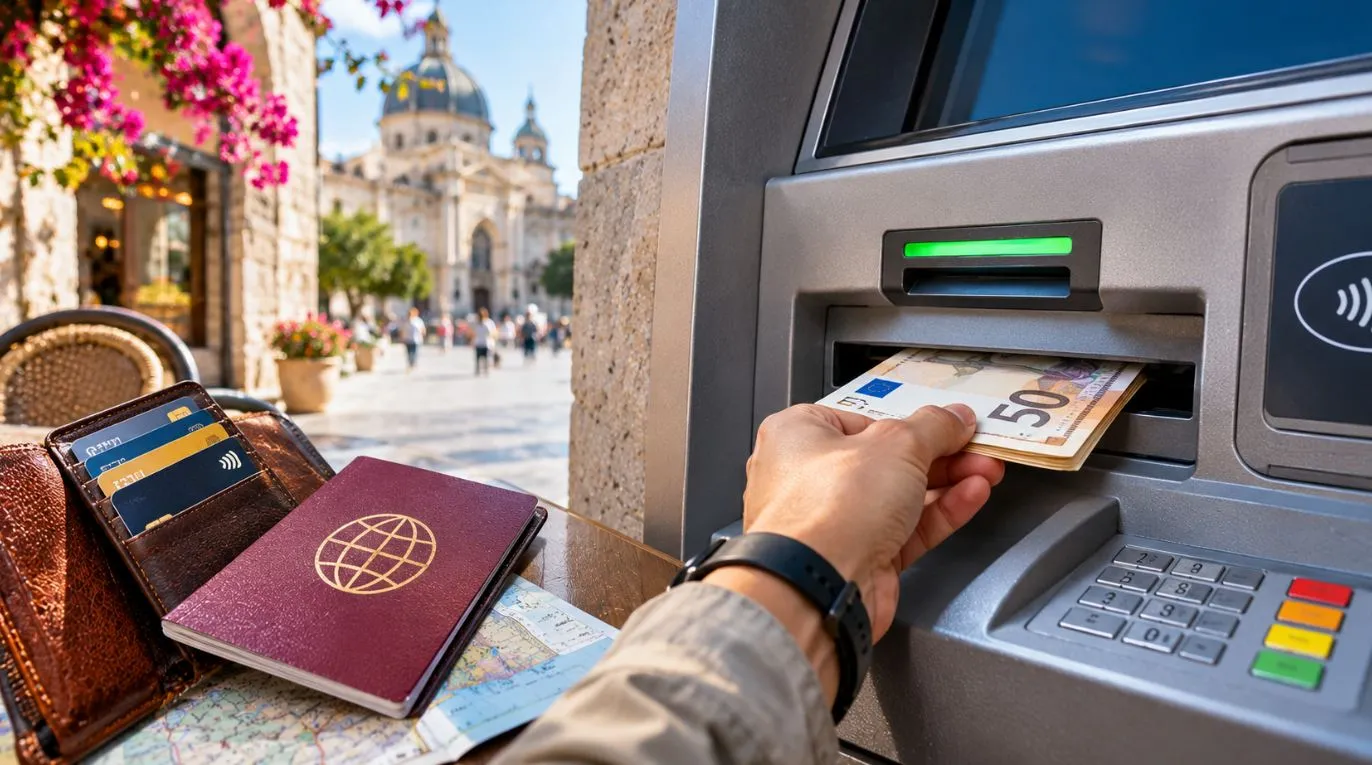
ATM fees are the silent tax on travel. Withdraw money in Rome, Tokyo or Mexico City and three separate charges can stack up before the receipt prints: your bank’s out-of-network fee, the foreign operator’s surcharge and, worst of all, an inflated exchange rate hidden inside the transaction. Stack those losses over a two-week trip and travelers routinely hand over 50 to 100 dollars more than they should — for nothing. The maddening part is that every one of those charges is avoidable with the right card, the right habits and the right screen choices.
The system rewards preparation, but the rules are simple and learnable in ten minutes. This guide covers the whole machinery of getting cash abroad: which cards refund fees, how the conversion screen at the machine tries to trick you, how much to withdraw per transaction, and the handful of habits that keep your costs close to the true exchange rate. Nothing here requires financial sophistication — just knowing where the tripwires are before your card goes into the slot.
The three fees stacked against you
Every foreign withdrawal can carry up to three separate costs, and knowing which one you are paying is half the battle. They behave differently, and the strategies for avoiding them differ too:
| Fee | Who charges it | Typical size | How to avoid it |
|---|---|---|---|
| Foreign transaction fee | Your own bank or card issuer | 1–3% of the amount | Use a travel card with no foreign fees |
| ATM operator surcharge | The machine’s owner | 2–5 dollars or euros per withdrawal | Use partner networks or fee-refund cards |
| Poor exchange rate margin | Whoever converts the currency | 1–5% hidden in the rate | Always choose to be charged in local currency |
The first fee is a percentage your bank adds for the privilege of foreign transactions; the second is a flat charge levied by whoever owns the machine; and the third, the quietest and often the largest, comes from the exchange rate applied to your withdrawal. The flat surcharge is also why withdrawal size matters so much: taking out 50 dollars twice pays the operator fee twice, while taking out 100 once pays it once. Large, infrequent withdrawals are almost always cheaper than small, frequent ones.
Cards that come with fee-free withdrawals
The single most effective move happens before the trip: carrying a card built for foreign use. A small but growing set of banks and fintech providers offer accounts with no foreign transaction fees and ATM fee refunds worldwide or within broad networks, and for frequent travelers these cards pay for themselves on the first trip. When comparing candidates, the features that actually matter are:
- Zero foreign transaction fees — the baseline feature; without it, every card purchase and withdrawal carries the 1–3% penalty regardless of anything else.
- ATM fee refunds — some issuers reimburse the operator’s surcharge up to a monthly cap, which turns almost any machine worldwide into a free cash source.
- The Visa or Mastercard interbank rate — the fairest rate available to ordinary travelers, applied automatically with no margin added by the issuer.
- Wide acceptance — the major card networks work in the vast majority of countries; niche travel cards sometimes do not, which matters more in Asia and Latin America than in Europe.
Debit and credit play different roles here. Cash comes from the debit card, because credit card cash advances trigger separate fees and interest from day one — a trap worth flagging loudly. The credit card’s job abroad is purchases, where its consumer protections and fee-free structure shine; the debit card’s job is cash, ideally the fee-refunding kind. Travelers who arrive with both, each suited to its role, pay the true exchange rate on nearly every transaction of the trip.
Dynamic currency conversion: the screen that costs you money
Of all the tricks in foreign banking, dynamic currency conversion is the most expensive and the least understood. Here is how it works: at a foreign ATM — or a restaurant card terminal — the machine offers to charge you in your home currency instead of the local one. It sounds considerate. It is a trap. The merchant or operator applies its own exchange rate, typically 3 to 10 percent worse than the real one, and pockets the difference. Choosing your home currency is always, without exception, the more expensive option.
The defense takes one second per transaction: when the screen offers a choice between the local currency and your home currency, always choose the local one. The wording varies — “guaranteed rate,” “pay in dollars,” “home currency for your convenience” — but the answer never changes. Your bank, assuming it has no foreign fees, converts at close to the true market rate, while the machine’s offer is a margin dressed up as a service. This rule applies identically to card payments in shops and restaurants, not just cash machines.
Where to withdraw: machines and locations
Not all ATMs are equal, and the difference between a good machine and a bad one can be several dollars per withdrawal. The rules of thumb come from how the economics work rather than from any loyalty to particular banks:
- Use ATMs attached to real banks where possible, since bank-owned machines charge transparent, regulated fees and are far less likely to skim or tamper than isolated machines in tourist zones.
- Avoid standalone machines in airports, hotels and tourist squares, which often add operator surcharges of 5 dollars or more on top of everything else.
- Check whether your bank belongs to a global ATM alliance, because partner-network machines waive their surcharge for your card entirely.
- Decline the machine’s currency conversion offer every time, no matter how the screen phrases the question.
- Withdraw the maximum your daily limit and safety comfort allow, since the fixed operator fee amortizes best across larger amounts.
One more habit from the experienced-traveler playbook: withdraw at the start of each country rather than rationing cash across the whole trip. Currency left over at the end gets changed back at tourist rates or hoarded in drawers, and neither outcome beats simply taking out what you need, when you need it.
Safety and practical habits at the machine
Cash security abroad is mostly about avoiding attention and avoiding tampering, and the habits are simple enough to become automatic. Withdraw during daylight inside bank branches when possible, shield the keypad with your hand, and refuse help from overly friendly strangers hovering nearby — a well-documented scam in several regions. Check the card slot for loose attachments before inserting anything, since skimmers still catch inattentive travelers, and put the cash away before walking on rather than counting it at the machine.
Keep a second card stored separately from your wallet, in the hotel safe or luggage, because losing your only card abroad turns a financial topic into a logistics crisis. Photograph the cards’ front (never the back, where the security code sits), know your bank’s blocking procedure and emergency number, and consider carrying a modest cash reserve in a widely convertible currency like dollars or euros for countries where card acceptance fails entirely — which, despite the digital revolution, still happens more often than city dwellers expect.
Paying by card versus paying in cash
The best way to avoid ATM fees is to need fewer withdrawals, and that means understanding when cards beat cash. Card acceptance is now near-universal across Europe, East Asia and much of Latin America, and contactless payments work in the smallest cafés in countries like Portugal, Poland and Japan’s convenience stores. Every purchase on a fee-free travel card costs you the true exchange rate and nothing more, which makes card-first the default strategy in any well-banked destination.
Cash still rules in specific pockets: street markets in much of Asia and Latin America, small family restaurants in southern Europe, rural areas of any continent, tips in the United States, and transit in cities where card readers remain patchy. A workable rule for most trips is carrying the equivalent of 100 to 200 dollars in local cash, topping up once a week from a bank ATM, and letting the card absorb everything else. That rhythm minimizes both the number of withdrawals and the amount of cash sitting exposed in your pocket.
What it costs when you get it right
The reward for good habits is measurable. A traveler with a no-foreign-fee card, a fee-refund arrangement and a strict local-currency rule pays essentially the interbank exchange rate on all purchases and close to zero on withdrawals — a total friction cost near one percent of spending. The unprepared traveler, hit by card fees, operator surcharges and dynamic conversion, pays eight to twelve percent. On a 2,000-dollar trip budget, that gap exceeds 150 dollars — enough for two more hotel nights, a nice dinner or the guilt-free souvenir that would otherwise have been rationalized away.
The whole system, stripped to its essentials, fits in four sentences. Get a card with no foreign fees before you leave. Withdraw from bank-owned machines, in local currency, in large amounts. Pay by card wherever cards are accepted. And never let any screen anywhere charge you in your home currency. Follow those rules and the fees that once taxed every holiday quietly disappear — leaving your money to spend on the trip itself, which is what it was saved for in the first place.