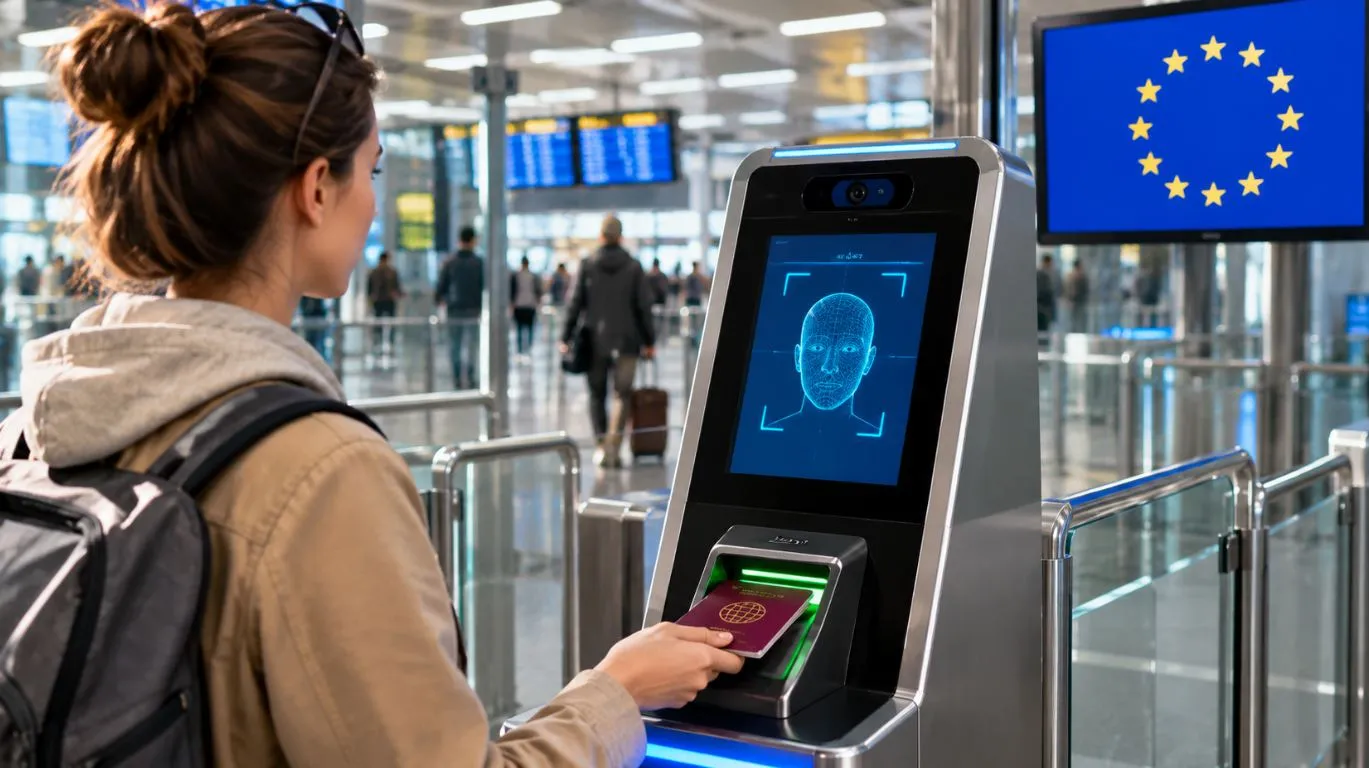
The passport stamp is dead. Since April 2026, the European Union’s Entry/Exit System — EES for short — has been fully operational at external borders across the Schengen area, replacing ink stamps with digital records: biometric data, entry dates and a running calculation of each traveler’s remaining time in Europe, all stored centrally and checked automatically at every crossing. For non-EU travelers, this is the biggest change to European border crossings in decades, and it touches almost everyone: Americans, Britons, Canadians, Australians, Indians, Chinese citizens — anyone entering from outside the EU, whether visa-free or holding a Schengen visa.
The change has already shaken out its biggest confusion: a phased rollout that began in October 2025 turned into full enforcement by April 2026, so there is no more waiting, no more “gradual introduction” and no more stamped passports at EU borders. If you are crossing into the Schengen area from outside it, you are registering — period. What matters now is understanding what happens at the border, who gets registered and who is exempt, how your 90 days are counted, and where the friction still lives. This guide covers all of it in practical terms.
What the system actually does
EES is not a visa, a permit or an application. It is a border computer that registers every non-EU traveler entering for short stays of up to 90 days within any 180-day period, regardless of whether they travel visa-free or on a Schengen visa. On your first crossing, a border officer records your facial image and four fingerprints; from then on, each entry and exit is logged automatically, and a simple check at any gate shows exactly how many days you have left.
Three practical consequences follow, and travelers understand them quickly once spelled out. First, your 90/180-day allowance is now calculated by a computer, not by counting passport stamps with a calendar — which means overstays are detected instantly, at the border, rather than discovered years later during a visa application. Second, the old habit of “resetting” your days by hoping an officer forgets to stamp is over: the system never forgets. Third, the physical stamp disappears, so travelers who relied on stamps for insurance claims, proof of travel or employer documentation should save boarding passes and bookings instead.
Who gets registered and who does not
Most non-EU travelers fall under EES, but the exemptions are real and worth knowing, because they catch people by surprise in both directions. Here is how the categories divide:
| Traveler category | Registered in EES? | What to expect |
|---|---|---|
| Visa-free non-EU citizens (US, UK, Canada, Australia, Japan and others) | Yes | Biometrics on first entry, then automatic logging |
| Non-EU citizens with a Schengen visa | Yes | Same registration; visa validity does not exempt from it |
| Children under 12 | Only facial image | No fingerprints collected at this age |
| Teenagers 12 and over | Yes, fully | Fingerprints and photo, as for adults |
| Holders of EU residence permits or long-stay cards | No | Their permit status places them outside short-stay tracking |
| Family members of EU citizens exercising free movement | No | Covered by free movement rules instead |
| Diplomats and transport crews | No | Standard exemptions apply |
The most common misunderstandings cluster around visas. Holding a Schengen visa does not remove you from EES — the system tracks your presence in the region even though the visa governs your right to be there. Conversely, a residence permit from a European country, even a tourist-oriented long-stay visa, places you outside the system entirely. And since the registration follows the passport you travel on, dual citizens should use their EU or EEA passport at the border when they hold one, because presenting the non-EU document triggers full registration.
What happens at the border, step by step
The first crossing after registration became mandatory takes longer than the old stamp, and knowing the sequence removes most of the anxiety. The process looks like this:
- Approach the border control booth or, at larger airports, the automated self-service kiosks designated for first-time registration.
- Present your passport to the officer or scanner; the system checks whether you are already registered.
- If you are not, look into the facial-recognition camera and place four fingers on the reader — a process of about a minute.
- The officer or kiosk confirms your registration, records the entry, and you proceed; on later crossings, the camera alone typically suffices.
From the second crossing onward, the experience becomes faster than the old stamp system in many cases, because the biometric check replaces both the stamp and part of the manual document inspection. Automated gates at major airports — already widespread — now serve registered travelers directly, and queues split between first-timers at kiosks and everyone else at the fast lanes. Airports in Frankfurt, Paris, Amsterdam and Madrid have built dedicated first-registration zones, and ferry terminals in Dover, Calais and the Mediterranean ports have their own layouts, which is worth checking before a road or sea crossing.
The 90/180 rule under the new system
The rules have not changed, but their enforcement has become ruthless. Under EES, every non-EU traveler can stay in the 29 Schengen countries for 90 days in any rolling 180-day period, and the system counts this automatically across all borders. Leave after 89 days and the computer knows; return three weeks later and the remaining days are calculated to the hour, because entries and exits are timestamped rather than dated.
This precision ends several habits travelers developed over the years. Rounding a stay to “about three months” no longer works, since a few extra hours count. Crossing a border to restart the clock — the old trick of a same-day trip to Croatia, Serbia or the UK — is now visible as a pattern, and repeated reset attempts raise flags in the system rather than resetting anything. If your plans genuinely require longer stays, the correct instrument remains a long-stay visa or residence permit, and applying for one before arrival saves far more trouble than any border gymnastics ever did.
Where the friction still lives
The technology works, but the human layer around it produces most of the current headaches, and travelers should plan for them rather than be surprised. The pain points concentrate in predictable places:
- Land borders during peak season — road crossings into Spain, Italy and Greece queue longest in summer, since the registration time per vehicle exceeds the old stamp by a minute or more.
- Ferry and rail terminals — Dover in particular has drawn scrutiny, because a queue of unregistered passengers on a coach can add hours; departures from the UK now build registration time into their schedules.
- First-time families with children — registering several passports at once takes longer, and young children’s facial scans occasionally need retakes, so budget extra minutes at the crossing.
- Ferry and rail terminals, technical hiccups — like any new system, outages and slowdowns occur, and patience at the booth remains the only cure.
None of these problems is structural; they are birth pains of a system in its first year, and they shrink as more travelers carry completed registrations. The advice for the remainder of 2026 is simple: arrive early for any cross-border leg, prefer morning crossings over afternoon ones, and treat any schedule involving a land border with the margin you would give a flight connection.
Data, privacy and how long the records last
The privacy questions deserve straight answers. EES stores identity data, biometrics and movement records in a central database, and travelers have the right to access, correct or delete their own records through designated national authorities. Facial images and fingerprints are kept for three years after your last exit as a general rule; if you are refused entry, the refusal data remains for five years. The system is also linked to other EU databases — the Schengen Information System among them — so alerts on stolen documents or individuals under entry bans surface automatically during registration.
What the system does not do matters as much: it does not track movement inside the Schengen area. Once you cross the external border, no internal border check records your whereabouts in the database — hotels, trains and flights remain outside EES entirely. The system knows when you entered and when you left, and nothing in between, which is a point worth remembering when privacy concerns come up in conversation.
Practical preparation for your next trip
EES asks almost nothing of travelers before the border — there is no form, no fee and no website — but preparation still smooths the crossing. Before your next European trip, adopt these habits:
- Check that your passport is valid for at least three months beyond your planned departure from Europe, since the border system enforces this rule mechanically.
- Arrive at borders with extra buffer during your first post-registration crossing, because the biometric enrollment adds minutes that ferries and trains do not always forgive.
- Keep boarding passes and booking confirmations as your proof of travel, now that passport stamps no longer exist.
- Know the exemptions if they apply to you, and carry your residence card or EU family documentation at the border, since officers verify these documents at every crossing.
- If you are a dual citizen, cross on your European passport and skip the system entirely.
Frequent visitors will find the burden front-loaded and light afterward: one enrollment, years of fast crossings. Families and occasional travelers carry the longer first visit, and the earlier in the trip schedule that enrollment happens — ideally at the arrival airport rather than a rushed land crossing later — the easier the rest of the journey flows.
How EES connects to ETIAS
Travelers who have followed European border news know one more system is coming. ETIAS, the pre-travel authorization for visa-free visitors, has not yet launched; its start date was removed from official schedules in 2026, with reporting pointing to 2027 once EES has fully settled. When it arrives, the two systems will work in sequence: ETIAS authorizes you to travel, and EES records your actual entry and exit. The two do not overlap — an ETIAS approval does not exempt anyone from EES registration, and EES enrollment does not substitute for ETIAS.
For now, that means no pre-travel application exists for visa-free travelers, and any website selling “ETIAS applications” today is collecting money for a service the EU has not opened. The practical guidance holds steady: watch the official EU channels for the ETIAS launch announcement, expect months of advance notice and a transitional grace period, and budget nothing more than a ten-minute form and 20 euros when the day comes.
The bigger picture
EES marks the end of an era, and its direction is unmistakable: Europe is moving toward entirely automated, biometric border crossings, with the paper stamp already a museum piece and human officers increasingly reserved for exceptions rather than routine. Travelers who register once, keep their documents valid and their stays within the counted limit will experience the system as it was intended — faster borders, fewer disputes and a digital record that works in their favor when proving their travel history for visas, banks or employers.
The one habit worth taking away from all of this is the same habit that replaced the stamp: keep your own records. Screenshot the boarding passes, save the hotel confirmations, and know your own day count. The computer at the border certainly knows — and now, with a little preparation, so will you.