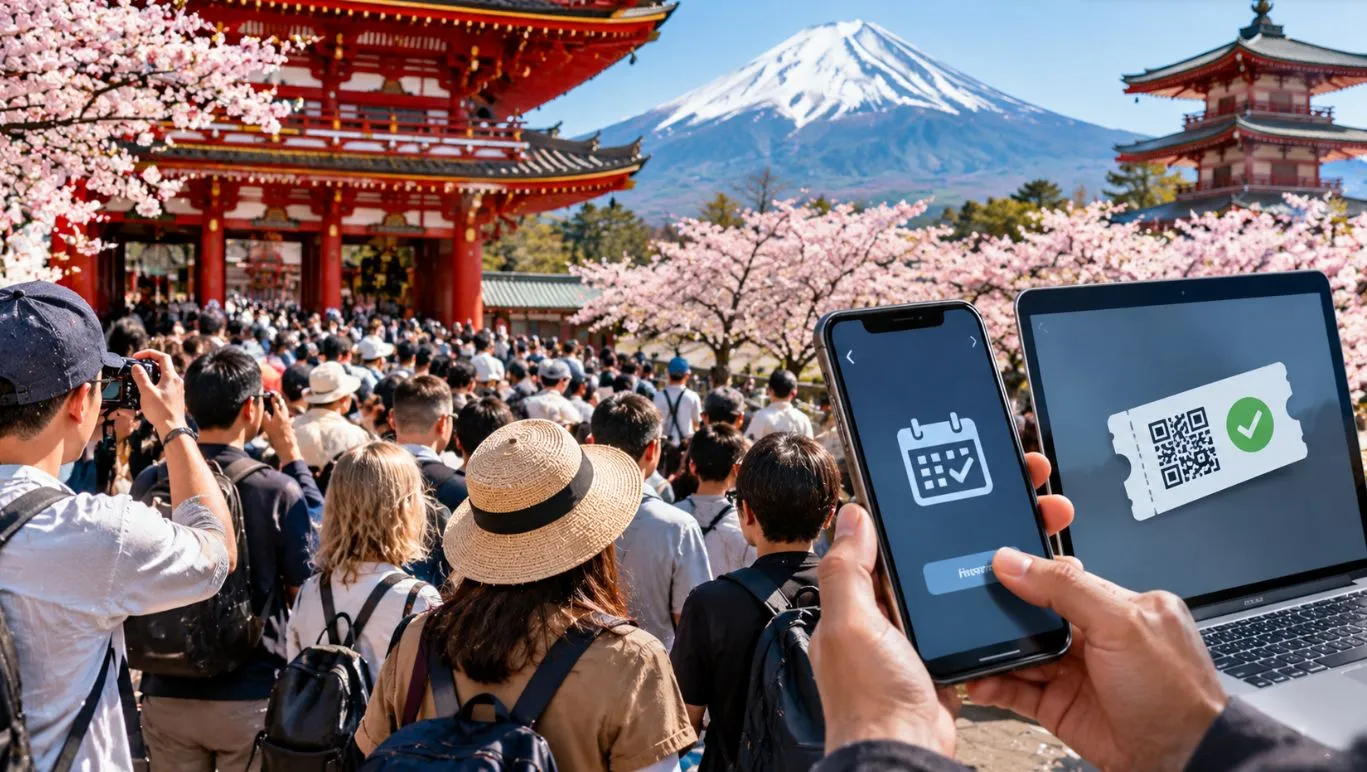
Japan in the late 2020s is a country negotiating with its own success. Visitor numbers have climbed to record heights year after year, and the places everyone wants to see — a pagoda framing Mount Fuji, lantern-lit lanes in Kyoto, a snow-covered village in the Japanese Alps — were never designed to process Instagram-scale demand. The response has been a patchwork of permits, reservation systems, daily caps and fines, rolled out site by site rather than nationally, which is precisely why travelers find the current landscape confusing. Some attractions require booking weeks ahead, some fine you for taking photos, and some have simply closed their most photogenic corners to everyone.
The practical truth is that Japan remains one of the easiest countries in the world to visit — provided you know where the new friction points are. This guide maps them: the reservation systems that actually matter, the sites with hard visitor limits, the rules that carry real fines, and the habits that get you better experiences at every one of these places, because the crowds and the rules have a shared solution. Travel earlier in the day, book the big-ticket items ahead, and treat the small rules as signs of a country protecting itself rather than turning against its guests.
The rules that changed the game
Two sites did more to change Japan travel than any others, and both belong on any itinerary that touches them. Mount Fuji, which recorded its busiest seasons ever in the mid-2020s, now operates a formal permit system on all four official trails. Climbers pay a 4,000-yen entry fee, and the Yoshida trail — the most popular route — runs a hard daily cap of 4,000 hikers, with three-quarters of those slots released through advance online reservation and the rest held for same-day climbers. Registration for the July-to-September season opens in spring, and during peak weeks in July and August the advance slots disappear within hours. The gates close between 2 p.m. and 3 a.m. for anyone without a mountain hut booking, which ended the overnight “bullet climb” that once defined summit culture, and trailhead gear checks are now part of entry.
Kyoto’s change is different in nature: less about caps, more about conduct. The famous alleys of Gion, where geiko and maiko live and work, are now formally closed to tourists in their private sections, with photography in the residential side streets off Hanamikoji prohibited and violations carrying a 10,000-yen fine. The rules took effect in 2024 and have been tightened since, and the logic behind them is worth internalizing beyond Gion — residents’ daily routes are not photo sets, and Japan’s local governments have made clear that enforcement will grow where behavior does not improve.
Beyond those two, the list of managed sites keeps growing, and the differences between them matter for planning. The sites with formal systems in place now look like this:
| Site | System in place | What you need to do |
|---|---|---|
| Mount Fuji (all four trails) | 4,000-yen fee, daily cap of 4,000 climbers | Reserve ahead online for the Yoshida trail; gear checks at trailhead |
| Shirakawa-go winter light-up | Full reservation-only event | Book bus tours, parking or the overnight lottery by autumn |
| Kyoto’s Gion district | Closed private alleys, photo bans | Stick to main streets; no photos of geiko in side lanes |
| Shibuya center | Night drinking ban, smoking fines | No street alcohol from 6 p.m. to 5 a.m.; use designated smoking areas |
| Ghibli Park and teamLab venues | Timed-entry tickets only | Buy tickets weeks ahead; no walk-up sales |
| Tokyo Skytree and Shibuya Sky | Timed-entry booking system | Reserve slots online, especially for sunset hours |
| Itsukushima Shrine, Miyajima | Crowding management at high tide | Visit at early-morning low tide; expect queueing at sunset |
The pattern across the table is consistent: Japan is not banning tourists anywhere, but it is converting its most fragile and most crowded spots from free-for-all access into scheduled, priced and policed experiences. Knowing which system applies where is the difference between walking up to a closed gate and sailing through on the right ticket.
The sites with reservation systems that actually sell out
Advance booking in Japan used to be optional. It no longer is, and the reservation-based attractions now divide into two tiers: those that sell out in days and those that sell out in minutes. The ones worth setting alarms for:
- Mount Fuji permits — the Yoshida trail’s 3,000 advance slots for peak weekends in July and August fill almost immediately after registration opens, so book the moment your travel dates are confirmed.
- Ghibli Park — tickets release on fixed sale dates months ahead, and popular dates in school holidays vanish the same day.
- Shirakawa-go winter light-up — the overnight stays run on a lottery system with applications accepted in October, parking is reserved online in separate sessions, and bus tours from Takayama and Kanazawa sell out in early autumn.
- teamLab Tokyo venues — timed-entry tickets for evening sessions sell out weeks ahead in spring and autumn.
- Universal Studios Japan and Tokyo Disney — express passes, rather than base tickets, are the scarce commodity during Japanese school holidays.
The reservation habit extends beyond the famous five. Shibuya Sky’s sunset slots, restaurant bookings in high-end Tokyo dining and kaiseki counters, and onsen town ryokans in Hakone and Kinosaki all reward booking weeks out. A simple rule covers the whole landscape: if the experience is number-capped, priced with a peak/off-peak difference or famous enough to appear in every guidebook, assume it needs a reservation and book it before you fly.
The fines and conduct rules with teeth
Japan’s response to bad behavior has shifted from pleading to enforcement, and the fines now carry real amounts. Private photography in Gion’s closed alleys runs 10,000 yen, and locals have grown comfortable reporting violations. Street smoking outside designated areas costs 1,000 yen in Osaka and 2,000 yen in central Tokyo wards including Shibuya and Chiyoda — a trap for visitors whose home cities allow it freely. The Shibuya drinking ban, enforced year-round from 6 p.m. to 5 a.m. in the streets around the crossing, came after Halloween crowds turned dangerous; convenience stores in the zone now voluntarily withhold alcohol during restricted hours. Nara’s deer park, meanwhile, has tightened its feeding rules after injuries from visitors teasing the animals with paper and packaging.
None of these rules targets tourists specifically — Japanese residents face the same fines — but they land hardest on visitors who assumed Japan’s famous tolerance extended to everything. It does not, and the better framing is that the country has simply started writing down rules that its residents never needed written. Standing on the correct side of the escalator, queueing calmly, eating in designated areas and keeping voice levels low have always been the operating manual; the fines merely made the invisible legible.
Where overtourism bites hardest — and the timing that fixes it
The geography of crowding follows the guidebooks, which is why the solution often means following the locals instead. The Chureito Pagoda viewpoint at Fujiyoshida drew queues of three hours at dawn during cherry blossom season, and the town went so far as to cancel its 2026 cherry festival outright rather than feed the crush. The convenience-store corner by Lake Kawaguchiko — the famous “Lawson Fuji” shot — got a tall screen after visitors littered, trespassed and even cut holes in a previous barrier, and the tarp returned once the holes reappeared. Senso-ji in Asakusa, Dotonbori in Osaka and the Fushimi Inari approach in Kyoto each process staggering numbers on a good day.
Timing is the traveler’s most powerful tool, and it costs nothing. The sites that choke between 10 a.m. and 4 p.m. breathe at dawn: Fushimi Inari’s upper trails are nearly empty before 8 a.m., Senso-ji’s main hall belongs to residents before the shops open, and Miyajima’s torii gate at first light carries none of its midday chaos. Weekdays beat weekends everywhere, shoulder months — late May, early June, late October — beat the April and November peaks, and rain, which clears the paths of everyone else, rarely spoils the scenery in a country built for wet weather.
The other lever is substitution. Japan’s depth means every oversubscribed icon has quieter siblings of genuine quality, and locals have grown fluent in recommending them:
- Instead of Arashiyama’s bamboo grove — the smaller groves in Kyoto’s northern hills, or the bamboo lanes of Higashikurume in Tokyo’s west.
- Instead of the Chureito Pagoda crush — the Honmachi street view in Fujiyoshida or the shorelines of Lakes Saiko and Motosu, the view printed on the 1,000-yen note.
- Instead of Shirakawa-go — the post towns of Tsumago and Narai in the Kiso Valley, with identical Edo-era streets and no reservation system.
- Instead of Shibuya Crossing at rush hour — the crossing itself at 7 a.m., or the calmer district rhythm of Kichijoji.
- Instead of Senso-ji’s Nakamise midday — the same temple after 8 p.m., when the lanterns glow and the lanes empty.
None of these swaps sacrifices quality; most improve it. The crowded icons became crowded for reasons that remain real, and seeing them well — at 6 a.m., in rain, in shoulder season — is a better experience than seeing them at peak, which is what the crowd-avoidance game always comes down to.
The money side of the new rules
Japan’s costs are shifting alongside its crowds, and the changes all point the same direction: visitors pay more, gradually and in small increments. The international departure tax tripled to 3,000 yen per person from July 2026, collected inside air and ferry fares rather than at the airport. Kyoto introduced a five-tier accommodation tax in March 2026, with luxury rooms now taxed 10,000 yen per person per night while budget stays pay only 200. Tax-free shopping changed in November 2026 from instant point-of-sale exemption to a refund-at-departure system, which means paying the full price in shops first and claiming it back at the airport within 90 days. And the debate over dual pricing — higher entrance fees for foreign visitors at museums, temples and ski resorts — is moving from proposals toward practice at select sites.
Budget travelers feel the changes least, since hostel beds, trains and restaurant meals remain untaxed beyond the standard consumption rate. Luxury travelers feel them most, which is arguably their design. For a typical two-week trip, the new rules add the equivalent of 20 to 40 dollars per person — noticeable in a spreadsheet, invisible in the experience.
Practical etiquette that keeps you welcome
The systems and fines cover the extremes, but the daily texture of being a good visitor in Japan runs through smaller habits, and locals consistently name the same ones. Keeping to the left on escalators, letting train passengers off before boarding, carrying your trash until you find a bin, eating only where eating is permitted, staying quiet on trains, and asking before photographing people — especially craftspeople, monks and anyone in traditional dress — together account for nearly every friction a visitor can generate. Rural towns report that littering and trespassing on private farmland for photos are their top complaints, both solved by the same principle: if a lane has no shops, it is somebody’s street, not an attraction.
One habit deserves special mention because it solves half the etiquette problems at once: slow down. Most of the worst tourist behavior in Japan — blocking lanes for photos, crowding deer, standing in the middle of crossings — traces to hurry. The country rewards a slower clock with better everything, from food to light, and the visitors who adopt Japanese pace report the trip improving in ways no itinerary change explains.
What comes next for travelers
Japan’s tourism policy is still moving, and the direction is visible enough to plan around. The electronic travel authorization known as JESTA, announced by the government and passed into law in 2026, will require pre-departure registration for visa-free visitors — but it does not take effect until the end of the decade, so current trips need nothing beyond a valid passport and the visa-free entry that already applies. Dual pricing schemes will likely spread from ski resorts to museums. More sites will adopt timed-entry and daily caps as they become the standard toolkit, and the departure tax may climb again if the trend continues.
The bigger shift, though, is one travelers can choose to join rather than merely endure. Japan’s regions are actively promoting destinations beyond the Golden Route — Tohoku’s festivals and coastlines, Shikoku’s pilgrimage trails, the wild peninsulas of Kyushu — and infrastructure follows the promotion, with better trains and hotels in places tourists once skipped. Visitors who spread themselves across the country rather than concentrating on six famous spots get better prices, warmer welcomes and photos no one else has. Overtourism is, in the end, a distribution problem, and every traveler who chooses the quieter valley over the famous gate is part of the solution Japan is asking for — while still seeing, at dawn or in the off-season, every scene that made the trip worth booking in the first place.a