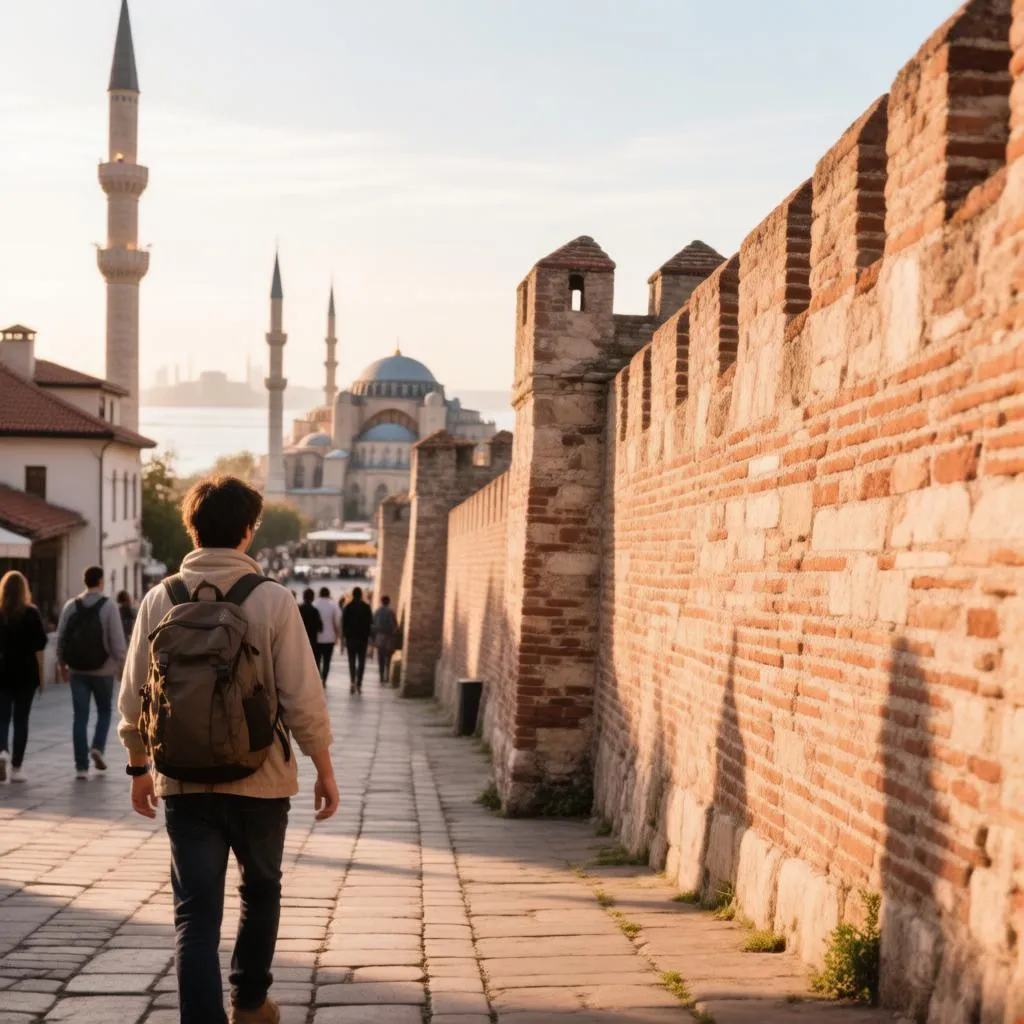
Stand in the middle of Sultanahmet square and close your eyes. Somewhere beneath your feet, Roman legions once drilled in a hippodrome that held a hundred thousand spectators; above your head, a minaret broadcasts the call to prayer from a mosque built by an emperor determined to outdo a church. Open them again, and you are standing on seventeen centuries stacked like sediment — and the remarkable thing about Istanbul is that the stack is walkable. Not by metro, not by tour bus, but on foot, in three days, along streets that connect the basilicas of the sixth century to the bazaars of the sixteenth with nothing but a pair of comfortable shoes. This is how the city reveals its layers properly: Byzantium and the Ottomans are not museum exhibits here but living districts, and the best way to tell them apart is simply to walk between them.
Reading the two empires through the streets
Before the walking begins, one idea makes the whole trip cohere. Istanbul is a palimpsest, and its layers are surprisingly legible once you know what to look for. The Byzantine city reveals itself in materials and heights: brick-and-stone churches with recessed windows, cisterns and city walls, churches converted into mosques where the architecture still speaks Greek. The Ottoman layer announces itself in domes and minarets, in wooden houses painted on hillsides, in mosques built as complexes — with schools, kitchens and baths attached — and in the Süleymaniye and Fatih districts rising on their hills.
The practical consequence is that the three days should not be divided by monument type but by geography, because the layers interleave everywhere. The Byzantines built most of their city on the peninsula between the Sea of Marmara and the Golden Horn; the Ottomans added to it and spread across the Bosphorus. A walker who starts at the ancient core and moves outward through the centuries will feel the transition happen underfoot.
Day one: the Byzantine core
The first day belongs to Constantinople. Starting early is the single most valuable habit in this city, and the reasoning is practical: the great monuments open at nine, cruise groups arrive by ten-thirty, and the difference between nine-thirty and eleven-thirty in Hagia Sophia is the difference between a cathedral and a crowd. The day’s route follows the historic spine:
- Hagia Sophia at opening — the sixth-century church built under Justinian, later a mosque and now a functioning one; the mosaics, the 31-metre dome and the marble columns reward the quietest hour of the day.
- The Basilica Cistern — a fifth-century underground water reservoir of 336 columns, where the city’s engineering genius hides a few metres below street level; tickets are best bought online in advance.
- The Blue Mosque — the Ottoman answer to Hagia Sophia, with more than twenty thousand İznik tiles; visiting between prayer times preserves both the etiquette and the calm.
- The Hippodrome square — an obelisk from Egypt, a serpent column from Delphi and the base of a bronze monument: four civilisations within fifty metres of pavement.
- Topkapı Palace — the Ottoman imperial residence, where the treasury, the harem and the council chamber need at least three unhurried hours; pre-booking is essential in season.
- Gülhane Park and the first walls — an evening descent through the palace gardens to the shore, closing the day where the Byzantine navy once defended the peninsula.
The logic of this sequence is momentum: monuments are ordered from the most demanding to the most atmospheric, and the final walk through Gülhane drops the traveller at the water’s edge exactly as the light fades — the moment when the Bosphorus ferries begin their evening crossings and the city shows the side that photos never capture.
Day two: bazaars, water and the Golden Horn
The second day shifts from imperial monuments to the working city. The Ottoman commercial heart lies west of the Byzantine core, and the walk between the two districts passes through neighbourhoods where both empires left their fingerprints. The route heads first to the Süleymaniye Mosque, the masterpiece of the sixteenth-century architect Sinan, perched on a hill with the Golden Horn spread below its courtyard — the finest free viewpoint in the old city. From there the path descends through the labyrinth of the Grand Bazaar, over four thousand shops under vaulted lanes, and continues downhill to the Spice Bazaar and the ferry docks at Eminönü.
The afternoon belongs to the water. A short ferry crossing — the twenty-minute commuter ride to Kadıköy or the longer Bosphorus cruise — costs the price of a coffee ticket and delivers the perspective every visitor needs: Istanbul from outside, domes and minarets stacked across the horizon on two continents. Returning by late afternoon, the evening belongs to the districts north of the Golden Horn — Karaköy’s coffee houses and the ferry-side tea gardens — where the city’s contemporary layer sits comfortably beside its historic ones.
Day three: walls, viewpoints and the north shore
The third day answers the question most itineraries forget: where does Byzantium end? The answer is the Theodosian walls, the fifth-century land fortifications that kept the city unconquered for a thousand years. A morning walk along the restored sections near the Topkapı gate — with the city on one side and the modern sprawl on the other — makes the empire’s scale tangible in a way no museum can.
From the walls, the day turns north. The neighbourhoods of Fener and Balat, once the Byzantine Greek heartland and later home to Istanbul’s Jewish and Armenian communities, hold the city’s most photogenic streets: painted wooden houses, a Greek patriarchal church, the red-brick Fener Greek high school and steep cobbled lanes climbing over the Golden Horn. The afternoon connects these districts to the modern face of the city — the Galata Tower, rebuilt by the Genoese in the fourteenth century, and the boulevards of Beyoğlu, where the Orientalist era of steamships, embassies and cafés wrote the final chapter before the republic. A walker finishing at the Galata Bridge at sunset has, in three days, covered every major civilisation that ruled this shore.
The practical craft of walking Istanbul
Distance in Istanbul is deceptive, and the city’s geography punishes the unprepared. The old peninsula looks compact and behaves like a succession of hills; the trams and ferries fill the gaps between districts far better than taxis stuck in traffic. The habits that make all three days smoother:
- Get an Istanbulkart on arrival — the rechargeable transport card that works on trams, ferries, funiculars and buses; it transforms the city from a walking challenge into a walking pleasure.
- Time the mosques around prayers — tourist visits pause at the five daily prayer times, and arriving just after a prayer ends gives the calmest half-hour of the day.
- Carry cash for the bazaar quarters — cards work everywhere in shops, but the smaller stalls, ferry tea gardens and street vendors remain cash territory.
- Dress for both the mosque and the hills — shoulders and knees covered for sacred buildings, and shoes that can handle cobbles; the old city’s pavement does not forgive sandals with thin soles.
- Eat where the workers eat — the simit carts at dawn, the lokanta counters at lunch and the fish-bread boats at Eminönü are the cheapest and best meals in the city.
None of these rules needs more than a day to internalise, and together they convert the city’s legendary chaos into a rhythm. The traveller who walks Istanbul with a transport card in one pocket and prayer times in mind discovers something that organised tours cannot show: a city that works, not only a city that impresses.
Timing the three days
Season and weekday shape the experience more than any planning decision except the crowds at Hagia Sophia. The comparison worth making before booking flights:
| Season | Crowds and heat | Walking conditions | What changes |
|---|---|---|---|
| April–May and September–October | Moderate crowds, mild days | Ideal, 15–25 °C | Best overall window; ferries pleasant |
| June–August | Peak crowds, 30–35 °C heat | Early starts essential | Bosphorus walks best before ten |
| November–March | Low crowds, cool and rainy | Good with layers | Lowest prices; sea views with grey skies |
Two further notes refine the picture. Weekends bring Turkish domestic tourism to the old city, which means Tuesday to Thursday are the calmest walking days of the week. And the muezzin’s evening call at sunset — audible across every district on all three routes — marks the single most atmospheric hour in the city regardless of season.
Three days, seventeen centuries
Walking Istanbul for three days produces an understanding that no amount of guidebook reading delivers beforehand: the realisation that the Byzantine and Ottoman layers are not alternating exhibits but a single continuous fabric. The cistern lies under the mosque; the wall protects the bazaar; the Genoese tower overlooks the sultan’s palace. The city was never one thing at one time, and the walker who traces its spine — church, mosque, market, wall, ferry, tower — walks through that continuity in real time. Three days is enough to feel it; a lifetime would not be enough to exhaust it. And the practical residue of the trip is simple: comfortable shoes, an Istanbulkart, and the good sense to stand still at sunset wherever the day happens to end — because in Istanbul, the light does the final guiding that no map ever will.