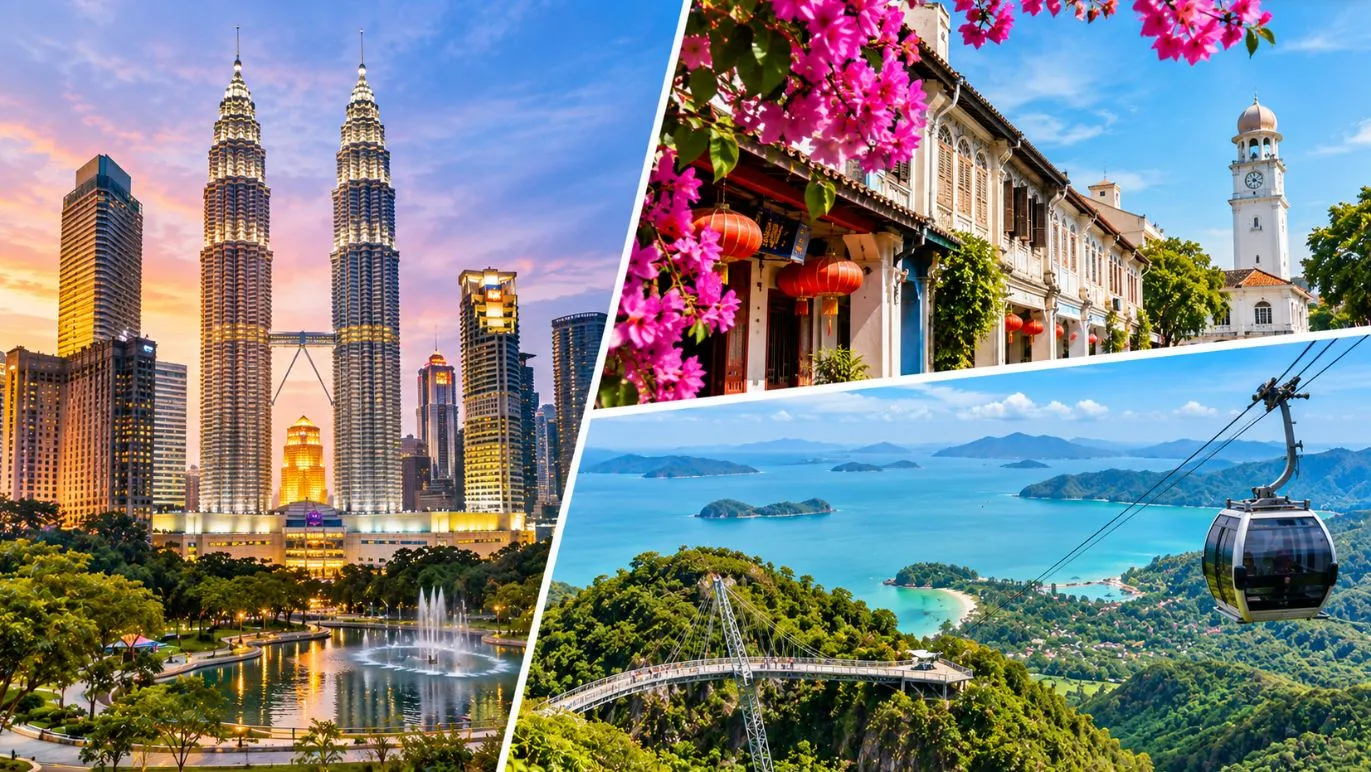
Fourteen days is the amount of time Malaysia quietly deserves. Most visitors give it a week, rushing between the Petronas Towers and one beach, and leave without understanding why travelers who linger speak about the country with such affection. Spread over two weeks, Malaysia reveals its layers: a futuristic capital built on top of colonial streets, a food-crazed island where hawker stalls earn Michelin nods, and a jungle-crowned archipelago where the hardest decision of the day is which bay to swim in. The route from Kuala Lumpur north to Penang and on to Langkawi is the classic first-timer’s spine, and it flows almost entirely by train, ferry and short flights.
The logic of the order matters. You start in the capital, where jet lag is easiest to shake off amid air-conditioned malls and lively street food. Penang then slows the pace down into heritage lanes and tea houses, and Langkawi finishes the trip in full holiday mode — geoparks, mangrove cruises and sunsets over the Andaman Sea. By the time you fly home, the trip will have moved from city pulse to island heartbeat, which is exactly the arc that makes two weeks feel like a genuine escape rather than a sprint.
The route in numbers
Before unpacking each stop, it helps to see how the fortnight divides up. The plan alternates energetic city days with slower ones, keeps hotel changes to just three, and uses fast connections so that no day is lost to travel.
| Days | Base | Main experiences | Connection onward |
|---|---|---|---|
| 1–5 | Kuala Lumpur | Petronas Towers, Batu Caves, Merdeka Square, Kampung Baru food walk, Genting Highlands day trip | Flight or train toward Penang |
| 6–9 | George Town, Penang | Street art hunt, clan jetties, hawker centres, Penang Hill, Kek Lok Si temple | Ferry or short flight to Langkawi |
| 10–14 | Langkawi | Sky Bridge, mangrove kayak, island hopping, beaches, cable car sunset | Flight back to Kuala Lumpur |
Spending five nights in the capital might sound generous until you realize how much KL holds, from rainforest canopy walks inside the city limits to cave temples guarded by golden statues. The final five days on Langkawi work as a genuine wind-down, and the mid-trip flight from Penang to Langkawi takes barely an hour, protecting your beach time from wasted transit.
Days 1–5: Kuala Lumpur, a capital of pleasant contradictions
Kuala Lumpur is the kind of city that keeps surprising you after you think you have it figured out. Glass towers of the KLCC district rise directly behind colonial-era Moorish buildings, and a ten-minute walk can take you from a luxury mall to a neighborhood where families grill satay over charcoal in their front yards. Start with the obvious: the Petronas Towers look best from the fountain plaza at dusk, and the skybridge visit in the morning is worth the ticket for the view over the green lump of Bukit Nanas forest below.
The Batu Caves, reached by a commuter train in half an hour, deliver the trip’s first wow moment: a 272-step staircase guarded by a towering golden Murugan statue, leading into a cathedral-sized cavern where monkeys plot the theft of your snacks. Go early, wear shoes you can climb in, and hold your bags tightly — the macaques are professionals.
Dedicate at least one evening to Kampung Baru, the last traditional Malay village in central KL, where wooden stilt houses sit in the shadow of the towers and the street food reaches its purest form. Between sights, ride the monorail and LRT, visit the Islamic Arts Museum, and consider a day trip up to Genting Highlands or out to the silver-leafed tin-mining landscapes of Kanching waterfall. If jet lag hits, the city’s abundance of late-night mamak stalls serving roti canai and teh tarik will sort you out.
Days 6–9: Penang, where Malaysia comes to eat
From KL, the journey north to Penang takes under two hours by direct flight or about four by train to Butterworth plus a quick ferry across the channel. Either way, the moment you roll your suitcase through the lanes of George Town, the trip changes register. The capital of Penang is a UNESCO-listed patchwork of shophouses, Chinese clan piers, Hindu shrines and British-era government buildings, and its famous street art turns a simple walk into a scavenger hunt.
George Town rewards a loose plan. Wander Armenian Street for the murals, walk the clan jetties at sunset when the stilted wooden houses glow over the water, and visit the ornate Khoo Kongsi clanhouse with its carved dragons. Take the funicular up Penang Hill for the panorama over the strait, and pair it with the colossal Kek Lok Si temple in the suburb of Air Itam, whose seven-tier pagoda crowns the hillside.
But food is the real reason Penang tops so many lists, and hawker centres are where you find it. A few dishes deserve priority status:
- Char kway teow — flat noodles wok-fried over roaring charcoal with prawns, cockles and egg, smoky and unrepentantly rich.
- Assam laksa — a tamarind-sour fish broth with noodles, Penang’s signature bowl and nothing like coconut laksa.
- Cendol — shaved ice with coconut milk, palm sugar and green pandan jelly, the town’s answer to tropical afternoons.
- Nasi kandar — Indian-Muslim rice drowned in layered curries, best at a busy stall after dark.
Eat at Gurney Drive hawker centre, New Lane and the markets around Chulia Street, and let queues guide you — a stall with a line of locals is never a mistake. Between meals, coffee shops serving white coffee and old-style kopitiam toast make ideal rest stops, and the island’s botanical gardens and beaches at Batu Ferringhi give you a taste of the coast before the real beaches arrive.
Days 10–14: Langkawi, the geopark archipelago
The hop from Penang to Langkawi takes about an hour by air or several hours by ferry, and the island rewards the journey immediately. Langkawi is a duty-free archipelago of 99 islands where ancient rainforest tumbles down to turquoise bays, and where a UNESCO Global Geopark status means the scenery is protected as seriously as any monument. Base yourself near Pantai Cenang for convenience or Pantai Kok for quiet, and rent a car or scooter, since the island is bigger than it looks on a map.
Give your first full day to the island’s icons. The Langkawi Cable Car hauls you up Mount Mat Cincang to the Sky Bridge, a curved pedestrian span suspended 700 meters above the jungle canopy, with views that stretch to Thailand on clear days. Below it, the Sky Din options and the Seven Wells waterfall trail round out a full mountain morning. The Kuah town side offers the legendary Eagle Square, where a giant red eagle marks the island’s mythological name — “eagle” in old Malay.
The middle days belong to the water and the forest. A mangrove tour through the Kilim Geoforest Park takes you past eagles swooping over the riverbanks, into caves hung with stalactites and past fish farms where stingrays circle for handouts. Kayaking the same channels at high tide, with only the sound of kingfishers and your own paddle, is a quieter and equally memorable alternative. Island-hopping boats run daily to the Pregnant Maiden lake and Beras Basah beach, while dedicated snorkelers head further out for the coral reefs around Pulau Payar.
Save the final days for the beaches themselves. Tanjung Rhu at the island’s northern tip is a long, pale arc fringed by casuarina trees, and Pantai Cenang earns its popularity with a sunset worth arranging dinner around. If the sky cooperates, book a sunset cruise or a parasailing flight; if it does not, the island’s spas and night markets fill rainy afternoons gracefully.
Getting around Malaysia without stress
Malaysia’s transport network makes this itinerary unusually painless, but a few decisions at the start save headaches later. These are the habits that matter most:
- Book domestic flights with AirAsia or Batik Air a few weeks ahead, since walk-up fares on short routes can cost triple.
- Use Grab for city rides, as it is cheap, transparent and works everywhere from KL to Langkawi.
- Consider the KTM train from KL to Penang for the scenery, but note that it ends in Butterworth, not on the island itself.
- Buy a prepaid SIM or eSIM at the airport, because coverage across the whole route is excellent and cheap.
- Check ferry schedules between Penang and Langkawi in advance, since they are less frequent in rough weather.
Ride-hailing prices mean you rarely need a rental car outside Langkawi, and the capital’s rail network covers most tourist districts. For the KL–Penang leg, frequent travelers split evenly between flying and trains, so treat both as equally legitimate choices rather than one being the “correct” answer.
Money, weather and timing
Malaysia’s ringgit offers solid value for most Western visitors, and two weeks here costs far less than a comparable trip to Singapore or Japan. A comfortable mid-range budget runs 50 to 80 US dollars per day per person, covering well-located hotels, abundant meals and all internal transport. Cards work in cities and malls, but hawker stalls, markets and village shops stay cash-first, so withdraw regularly.
The weather shapes the itinerary more than anything else. The west coast, which this route follows, enjoys its driest and sunniest stretch from December to February, while March to April builds heat before afternoon showers return. May to November brings the wetter monsoon-influenced season, though rain here usually means a dramatic afternoon downpour followed by clearing skies, not days of grey. Avoid planning the Langkawi days around national holidays like Chinese New Year or Merdeka week, when hotels fill and prices climb.
Two health notes worth mentioning: the sun near the equator punishes unprepared skin within an hour, so sunscreen and hydration are daily disciplines, and tap water is generally safe in cities but bottled water remains the easy default. Pharmacies and clinics are plentiful and inexpensive should anything minor come up.
How to adapt the plan to your style
The fortnight flexes easily in both directions. Food lovers can trade a Langkawi beach day for a Penang cooking class, where markets tours end with you pounding sambal by hand. Families might swap the Batu Caves morning for KL’s aquarium or the Sunway Lagoon theme park. Nature-focused travelers can add Taman Negara or the Cameron Highlands by trimming the capital to four nights, since the tea plantations sit only a few hours from KL by bus.
Whatever variations you choose, keep the trip’s bones intact: a capital bursting with energy, a food island that slows everything down, and a final stretch of beaches and rainforest where the itinerary’s remaining jobs are swimming, eating and watching the sun drop into the Andaman Sea. That final image is the reason two weeks beats one — because it gives the trip time to end the way Malaysia deserves, unhurried and entirely on your own terms.