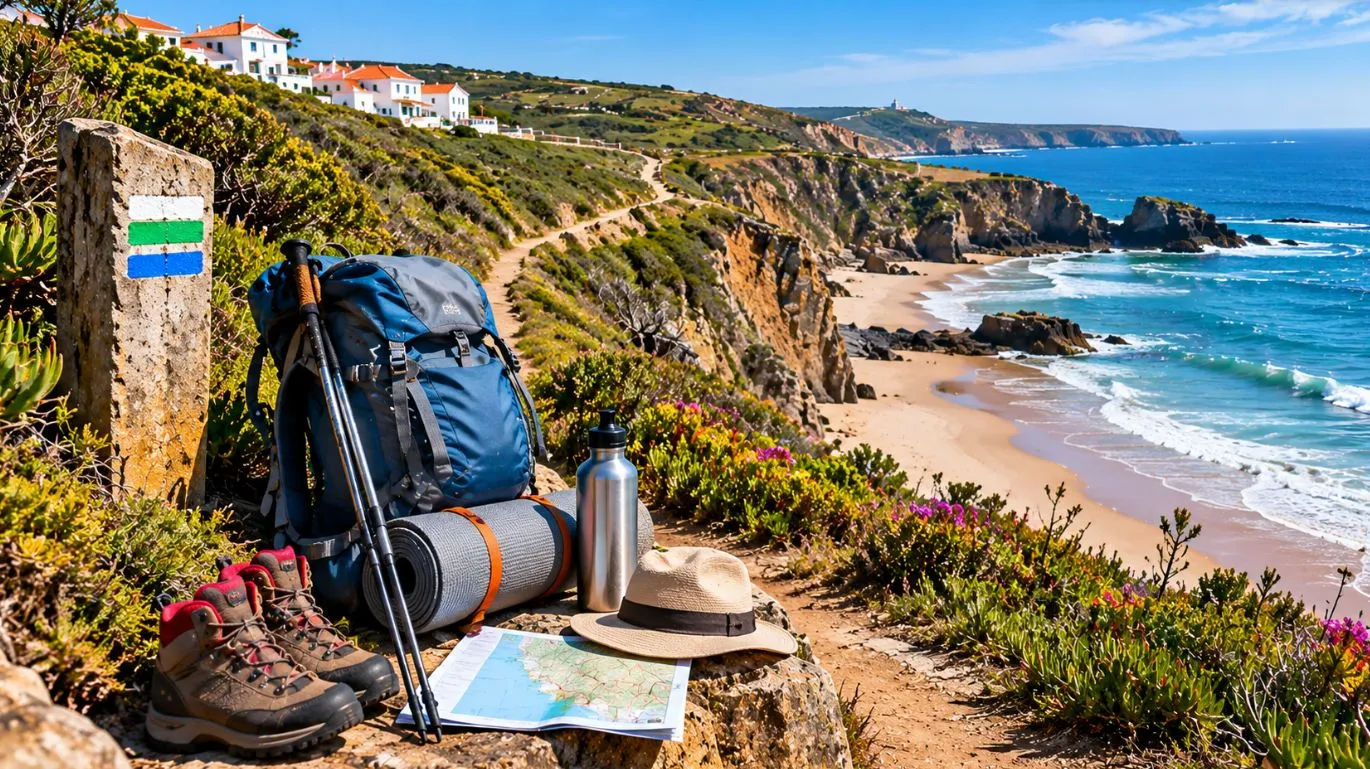
The Fishermen’s Trail follows the line where Europe runs out of land. For 75 miles along Portugal’s southwest coast, it tracks the cliffs, dunes and empty beaches that fishermen once walked between their boats and their villages — a coast of ochre cliffs, white sand coves and Atlantic wind that never quite stops. It is a linear walk with no luggage of consequence: you carry a daypack, your bags travel ahead by taxi transfer, and each evening ends in a whitewashed village where grilled fish and cold wine are the entire evening agenda.
The trail is part of the wider Rota Vicentina network in the Alentejo and Algarve regions, running from São Torpes near Sines down to Cape St. Vincent, the southwestern tip of Europe. What makes it different from most European long-distance paths is the terrain: much of the route walks directly on sand, which is harder work than distance alone suggests, and the scenery changes daily from lagoons to sea stacks to the steepest cliffs on the continent. Planning matters here — stages, beds and packing all reward a little foresight — and this guide puts the whole trip in one place.
How the route is organized
The Fishermen’s Trail divides naturally into five or six stages, depending on how you group the shorter sections near the southern end. Most walkers take five to six days, adding a rest day in Zambujeira do Mar or Odeceixe if the calendar allows. North to south is the traditional direction because the prevailing wind is at your back for much of the way and the sun stays behind you in the morning.
| Stage | Route | Distance | Typical time | Night stop |
|---|---|---|---|---|
| 1 | São Torpes to Vila Nova de Milfontes | About 12 miles | 5–6 hours | Milfontes |
| 2 | Milfontes to Almograve | About 9 miles | 4–5 hours | Almograve |
| 3 | Almograve to Zambujeira do Mar | About 10 miles | 4–5 hours | Zambujeira do Mar |
| 4 | Zambujeira to Odeceixe | About 11 miles | 5 hours | Odeceixe |
| 5 | Odeceixe to Aljezur | About 11 miles | 5–6 hours | Aljezur |
| 6 | Aljezur to Arrifana and south | About 10 miles | 4–5 hours | Arrifana or further south |
The distances look modest for experienced walkers, and they are — but sand converts every mile into about a mile and a half of normal effort, and the coastal path rises and falls in short, sharp climbs. Treat the times above as honest rather than optimistic. Walkers who finish stages by early afternoon report the best experience, because the villages empty out by mid-afternoon and the beaches at each stage’s end are worth an unhurried swim rather than a rushed photo.
The stages in character, not just kilometers
Every stage has its own personality, and knowing what awaits shapes how you pace each day. The opening stretch north of Milfontes introduces the trail’s signature landscape: wide dunes, the Mira river mouth and long empty beaches crossed by planked walkways. Stage two past Almograve brings the first true cliffs, with storks nesting on the sea stacks below — one of the few places in the world where white storks nest on marine cliffs.
Stage three into Zambujeira passes the most photographed section of the whole coast, where coves like Praia do Carvalhal appear in the gaps between cliff tops. Stage four is the walkers’ favorite: it rounds Cabo Sardão, where the lighthouse sits on a headland swept by wind, and finishes in Odeceixe, a village perched above a river beach. The final stages into the Algarve turn quieter and more rural, with sandy tracks through pine and the dramatic approach to Arrifana’s surfing cliffs. Nothing here is difficult technically; the challenge is cumulative, and the stages that look easy on paper still empty your legs by the fourth day.
Where to sleep along the way
Accommodation is the logistical backbone of this trail, and the good news is that every stage town offers beds. The range runs from simple guesthouses to design hotels, with a handful of surf lodges in the southern half. What matters most is booking the right bed for the right night, and these are the options that work best:
- Local guesthouses and rooms — family-run, inexpensive, and the most common choice; hosts often arrange the next morning’s breakfast bag and luggage transfer.
- Trail-side hostels and surf camps — sociable and budget-friendly, concentrated in Milfontes, Zambujeira and Arrifana, with kitchen access for self-catering.
- Boutique hotels and rural estates — the comfortable end of the scale, worth choosing for a rest night in Zambujeira or Aljezur.
- Luggage transfer services — not accommodation itself, but the service that makes light hiking possible; local operators move bags between your nightly bookings for a modest daily fee.
Book everything before you leave home between May and September, when the coast fills with Portuguese holidaymakers and European walkers, and village beds number in the dozens rather than hundreds. Outside peak season, walk-in availability is realistic, but the trail’s charm in winter — dramatic, empty, stormy — pairs poorly with cold guesthouses, so shoulder-season walkers should still confirm the first and last nights at minimum.
What to pack for sandy miles
Packing is where this trail differs from alpine routes. There is no altitude, no exposure and no need for boots with stiff soles — but the sand, the wind and the absence of shade change what belongs on your back. The whole kit fits in a 20-liter daypack, and the essentials are these:
- Trail runners or light shoes with aggressive grip, ideally ones you do not mind sanding up from the inside.
- A windproof layer, because the Atlantic breeze turns punishing on exposed cliff tops even on warm days.
- Sun protection at the top of the list: hat, high-factor sunscreen, sunglasses and lip balm, since the route offers almost no shade.
- Two liters of water minimum, refilled at village cafés and fountains, plus electrolyte tablets for hot afternoons.
- A swimsuit and quick-dry towel, because the coves along the way are the trail’s real reward.
- Cash in small notes for cafés and village shops, as card payment thins out in the smaller settlements.
- A charged phone with offline maps, plus a light battery pack for multi-day stretches.
- Blister plasters and a small first-aid kit, since sand in shoes is the trail’s trademark ailment.
Leave the rest with the transfer service. The temptation to overpack is universal, and the walkers gliding up the dunes with tiny packs are not tougher than the ones grinding along with 40-liter rucksacks — they simply sent their bags ahead, and you should too.
Food, water and the rhythm of the day
The Alentejo coast eats well, and the trail’s rhythm is built around it. Mornings begin with coffee and a tosta mista at the village café, lunches are either picnic ingredients from the local mini-market or a late plate of grilled fish at the day’s end, and dinners run to whatever the sea delivered — percebes, dourada, ameijoas — with the region’s reds and the local green wine by the carafe. In Zambujeira and Milfontes, restaurants fill by eight; in Almograve and Odeceixe, the pace is slower but the kitchens close early, so eat when the locals do.
Water logistics deserve attention because the coast is dry and the sun is constant. Villages sit close enough together that no stage requires carrying more than two liters, but there are long gaps between fountains on the dune sections, particularly in stages one and five. Stock up before leaving each village, and treat the café stops as refueling stations rather than luxuries — the Portuguese habit of a mid-morning bica and custard tart is trail-tested and highly recommended.
Practicalities: season, costs and navigation
May, June and September are the ideal months: warm but not scorching, the sea warm enough to swim and the villages lively but not overwhelmed. July and August bring heat and holiday crowds to the beach towns, though the trail itself rarely feels busy; October offers quieter paths and cooler swimming. Winter is dramatic and empty, but many village services close, and the wind can make cliff-top sections genuinely unpleasant.
Costs stay moderate by Western European standards. Guesthouse beds run from 35 to 70 euros per night, dinner with wine costs 15 to 25 euros, and the full week — including transfers — typically lands between 450 and 700 euros per person. Navigation is straightforward: the route is waymarked with the distinctive fish-and-arrow markings, and the sandy sections follow obvious lines, though wind-blown sand can erase tracks in places, so offline maps remain the sensible backup.
One safety note belongs in every plan: cliff edges crumble, and the trail deliberately routes walkers a safe distance back from the rim in most sections. Stay on the marked path, respect temporary closures after winter storms, and keep dogs and children close on the cliff sections. Tides matter only on the rare beach crossings, which signage flags clearly.
Beyond the Trail: what to add if you have time
The Rota Vicentina network extends well beyond the Fishermen’s Trail, and a rest day or a longer holiday can absorb some worthwhile additions. These are the ones walkers rate highest:
- The Historical Way inland stages — the sister route through villages, cork forest and river valleys, ideal if coastal wind frustrates you for a day.
- Praia de Odeceixe — the river-mouth beach at the stage four finish, arguably the finest swim of the whole route.
- The Milfontes river ferry crossing — the tiny boat across the Mira that saves a long road detour at the end of stage one.
- Cabo de São Vicente and Sagres — the trail’s southern finale at Europe’s edge, with sunset crowds applauding the light.
However long you give it, the Fishermen’s Trail earns its reputation honestly: a coast that still belongs to the fishermen who named it, walked at the pace the sand dictates. Book the beds, send the bags ahead, start each stage early, and the trail does the rest — which is exactly what a good long-distance walk is supposed to do.