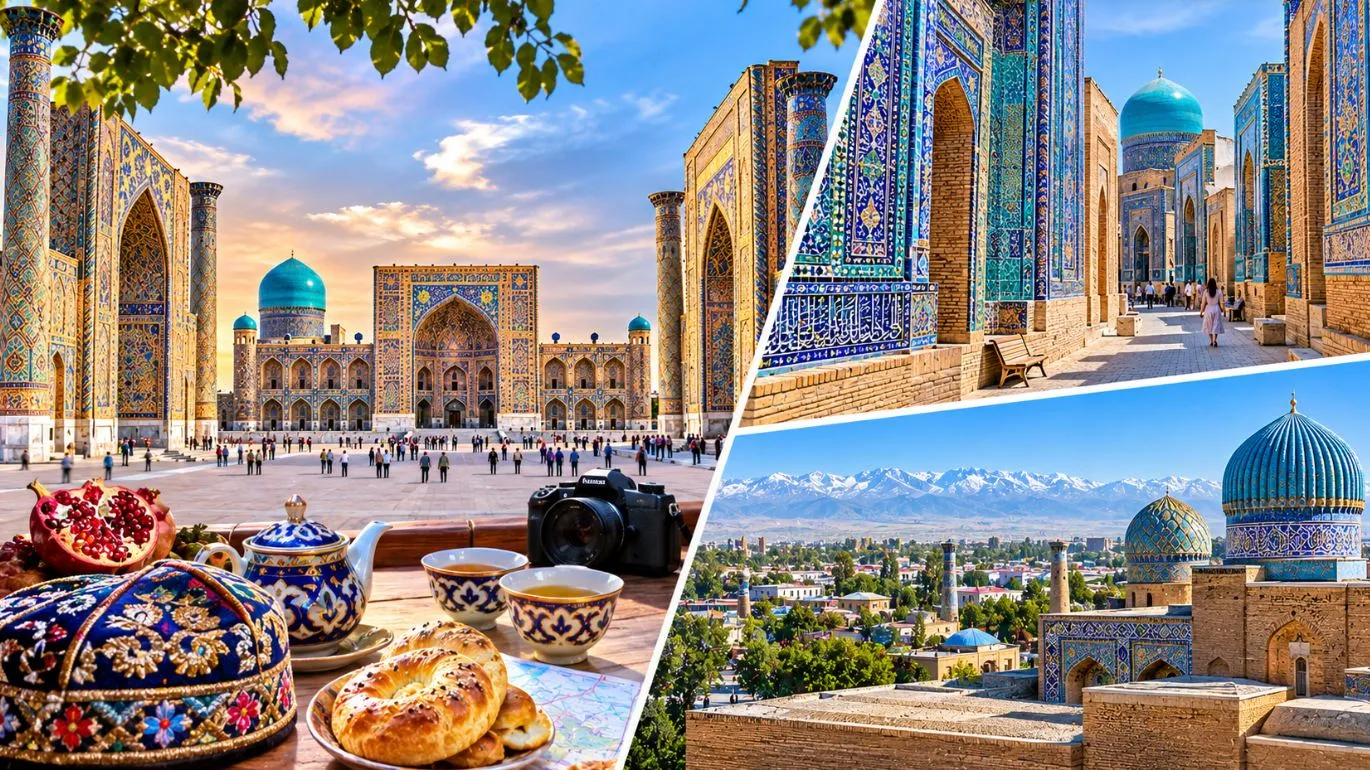
Samarkand rewards travelers who arrive with a plan. In two days you can see every monument that earned the city its legend — the Registan at dusk, the tiled alleyway of Shah-i-Zinda at dawn, the domes of Gur-e Amir glowing in late afternoon — and still have time for plov, bazaars and slow tea. The mistake most short-term visitors make is trying to do everything in one rushed day, arriving at Shah-i-Zinda at noon under a merciless sun and at the Registan in flat midday light. Two days, organized around light and temperature rather than a strict list, turn Samarkand from a busy stopover into the highlight of an Uzbekistan trip.
The city also works in your favor logistically. The Afrosiyob high-speed train from Tashkent takes about two hours and stops at a station only fifteen minutes by taxi from the old town. Monuments sit in three loose clusters, and the distances between them are walkable or a few thousand som by taxi. What follows is a two-day plan built around those clusters, with the practical details — tickets, timing, dress, food — woven in where you actually need them.
Know before you go: the essentials
A few facts shape everything else, so they come first. Samarkand’s main monuments charge entrance fees that add up quickly, the sun dictates your schedule from April to September, and the light changes the buildings dramatically between morning and evening. Costs and timings vary by season, so treat the figures below as planning estimates rather than gospel.
| Monument | Typical visit time | Entrance fee (approx.) | Best time of day |
|---|---|---|---|
| Registan ensemble | 1.5–2 hours | Around 60,000 som | Evening light show, or early morning |
| Shah-i-Zinda | 1–1.5 hours | Around 40,000 som | Sunrise to 9 a.m. |
| Gur-e Amir mausoleum | 45–60 minutes | Around 40,000 som | Late afternoon |
| Ulugh Beg observatory | 30–45 minutes | Around 30,000 som | Any time, ideally before noon |
| Afrasiyab museum and site | 1–1.5 hours | Around 30,000 som | Morning, before the heat |
If you are short on cash, the Registan and Shah-i-Zinda are non-negotiable; the observatory and Afrasiyab reward history lovers most. Combination logic matters too: Shah-i-Zinda and the observatory sit on the same northeastern edge of town, so they pair naturally in one block, while Gur-e Amir stands alone near the Chorsu area, a short walk from good restaurants. Buy your sim card or eSIM in Tashkent, download offline maps, and you can navigate the whole city without paying for roaming surprises.
Day one: the Registan and the heart of Timurid power
Start your first day at the Registan, but not at noon. If you arrive on a morning train, drop your bags, have breakfast and enter the ensemble before the tour groups thicken around eleven. Three madrasahs — Ulugh Beg, Sher-Dor and Tilya-Kori — frame the square, and their differences tell six centuries of history: the oldest facade is restrained and scholarly, Sher-Dor scandalizes purists with its tigers chasing deer, and Tilya-Kori earns its name, “gilded,” with an interior of gold leaf that will keep your neck craned for an hour.
Climb the minaret tower of one madrasah for the overhead view of the square — access rotates between the buildings, so ask the staff which one is open. Inside the courtyards, look up at the restored domes and down at the small exhibitions of costumes and miniature painting; both are included in the ticket. Return after dark as well, when the facades are floodlit and the square fills with local families. The light show is free from the outside, and many travelers say the Registan at night, viewed from the steps of the Sher-Dor across the square, beats any paid view of the day.
After lunch, walk twenty minutes west to Gur-e Amir, the mausoleum of Timur himself. Its ribbed turquoise dome is the masterwork the Registan’s architects studied before going bigger, and the interior — paper-thin gold on deep blue in a low octagonal chamber — hits harder than any photograph suggests. Timur’s dark green jade tombstone sits beneath the dome, and the inscriptions around the room read like imperial self-confidence carved in stone. Spend your evening on the Siyob street and bazaar area, where bread sellers stack round loaves stamped with the city’s seal and the evening crowd thickens around the siyob food stalls.
Day two: Shah-i-Zinda, the observatory and the old ground
Set your alarm, because Shah-i-Zinda deserves the dawn. This necropolis, climbing a hillside in a narrow corridor of mausoleums, is the most beautiful ensemble in Uzbekistan — a canyon of turquoise and cobalt tilework so dense that the sky appears only in fragments above. Come between seven and nine in the morning and you will have the corridor nearly to yourself, the tiles glowing cool blue in low sun, local families visiting graves around you as they have for a thousand years. By ten, the corridor fills with tours and the temperature climbs; by then, you should already be on your way down.
The name means “the living king,” referring to a companion of the Prophet believed buried here, and the complex grew around that tomb over centuries. Walk the full corridor to the 14th-century mausoleum at the top, then duck into the side structures — the Shadi Mulk mausoleum and the unnamed smaller tombs hold the finest tile details in the whole complex. Dress respectfully: this is an active place of pilgrimage, so covered shoulders and knees matter more here than anywhere else in the city.
From Shah-i-Zinda, it is a short taxi ride to the Ulugh Beg observatory, where a 15th-century astronomer-king built one of the greatest observatories of the medieval world. Only the sunken arc of a giant sextant survives, a trench carved into the earth that once measured the stars with astonishing precision. The small museum explains the mathematics; the site itself, quietly humbling, stays with visitors longer than its modest size suggests. Close the loop at the Afrasiyab museum and hill, where the earliest Samarkand — the pre-Mongol capital razed by Genghis Khan’s army — lies in excavated silence, and the wall frescoes in the museum show what the city looked like at its first golden age.
Where the two-day plan flexes
Not every visitor wants the same Samarkand, and the plan above bends easily. If you have only one day, do the Registan at opening, Gur-e Amir before lunch and Shah-i-Zinda in the late afternoon, accepting that you lose the best light at the necropolis. If you have a third day or a free morning, these are the additions worth considering:
- Koni Ghil paper mill — a working workshop reviving Samarkand’s ancient mulberry-paper craft, in a peaceful riverside setting east of town.
- Siyob bazaar in full swing — spices, dried apricots and bread in the morning, when the market runs at full voice.
- A plov master class or lunch at a choykhona — Samarkand’s version of the national dish, served from a single great cauldron.
- Hazrat Khizr mosque — a small, elegant mosque overlooking the Registan, quiet and often overlooked.
- The Afrosiyob light fountains — evening musical fountains near the bazaar, popular with local families after dinner.
Each of these slots into a gap of two hours or less, which is why the two-day frame holds its shape even when the train schedule or the weather forces changes. Prioritize the light: monuments look different at different hours, and Samarkand’s architecture is essentially architecture about light.
Getting around, sleeping and eating
Everything central happens within a loose triangle from the train station to the Registan to Shah-i-Zinda, so choose your hotel inside that triangle and you may never need a taxi except to the observatory. Guesthouses in the old mahalla streets around the Registan offer courtyard breakfasts and walking access to everything on the first day’s plan; the newer hotels near the Siyob and boulevard areas trade charm for comfort and elevators. Book ahead from April to October, when the best small properties sell out weeks in advance.
Eating is one of Samarkand’s pleasures rather than a logistical challenge. The city’s plov, served from cauldrons before early afternoon, is considered the country’s finest — go at lunch, not dinner, because the best places sell out. Beyond the signature dish, keep an eye out for these:
- Samarkand non — the dense, sourdough-style bread stamped with the city’s pattern, sold fresh from clay ovens all day.
- Shashlik at Siyob bazaar — lamb skewers grilled over coals beside the bread stalls, best around lunch.
- Mastava and shurpa — hearty soups that suit a cool evening after a long day of walking.
- Green tea in bowls — poured everywhere, always free-flowing, and the true local unit of time.
Prices run low by European standards: a full meal with tea rarely exceeds five dollars per person, and taxis across town cost one or two. Carry small notes, as bazaar stalls and taxis prefer cash, while hotels and larger restaurants take cards without trouble.
Practical tips that make the difference
Samarkand is easy, but a handful of small habits separate smooth visits from frustrating ones. These are the details travelers most often wish they had known earlier:
- Buy Afrosiyob train tickets several days ahead in high season, since the morning departures sell out first.
- Enter Shah-i-Zinda before 9 a.m. to catch the best light and the thinnest crowds — this single decision changes the whole visit.
- Carry your passport or a copy, required for some ticket offices and hotels.
- Wear shoes you can walk cobblestones in; the Registan courtyards and the necropolis slope are harder on footwear than the map suggests.
- Agree on taxi prices or use a ride app before getting in, especially around the train station where drivers open high.
One cultural note ties it all together: Samarkand is a working, living city, not a museum set. Locals picnic on the lawns around the monuments, kids play football beneath the minarets, and weddings photograph at Shah-i-Zinda on weekends. Traveling with that rhythm — early starts, long lunches, evening strolls — is not just efficient but the way the city has always expected to be seen.
When to come and how to leave
Spring from April to May and autumn from late September to October offer the kindest combination of temperature and light, with poppies or golden light on the tiles and comfortable evenings. Summer visits still work if you adopt the local schedule — dawn monuments, midday shade, evening return — and winter brings empty sites, occasional snow on the domes and a quiet beauty that suits the mausoleums well.
Two days is enough to see Samarkand properly, and just short enough to leave you wanting the wider country: Bukhara’s trading domes, Khiva’s walled city, the valleys east of Tashkent. Most visitors board the evening train already planning the return, and that is the right way to think about it — Samarkand is not a box to tick but a city to begin with, and two well-spent days are the perfect opening chapter.