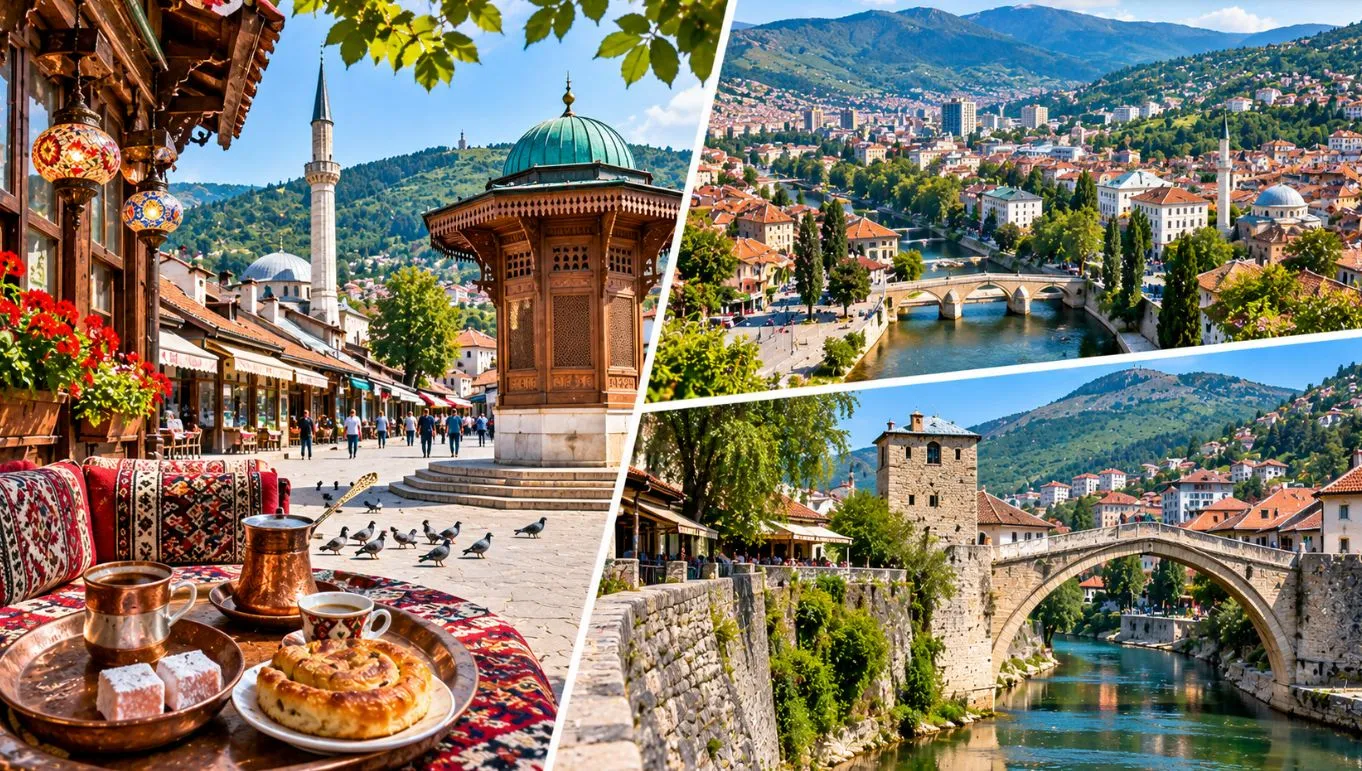
Sarajevo compresses more history into a few square kilometers than most capitals manage in their whole country. Ottoman mosques, Austro-Hungarian facades and socialist-era blocks stand within sight of each other, and the mountains that ring the valley keep the whole story within view. Two days is enough to feel the city properly — long enough to walk Baščaršija at dawn, stand on a hilltop at sunset and eat your way through burek and ćevapi between the two — but only if you spend your hours wisely.
The good news is that Sarajevo is compact and walkable. The old town and the modern center divide naturally along the Miljacka river, and viewpoints lie within a short taxi or cable car ride of each other. What follows is a plan built around the city’s real rhythms: mornings for the old town, afternoons for the hills, evenings for the food and the long dinners the city is built around.
First hours: landing lightly
Most visitors arrive by bus or from the small airport twenty minutes west of the center. Taxis are cheap and fixed-price from the airport; agree on the fare before you get in. Drop your bags near Baščaršija, the Ottoman-era heart, and start walking before you plan anything else. The district works best unfiltered — coppersmiths hammering coffee pots in Kazandžiluk, the smell of grilled meat drifting from every corner, minarets rising between tiled roofs.
Before the walking begins, it helps to see how the days divide. Sarajevo’s attractions cluster into natural groups by neighborhood and by time of day, and the plan below uses those clusters rather than fighting them.
| Time | Area | What to do | Notes |
|---|---|---|---|
| Day one, morning | Baščaršija | Sebilj fountain, coppersmith street, Gazi Husrev-bey mosque | Arrive before 10 a.m. for quiet lanes |
| Day one, afternoon | City center | Latin Bridge, City Hall, Gallery 11/07/95, Markale market | History sites pair naturally in this stretch |
| Day one, evening | Vratnik and viewpoints | Yellow Fortress at sunset, Kovači cemetery | Short taxi up, walk back down |
| Day two, morning | Trebević mountain | Cable car, bobsled track, forest trails | Start early for clear views |
| Day two, afternoon | Marijin Dvor and museums | National Museum, Emperor’s Mosque, river walk | Good rainy-day option |
| Day two, evening | Desserts and dinner | Baščaršija cafés, bosanska kahva, evening stroll | Reserve dinner on weekends |
The rhythm keeps walking manageable while covering the city’s two faces: the Ottoman east bank and the Austro-Hungarian west. Because everything sits within a half-hour walk of Baščaršija, you can improvise within the structure — swap afternoons for rain, add a museum when the heat builds, and never feel that plans are being wasted.
Day one morning: the Ottoman heart
Baščaršija rewards early arrival. The Sebilj fountain, the wooden kiosk that has become the city’s symbol, sits at the center of the main square, and the surrounding lanes hold craft shops unchanged in their trade for centuries. The coppersmith street, Kazandžiluk, rings with hammer strikes as artisans shape coffee sets by hand; buying directly from the workshop costs less than tourist shops and supports the last generation of masters.
The Gazi Husrev-bey mosque, built in 1530, anchors the district. Its courtyard, ablutions fountain and elegant minaret make it the finest Ottoman building in the Balkans, and the complex includes a covered bazaar, a madrasah and a clock tower that famously keeps lunar time. Non-Muslim visitors are welcome outside prayer times, with shoulders and knees covered; scarves are available at the entrance for women.
Between sights, graze. Burek — spiral layers of pastry filled with meat, cheese or spinach — is the local breakfast of champions, sold from bakeries that open at dawn. Pair it with bosanska kahva, coffee served in a copper džezva with a cube of sugar and a lump of rahat lokum on the side, and you have the full Sarajevo morning.
Day one afternoon: crossing the centuries
Cross the Latin Bridge at midday and the city changes centuries. On the northern corner stands the building where Archduke Franz Ferdinand was assassinated in 1914, an event that lit the fuse for the First World War; the small museum beside it explains the story. Continue to the City Hall, Vijecnica, whose reconstructed facade and interior were reopened after wartime destruction, and whose stained glass and Moorish revival style make it the city’s most photographed building.
From here, the city’s modern history becomes unavoidable. The Gallery 11/07/95 museum documents the siege of Sarajevo with photographs and personal objects, and the Markale market bears quiet memorial plaques where shells struck the crowd. These are heavy visits, but they are the reason the city exists as it does today, and locals will tell you they would rather visitors understand than look away.
Finish the afternoon in the Ferhadija pedestrian street, where Austro-Hungrarian facades give way, at the “Sarajevo meeting of cultures” line marked in the pavement, to the Ottoman east. The transition is literal: on one side of the street you face Catholic cathedrals and Secession buildings, and on the other, minarets and copper roofs. Few cities demonstrate layered history so visibly on a single street.
Day one evening: sunset from the Yellow Fortress
As the light drops, climb toward Vratnik, the walled old quarter on the eastern hill. The Yellow Fortress, a cannon-armed bastion from the 18th century, offers the classic Sarajevo panorama — minarets and red roofs below, the Miljacka winding through, the Olympic mountains behind. Locals gather here with picnic blankets and cameras at sunset, and the call to prayer rolling up from the city below as the light fades is the single most memorable moment of any visit.
The White Fortress, higher still, holds a second viewpoint and a small museum inside its walls, best reached by taxi if the legs are tired. Both forts are free, and both stay open into the evening in summer. Walk back down through Kovači, the great cemetery that holds the city’s siege-era dead, whose white markers climb the hillside in silent rows — sobering, dignified and impossible to forget.
Day two morning: Trebević and the bobsled track
The cable car from the city edge carries you up Trebević mountain in twelve minutes, replacing the road journey that took an hour before its reconstruction. At the top, forest trails loop around the summit, and the ruined Olympic bobsled track from 1984 — now a canvas for graffiti artists and one of the most photogenic ruins in Europe — sits a short walk downhill. Walk its full length; the curves rise above the trees and the artwork changes with every corner.
The mountain is part of Sarajevo’s identity in a way visitors should understand. The 1984 Winter Olympics once played out on these slopes, and during the siege the front line ran through this same forest. Standing on Trebević today, with picnicking families and runners on the trails, you are looking at a landscape that has moved from war zone to playground within one generation — which is precisely why the view matters more here than the photo.
Day two afternoon: museums, coffee and the river
If the morning climb left you tired, the afternoon works best slow. The National Museum of Bosnia and Herzegovina holds the famous Haggadah, a 14th-century manuscript rescued through wars by librarians of different faiths, alongside botanical gardens and Bosnian medieval tombstones. For art lovers, the Ars Aevi contemporary collection offers a different register, and the small War Childhood Museum near the old town tells the siege years through children’s eyes — small, powerful and often the most memorable visit of the trip.
Coffee in Sarajevo is not a beverage but a ritual. Café culture spans from traditional kafanas serving bosanska kahva to third-wave espresso bars along the Miljacka. Take a table by the river, order slowly, and let the hour stretch. If rain arrives, the city’s covered market halls and museums absorb the afternoon gracefully, and the shopping streets around Ferhadija stay lively regardless of weather.
Day two evening: the table as the main event
Dinner in Sarajevo is not a meal but an evening, and the city’s restaurants reward lingering. Traditional Bosnian cooking centers on grilled meat, stuffed vegetables and slow stews, and the best places hide in courtyards and side lanes off Baščaršija. Certain dishes deserve priority on any table:
- Ćevapi — grilled minced meat fingers in somun flatbread with raw onion and kajmak, the national dish and an evening ritual.
- Burek — layered pastry with meat, best fresh from the bakery at any hour.
- Japrak and dolma — vine leaves and peppers stuffed with rice and minced meat, home cooking at restaurants.
- Bosanski lonac — a layered meat and vegetable stew cooked in a clay pot, made for sharing.
- Baklava and tufahija — walnut-stuffed apples in syrup, the sweet finish locals recommend.
Order slowly, eat slowly, and accept the raki offered at the end; refusing it outright is more impolite than taking a small sip. Restaurants around Baščaršija stay lively until late, and a final walk through the floodlit old town is the traditional way to end the evening.
Viewpoints beyond the fortress
For travelers who cannot get enough of the panorama, Sarajevo hides more angles than the two fortresses. A few are worth the detour:
- Avaz Twist Tower café — a high-rise viewing terrace with the whole valley, best at sunset.
- The Vraca memorial park — a monumental ensemble south of the center, quiet and solemn, with an open view over the city bowl.
- The BT Centar rooftop — a low-key alternative with drinks and city views.
- The cable car station platform — surprisingly good angles over the Miljacka as you rise.
Each option shifts the perspective: towers flatten the city into a map, fortresses frame it with history, and the mountain trails give you the forest’s own angle. Combining one tower and one hilltop over two days covers the city’s vertical range without repeating yourself.
Practical tips that matter
Sarajevo is friendly, safe and inexpensive, but small details smooth the visit. Before you set out each morning, keep these points in mind:
- Carry cash in convertible marks, since markets, bakeries and taxis remain cash-first despite cards working in most shops.
- Buy a day pass for the cable car plus museums if planning both, or check combined tickets at the cable car base station.
- Wear sturdy shoes: Sarajevo’s hills are real, and the fortress paths and bobsled track are uneven underfoot.
- Book dinner ahead on weekends, when the best traditional restaurants fill quickly with local families.
- Learn the phrase “hvala” for thank you, which locals appreciate in either Bosnian, Croatian or Serbian contexts.
Budget travelers will find the city generous: guesthouses run from 25 to 50 euros per night, full meals rarely exceed 10 euros, and the cable car costs only a few marks. Mid-range travelers can eat and drink lavishly for 60 to 80 euros per day per person, which makes Sarajevo one of Europe’s best-value capitals.
When to come and how to extend
Spring and autumn bring the best walking weather and the clearest mountain views, while winter adds snow, ski season on Jahorina and a festive atmosphere around the old town. Summer is warm and lively, with long evenings on café terraces, though midday heat makes the hill climbs better saved for morning or late afternoon.
If a third day opens up, take a day trip to Mostar, ninety minutes away by bus or train, or explore the tunnel museum south of the city, where a section of the wartime lifeline under the runway survives. Both fit comfortably into a two-day visit’s natural gaps. Whether you stay two days or a week, the city works the same way: walk slowly, eat generously, look up at the hills and let Sarajevo tell its own story — because it has more than a few, and it tells them well.