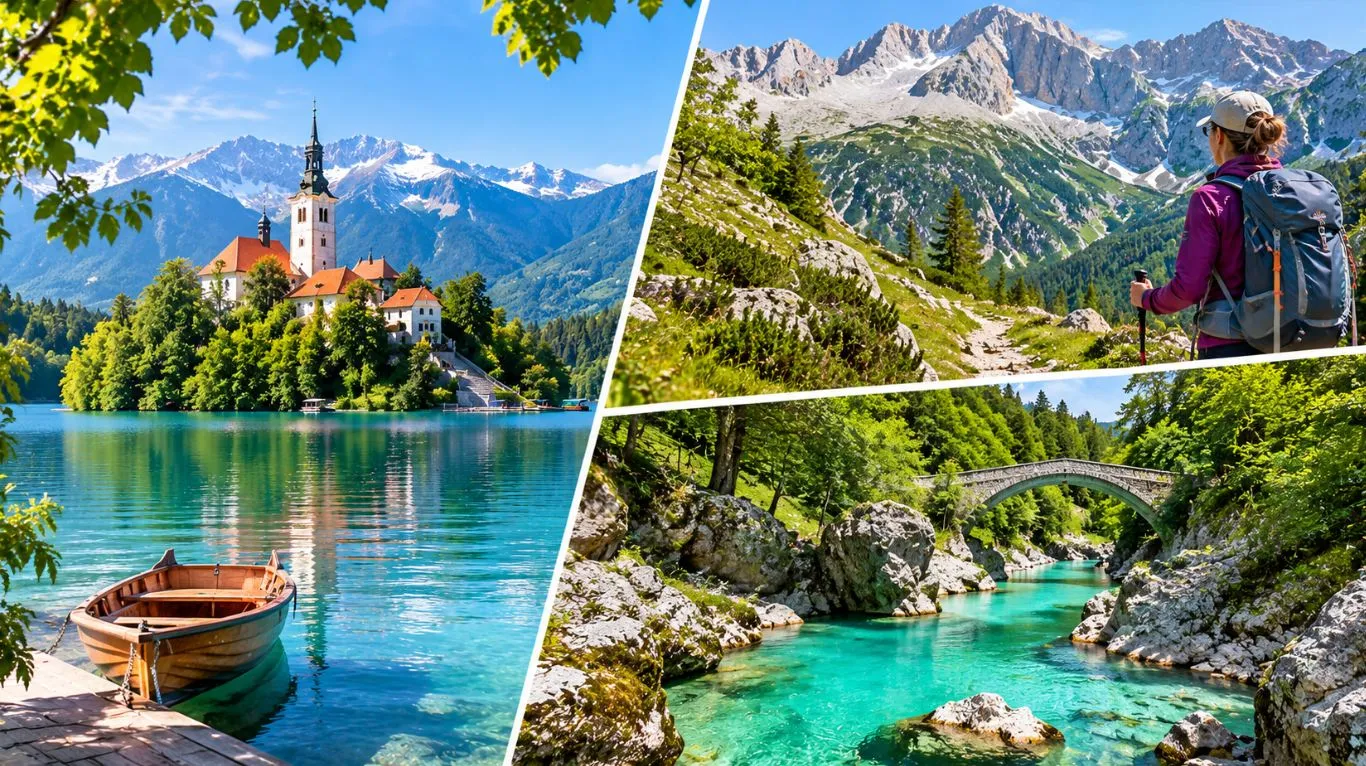
Slovenia packs an unreasonable amount of beauty into a country you can cross in three hours. Glacial lakes sit beneath limestone peaks, alpine rivers run a green so vivid it looks artificial, and vineyards, gorges and mountain passes sit within easy reach of one another. For travelers, this geography creates a rare gift: a proper mountain road trip where you never spend a full day behind the wheel. Seven days is enough to link the country’s three headliners — Lake Bled, the Triglav massif and the Soča Valley — at a pace that leaves room for swimming stops and long lunches rather than photo-checklist tourism.
The route described here forms a figure through the northwest, the only part of the country where Alps, lakes and Mediterranean-influenced valleys meet within a short drive of each other. You will sleep in four bases at most, hike something almost every day, and finish with an easy run back toward Ljubljana or the airport. Slovenia is also one of Europe’s most road-trip-friendly countries: roads are excellent, distances are short, and the driving itself — over Vršič Pass, along the Soča — is part of the experience rather than the price you pay for it.
The week in one view
Before getting into detail, it helps to see how the days fit together and where the long drives fall. Nothing here exceeds two hours behind the wheel, and the middle of the trip deliberately slows down around Kranjska Gora and Bovec, where the best hiking sits right on the doorstep.
| Days | Base | Focus | Drive to next base |
|---|---|---|---|
| 1–2 | Lake Bled | Island church, castle, Vintgar Gorge, Bohinj and Vogel cable car | 30–40 minutes to Kranjska Gora |
| 3–4 | Kranjska Gora | Vršič Pass drive, Triglav views, Zelenci springs, planica | 1.5–2 hours over the pass to Bovec |
| 5–6 | Bovec | Soča river, Great Soča Gorge, rafting, Mangart road, Kozjak waterfall | 2 hours via Predel or Tolmin |
| 7 | Ljubljana or departure | Return drive, capital stroll, airport | 1 hour to the airport |
That final day is flexible by design. If your flight leaves in the evening, there is time for a walk along the Ljubljanica river and a coffee in the old town; if you depart early, spend night seven closer to the airport and keep the capital for a future trip. Either way, the return drive out of the Soča Valley gives you one last look at the mountains from the opposite direction, which many travelers end up pulling over for anyway.
Days 1–2: Lake Bled and the Bohinj side of the range
Bled needs no introduction, but it still earns one. A glacial lake the color of pale jade, a church on an island in the middle, a clifftop castle above — the postcard is real, and it takes about five minutes of standing on the shore to stop being cynical about it. Row out to the island in one of the traditional pletna boats, climb to the castle for the classic view down the lake, and try the local cream cake, kremna rezina, which tastes better here than anywhere else for reasons locals will insist are structural rather than sentimental.
Save your second day for Bled’s quieter sibling, Lake Bohinj, half an hour into Triglav National Park. Bigger, wilder and far less crowded, Bohinj sits at the foot of the Julian Alps with a cable car rising to Mount Vogel at its edge. Ride up for the panorama over the lake and the high ridgelines, then walk one of the lakeshore trails or swim at the eastern end where the water warms shallow. The Savica waterfall, pouring 78 meters down a cliff into the valley, closes the day nicely, and the drive back to Bled along the Bohinj road is one of those stretches where you will keep finding excuses to stop.
Between the two lakes, squeeze in the Vintgar Gorge, a wooden walkway bolted to the walls of a narrow canyon where the Radovna river churns turquoise beneath your feet. Go at opening time; by late morning the boardwalk fills up and the magic gets rationed.
Days 3–4: Kranjska Gora and the road over Vršič Pass
The short hop from Bled to Kranjska Gora puts you in a different world: a proper alpine ski town ringed by peaks, with planica — the giant ski-jumping complex — filling the valley’s end. The town makes a relaxed base for two nights, and its surrounding trails suit every energy level, from a flat stroll to the emerald Zelenci springs to a proper climb toward the trails below Triglav’s north face.
Day four contains the drive most people remember for years: the Vršič Pass, built by Russian prisoners of war during the First World War and remembered in local legend by the name of the Russian Chapel partway up. Fifty hairpin bends climb through forest and karst to 1,611 meters, with each turn opening another view back down the valley. The pass closes in winter, so this route works from late spring to late autumn, and the road narrows in places — take it slowly, and let faster locals pass.
From the top, walk one of the short trails toward Slemenova Špica for a panorama over the Trenta valley, then continue down the serpentine switchbacks into the Soča drainage. The landscape flips on the descent: the Alps sharpen, the air warms, and the river begins showing that impossible green. You will understand within the first kilometer why people build entire trips around this valley.
Days 5–6: The Soča Valley, Slovenia’s wild green river
Bovec sits at the valley’s heart, a small town of whitewashed houses that has become the adventure capital of the Slovenian Alps. The Soča river is the reason people come: an alpine river whose color ranges from pale mint in the shallows to deep emerald in the pools, running through a landscape of boulders, gorges and wildflower meadows. Everything here revolves around the water, and choosing what to do is the day’s only real problem:
- Rafting the Soča — gentle in summer, thrilling in spring, and the best introduction to the river for mixed groups.
- Kayaking or canyoning — guided descents of side creeks with slides and plunge pools, ideal if you want adrenaline with a safety rope.
- The Great Soča Gorge trail — a walkable stretch of river pools near Trenta where the water glows over white stone.
- Fly fishing — the Soča is the home of the marbled trout, and permits are easy to arrange in town.
Set aside at least one pure hiking day. The trail toward the source of the Soča in Trenta leads through larch forest to the very spring where the river emerges from beneath a wall of stone, and the Mangart road, the highest paved road in Slovenia, climbs to a saddle at over 2,000 meters for views across the border into Italy. Waterfalls punctuate everything: Kozjak, hidden inside a dark rock amphitheater you reach through a narrow gorge, is the most theatrical of them, and its pooled basin tempts swimmers even in the shade.
Evenings in Bovec move slowly. Local restaurants serve Karst-influenced food — the border with Italy and the winemaking regions are close — and the town’s terrace bars fill with damp, happy rafters comparing the day’s swims. Two nights here feels right; three is a luxury worth considering if the forecast is good.
Day 7: Back over the mountains and out
The final day reverses the arc. The fastest return to Ljubljana runs through the Soča’s lower valley and over the pass at Bohinj or through the Vipava wine country, and both options have their appeal: the first keeps you in the high mountains longer, the second trades peaks for vineyard terraces and a last lunch overlooking the hills. Either way, plan around four hours of driving with stops, which leaves most of a day.
Ljubljana, if you make it there, is one of Europe’s most pleasant small capitals — pedestrianized riverbanks, a castle hill reachable by funicular, and a café culture that feels more Viennese than Balkan. Even a two-hour stop dissolves road-trip stiffness. From the city, the airport lies under half an hour north, and car rental returns are quick and painless.
Food and local flavors along the route
Alpine Slovenia eats heartily, and the regional differences track the geography you drive through. Around Bled and Bohinj, expect dairy-rich mountain dishes; in Kranjska Gora, hearty Slovenian classics; in the Soča Valley, a faint Mediterranean breeze in the cooking. Certain plates appear throughout and deserve chasing:
- Kranjska klobasa — the Carniolan sausage, smoked and served with mustard and fresh horseradish.
- Štruklji — rolled dumplings filled with cottage cheese or walnuts, baked or boiled, omnipresent and universally good.
- Bled cream cake — the puff-pastry-and-custard legend, best eaten on a terrace above the lake.
- Soča trout — often grilled whole with herbs, in riverside inns near Trenta and Bovec.
- Tolminc cheese and Soča valley honey — regional products sold at roadside farm stands, ideal road-trip snacks.
Farm tourism is a genuine Slovenian specialty, with many mountain farms opening simple restaurants where the menu depends on what the household cooked that day. Signposted turistična kmetija listings appear along most rural roads, and stopping at one turns lunch into half the day’s memory.
Practicalities of driving and planning
Slovenia rewards a little preparation, mostly around seasonal logistics and tolls rather than anything difficult. Keep these points in mind before you set off:
- Buy the e-vignette for motorways online or at fuel stations as soon as you collect the car; checks are frequent and fines are real.
- Book Bovec accommodation early for July and August, when the valley fills with rafters and kayakers.
- Check Vršič Pass status if traveling in May or October, since snow can close the road on either shoulder of the season.
- Reserve rental cars with automatic transmission well ahead, as the local fleet leans heavily toward manual.
- Carry small coins and notes for mountain parking meters and gorge entrance kiosks, which do not always take cards.
Fuel is widely available along this route, and charging stations for electric cars now cover the main bases, should you opt for one. Mountain weather is the only wildcard: afternoon storms build quickly in summer, so schedule exposed hikes and pass drives for the morning and leave lakes and gorges for the afternoons.
When to go and how to reshape the trip
Late June to early September offers the warmest water for swimming in the Soča and the fullest operation of cable cars and rafting companies. September might be the perfect month of all: stable weather, empty gorges, golden larches beginning at altitude and river levels still generous. Spring brings roaring waterfalls and snow on the high trails, which limits hiking but makes the gorges spectacular, while late autumn closes Vogel and the pass early — a beautiful but narrower window.
With fewer days, compress Bled and Bohinj into one and a half days and keep the Soča Valley at two nights; the river is the part visitors most regret rushing. With more time, extend south to the Škocjan caves and the Karst wine region, or west to Piran on the coast, which is barely 90 minutes from the Soča Valley. However you adjust it, the essential triangle stays the same — one lake, one mountain pass, one green river — and it is a combination few countries of any size can offer, let alone one you can cross on a single tank of fuel.