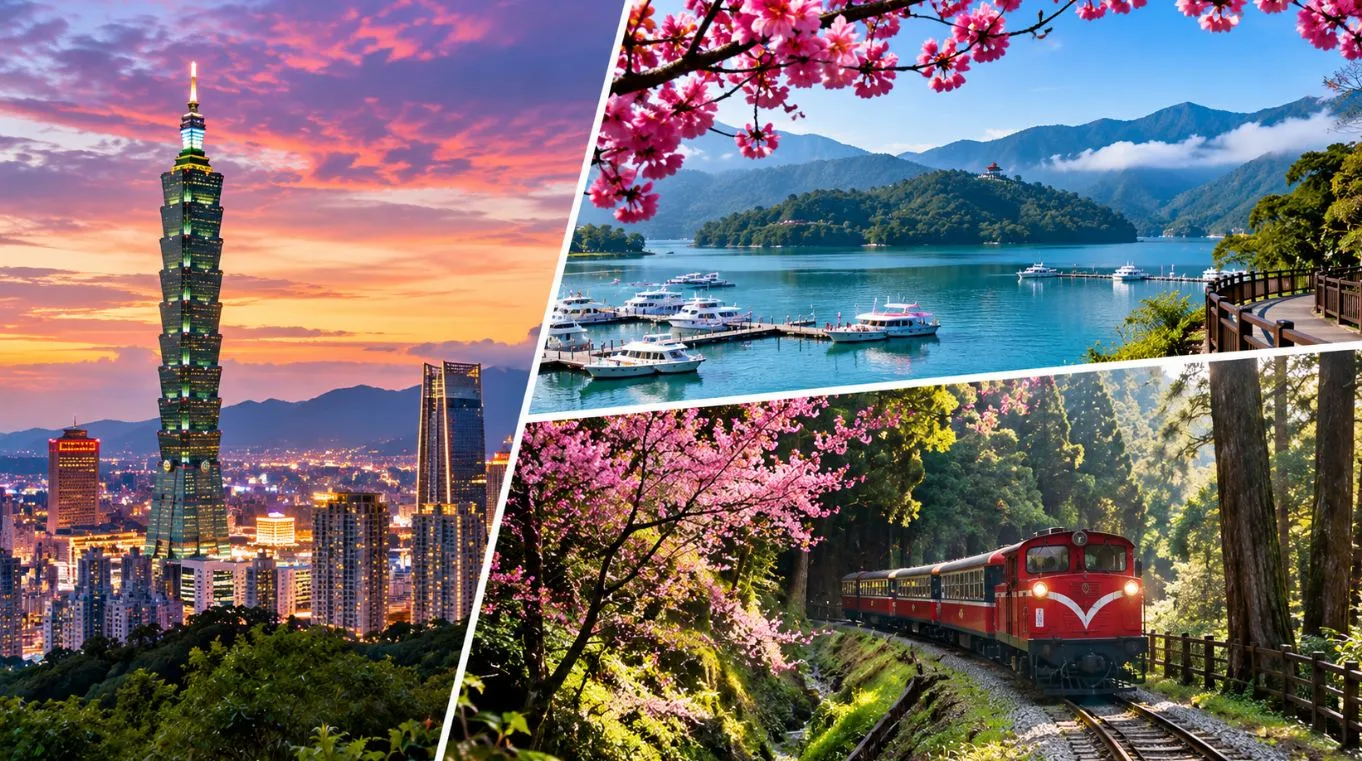
Seven days in Taiwan is enough to fall properly in love with the island. The classic first-timer route pairs the capital with the two landscapes foreigners remember long after they fly home: the mirror-calm alpine lake at Sun Moon Lake and the cloud sea at sunrise on Alishan. Together with Taipei’s night markets and temples, this triangle of city, water and mountains covers everything that makes Taiwan special, and it can be done comfortably using public transport, which in Taiwan is fast, punctual and easy to navigate even without Mandarin.
The trick to a great week here is not to overpack it. Taiwan rewards slow mornings and long dinners, and the distances are kind: the high-speed rail shoots you down the west coast in under two hours, and the mountain roads, while winding, are comfortable in a chartered car or tourist bus. This plan gives Taipei three days, the lake two, the mountains two, and it deliberately ends on a high note — literally — at 2,000 meters above sea level.
Your seven days, mapped out
A quick look at the whole week shows how the pieces fit together. Each base gets a full block of time, so you unpack once per destination rather than hopping hotels every night, and every transfer happens in the morning to protect the rest of your day.
| Days | Base | What you will do | Getting to the next stop |
|---|---|---|---|
| 1–3 | Taipei | Temples, night markets, Maokong, Beitou hot springs, day trip to Yehliu and Jiufen | High-speed rail to Taichung, about 1 hour, then bus to the lake |
| 4–5 | Sun Moon Lake | Boat cruises, cycling the lake loop, cable car, Wenwu temple | Nantou bus toward Chiayi, then Alishan Forest Railway |
| 6–7 | Alishan | Sunrise cloud sea, giant cypress trails, tea village of Fenqihu | Train back to Chiayi, high-speed rail to Taipei |
Because Taiwan is small, this schedule even leaves buffer built in: if rain closes a trail or a night market seduces you for an extra evening, the following day absorbs it. Book the HSR tickets and the Alishan sunrise train in advance during holidays, but outside peak weekends you can usually arrange everything a few days ahead.
Days 1–3: Taipei, a capital built for wandering
Land at Taoyuan airport, take the express MRT into the city, and Taipei immediately sets the tone: leafy, orderly, endlessly walkable, with a convenience store on every corner and a bubble tea stand on every second one. Start at Longshan Temple, the city’s most atmospheric shrine, where incense smoke curls past carvings of dragons and devotees chant over divination blocks. From there, the old Wanhua district spills out with traditional medicine shops and snack stalls.
Day two belongs to the north of the city. Ride the MRT to Beitou and soak in the hot springs fed by volcanic streams, then continue up to Tamsui for the riverside old street and the famous sunset over the harbor. Alternatively, spend the morning at the National Palace Museum, whose rotating collection of Chinese imperial treasures is so vast that the full display would take years to cycle through.
Reserve day three for the skyline and the viewpoints. Taipei 101 offers the iconic panorama, but locals know Maokong, reached by a scenic gondola over tea plantations, gives you the city from a teahouse terrace instead of an observation deck. Finish each day at a night market — Shilin for variety, Raohe for the famous pepper buns, Ningxia for old-school Taiwan food.
Day trips from Taipei worth stealing time for
If this is your first trip, consider swapping one Taipei evening for a coastal excursion. Two destinations in particular sit comfortably within a day of the capital, and both change how you see the island:
- Jiufen and Yehliu — a former gold-mining hill town of lantern-lit stairways, combined with the surreal mushroom-shaped rocks on the northeast coast.
- Shifen — a railway village where you can launch a sky lantern painted with your wishes onto the train tracks, then walk the spectacular Shifen waterfall.
Both trips work on public buses and local trains, though renting a driver for the day costs less than you might expect and saves hours of connection-hunting. Return to Taipei by early evening and you still have time for a final night market round.
Days 4–5: Sun Moon Lake, the island’s gentle heart
The high-speed rail carries you from Taipei to Taichung in about an hour, and from there dedicated buses reach Sun Moon Lake in roughly ninety minutes. The lake itself, formed in a mountain basin and named for its two lobes that resemble a sun and a crescent moon, is Taiwan at its most serene: mist on the water in the morning, wooden boardwalks through camphor forest, and aboriginal Thao culture woven into the villages on its shores.
Buy the lake pass when you arrive, because it bundles unlimited boat rides, the circular bus and bicycle rental into one ticket. The boats connect the three main piers of Shuishe, Ita Thao and Xuanguang, so you can hop on and off all day. Wenwu Temple, rising on its terrace above the water, rewards the climb with pavilions framing the lake below.
The single best thing you can do here is rent a bicycle. The lakeside path between Shuishe and Xiangshan is routinely named one of the most beautiful cycling routes anywhere, hugging the water past willow groves and wooden pavilions. Serious riders can attempt the full 30-kilometer loop with its rolling climbs, while casual cyclists can ride the flat section and still feel heroic. On the second day, add the cable car over the ridge to the Formosan Aboriginal Culture Village, then linger over afternoon tea watching the fog roll in.
Days 6–7: Alishan and the sunrise above the clouds
From Sun Moon Lake, tourist shuttle buses run across the mountains toward Alishan, a journey of dramatic switchbacks and tea terraces that takes about three and a half hours. Alternatively, travel via Chiayi on the west coast and board the Alishan Forest Railway, a century-old narrow-gauge line that climbs through cypress forest on scenic zigzags. Either way, arrive with time to walk the trails inside the recreation area, where thousand-year-old cypresses stand like columns in a cathedral.
Set your alarm early on the last full day, because the Alishan sunrise is the reason people come. Board the Zhushan sunrise train in darkness, ride up through the canopy, and watch from the viewing platform as the sun ignites a sea of clouds rolling over the layered ridgelines of the Central Mountain Range. After breakfast, walk the Giant Trees trail among trunks two meters across, then descend to Fenqihu, a railway lunchbox town famous for its wooden boxed meals.
From Chiayi, the high-speed rail returns you to Taipei in under an hour and a half, leaving time for a final dinner or, if your flight is next morning, an airport hotel. Some travelers squeeze in Taichung or Tainan by dropping one Taipei day, but the classic triangle remains the most satisfying shape for a first visit.
Eating your way through the week
Taiwan’s food scene is the strongest argument for the itinerary itself, and it changes character as you move. Taipei leans toward night-market creativity, the lake region toward mountain mushrooms and lake shrimp, and Alishan toward high-mountain oolong tea that tastes of gardenia and honey. Whatever region you are in, certain dishes demand attention:
- Beef noodle soup — the unofficial national dish, braised for hours and best at unassuming storefronts.
- Scallion pancakes — folded, fried and brushed with sauce, the perfect street snack between sights.
- Three-cup chicken — chicken braised in equal parts soy, sesame oil and rice wine with a mountain of basil.
- Xiaolongbao — soup-filled dumplings that require patience and the correct spoon technique.
- Bubble tea — invented in Taichung, best enjoyed at the lakeside where the tea is grown nearby.
Breakfast in Taiwan deserves its own mention: shops selling hot soy milk, sesame flatbreads and crispy youtiao open before seven, and a full sit-down breakfast costs a couple of dollars. Carry small cash notes for markets, as many stalls remain cash-first even as the cities go digital.
Money, tickets and timing
Taiwan is one of Asia’s most straightforward destinations for independent travelers, but a few practical habits will save you friction. Consider this checklist before departure:
- Get an EasyCard at any metro station on arrival and use it on trains, buses and convenience stores island-wide.
- Book HSR tickets online a few days ahead for early-bird discounts of up to 20 percent.
- Carry some cash, since mountain villages and small food stalls still prefer it.
- Pack a light rain shell, because mountain weather changes quickly at any time of year.
- Reserve the Alishan sunrise train and lake hotels in advance during Taiwanese holidays, especially Lunar New Year.
Budget-wise, a mid-range week lands around 50 to 80 US dollars per day per person, covering comfortable hotels, generous meals and all transport. Taiwan’s New Taiwan dollar exchange rate favors travelers from most Western countries, and tipping is neither expected nor customary anywhere.
When to go and how to stretch or trim the trip
Autumn from October to November brings the clearest mountain views and comfortable city temperatures, while spring from March to May adds cherry blossoms in Yangmingshan and around Alishan. Summer is hot and typhoon-prone, though the mountains stay pleasantly cool, and winter is mild in the lowlands with occasional fog on the peaks — bring layers either way.
If you only have five days, drop one Taipei day and travel directly from Taichung airport after arrival. If you have ten, extend south to Tainan, the old capital and food capital, or east to Taroko Gorge. But the three-stop spine of Taipei, Sun Moon Lake and Alishan is the version of Taiwan that first-time visitors remember, and seven days is exactly enough to do it justice.