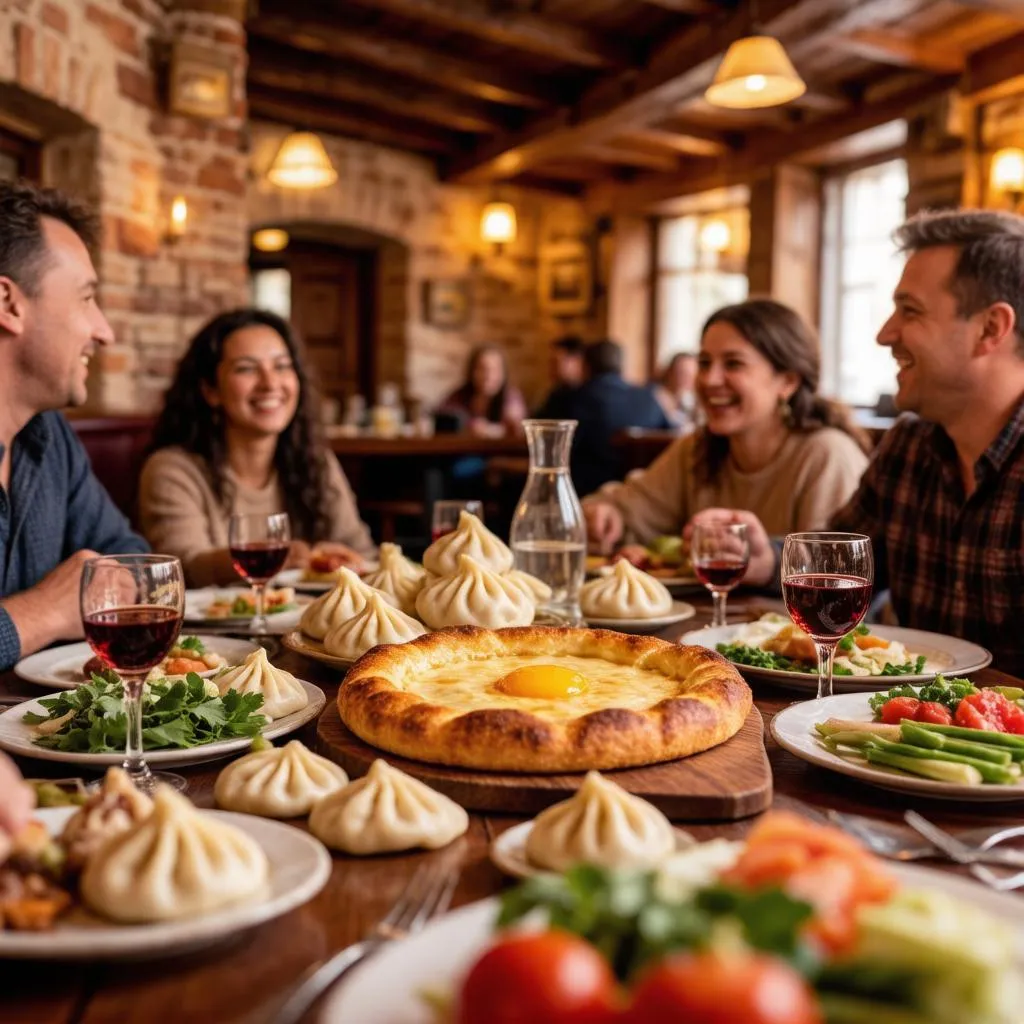
There is a saying in Georgia that a guest is a gift from God, and nowhere is the belief tested more thoroughly than at a Georgian table. Tbilisi does not do small meals. Lunch becomes a procession of dishes; dinner becomes a supra, the ritual feast where toasts are delivered by a tamada, a toastmaster, with the gravity of parliamentary speeches; and somewhere between the third khinkali and the fifth toast, the traveller understands that eating here is not refuelling but a social institution. The city rewards this appetite generously: neighbourhood bakeries that sell bread shaped like boats filled with molten cheese, courtyard restaurants that have cooked the same family recipes for decades, market stalls of amber wine and churchkhela candles of nuts, and cellars where eight-thousand-year-old winemaking traditions pour into modern glasses. What follows is the full geography of eating Tbilisi properly — the dishes to chase, the places locals trust, and the habits that separate a meal from an experience.
The essential dishes, ranked by priority
Georgian cuisine is regional by birth: each province contributes its own bread, cheese, spice palette and technique, and Tbilisi’s restaurants serve the whole map in one city. The newcomer’s table, however, has a clear hierarchy, and eating it in the right order turns confusion into pleasure:
- Khachapuri — the national cheese bread, and Tbilisi eats it in at least four dialects. Imeretian khachapuri is a round flatbread stuffed with salty cheese; Adjarian khachapuri arrives as a boat with a raw egg and butter stirred into the cheese at the table; Megruli adds a second layer of cheese on top; and Penovani wraps the filling in puff pastry. One bread, four debates — and every Georgian has an opinion.
- Khinkali — the dumpling diplomacy of the Caucasus. A pocket of thick dough holds hot broth and spiced meat, and the eating technique matters: hold it by the topknot, bite a small hole, drink the broth, then finish the dumpling. The topknot itself is never eaten; it is counted afterwards to keep score of how many each person consumed.
- Mtsvadi — grilled meat skewers over vine-wood coals, often accompanied by tkemali, the sour plum sauce that cuts the richness. The vine-wood smoke is the entire point: the same meat grilled on ordinary charcoal tastes like a different dish.
- Pkhali — the vegetarian rescue of the cuisine. Walnut paste binds spinach, beetroot, eggplant or beans into elegant patties, garnished with pomegranate seeds; a table of pkhali plates is the prettiest sight in Georgian dining.
- Kharcho and chikhirtma — the soup course. Kharcho is a rich beef soup thickened with rice and walnuts, sharp with spices; chikhirtma is a lighter chicken soup bound with egg and vinegar, the traditional hangover cure and comfort food in one.
- Churchkhela and pelamushi — the dessert logic. Nuts threaded on a string, dipped repeatedly in grape must and dried into candle-shaped sweets, alongside pelamushi, a grape-pudding served cold with walnuts.
Ordering all six in one sitting is possible but foolish. Georgian tables are built for sharing, the portions are honest, and the wine — discussed below — insists on staying longer than planned.
The wine that comes with everything
Georgia is not a wine country in the tourist-brochure sense; it is the oldest continuously winemaking territory on earth, and the qvevri — the clay vessel buried underground in which wine ferments for months — is recognised as heritage. The flavour profile is unlike anything produced elsewhere: amber wines made from white grapes fermented with their skins, earthy and tannic, alongside fresher reds from the saperavi grape, one of the few teinturier varieties in the world whose flesh itself is red.
The practical knowledge that elevates any meal:
- Ask for house wine, not bottled — the jugs of homemade wine in family restaurants are often the best thing on the menu and cost a fraction of the label bottles.
- Know the two grape names — saperavi for red, rkatsiteli for white and amber; ordering by grape rather than by label marks the drinker as informed.
- Respect the toast — at a supra, drinking before the tamada’s toast is traditionally a breach of etiquette; visitors are rarely corrected, but joining the ritual is the fastest route to the table’s heart.
Wine here is not a separate course but a thread running through the entire meal, and the restaurant choice determines its quality as much as the food does.
Where locals actually eat
Tbilisi’s dining map has three distinct layers: the tourist corridors of the old town, the neighbourhood institutions where families have eaten for generations, and the new wave of cafes and wine bars led by a young generation of chefs. The locals’ loyalty belongs mostly to the middle layer, and its geography follows the districts rather than the guidebooks:
| Venue type | Where to find it | What it excels at | Price signal |
|---|---|---|---|
| Neighbourhood bakeries | Sololaki, Vake, Saburtalo | Toné bread, lobiani, ghozalaki pastries | Barely more than pocket change |
| Family khinkali houses | Rustaveli surroundings, Didube | Khinkali in four or five fillings, cold beer | A few lari per dumpling |
| Courtyard family restaurants | Old town side streets, Avlabari | Full Georgian menus, house wine, live music evenings | Mid-range, honest portions |
| Modern wine bars and bistros | Vera, Vake, Fabrika area | Natural wines, refined small plates, young crowd | Higher, but comparable to European cities |
| Market and street stalls | Dezerter Bazaar, subway exits | Nazuki sweet bread, grilled corn, churchkhela | The cheapest food in the city |
Reading this map correctly means understanding the rhythm of the day. Bakeries work in the morning and run out by noon; khinkali houses peak at lunch; courtyard restaurants come alive from eight in the evening and stay loud until midnight; and the wine bars fill after dinner, because in Tbilisi the night has an encore.
Dezerter Bazaar and the market lesson
No food understanding of Tbilisi is complete without the market. Dezerter Bazaar, next to the central metro station, is the city’s pantry: mountains of spices, pyramids of churchkhela, rows of home-canned vegetables, rivers of fresh cheese, and vendors who will feed you a sample of everything and take offence if you refuse. The market visit teaches what restaurants only demonstrate: the seasonality of Georgian cooking, the importance of home preserves — every family stocks jars of pickled jonjoli, spicy adjika paste and wild herbs — and the generosity that underlies the entire culture. Arriving mid-morning, tasting before buying, and taking home a jar of adjika or a bag of sulguni cheese are the market’s simple rewards.
The supra: eating as a social act
The supra deserves its own paragraph because it is not a menu item but a social architecture. When Georgians gather — family, friends, strangers adopted at the table — a tamada presides, delivering toasts that move from ancestors to friendship to the future, each one a small speech that ends with glasses raised and drained. The food keeps arriving; the conversation keeps deepening; the evening acquires a shape no restaurant booking produces. Visitors encounter supras at guesthouses, wine tastings, rural homestays and, most reliably, at the table of any Georgian family met for more than an hour. The correct response to an invitation is always yes; the correct behaviour at the table is to eat heartily, drink moderately, and remember that refusing food entirely is the one genuine insult.
Practical habits of eating well in Tbilisi
A few local customs, learned in a day, transform the experience from tourist dining to local eating. They cost nothing and reward everything:
- Eat khinkali freshly boiled — reheated dumplings lose the broth that makes them; the houses with fast turnover are always the right choice.
- Order cheese bread before the main courses — khachapuri arrives hot and waits for nobody; timing it with the table’s rhythm keeps it at peak.
- Take the free extras seriously — the bread, the pickles, the green adjika on every table are part of the meal and often the best part; the household recipes vary house to house.
- Watch where the taxi drivers eat — the cheapest, fastest and most authentic lunch spots in Tbilisi are the ones where drivers stop between fares.
- Carry small cash — bakeries, markets and courtyard restaurants are cash-first; the larger wine bars take cards without hesitation.
- Pace the toasts — Georgian hospitality is sincere but relentless; drinking water alongside wine and eating between rounds keeps the evening pleasant rather than legendary for the wrong reasons.
None of these rules requires research beyond a day’s attention, and together they turn the city’s generosity into a mutual experience rather than a spectator sport.
The table that keeps calling back
Tbilisi’s food scene works on a simple paradox: the more the city modernises, the more its older kitchens matter. The new wine bars are excellent, the chef-driven bistros are ambitious, but the dish that haunts the departing traveller is usually the plainest one — a round of imeretian khachapuri from a bakery with no sign, a jug of house wine in a courtyard where the grandmother of the house kept refilling it, a stack of khinkali tops mounting on the plate while the conversation outlasted the meal. This is the city’s real food guide, written not in listings but in habits: eat early at the bakery, eat long at the table, drink what the house pours, and never, under any circumstance, leave a Georgian meal early. The table will keep calling back — and for once, answering it is the trip.