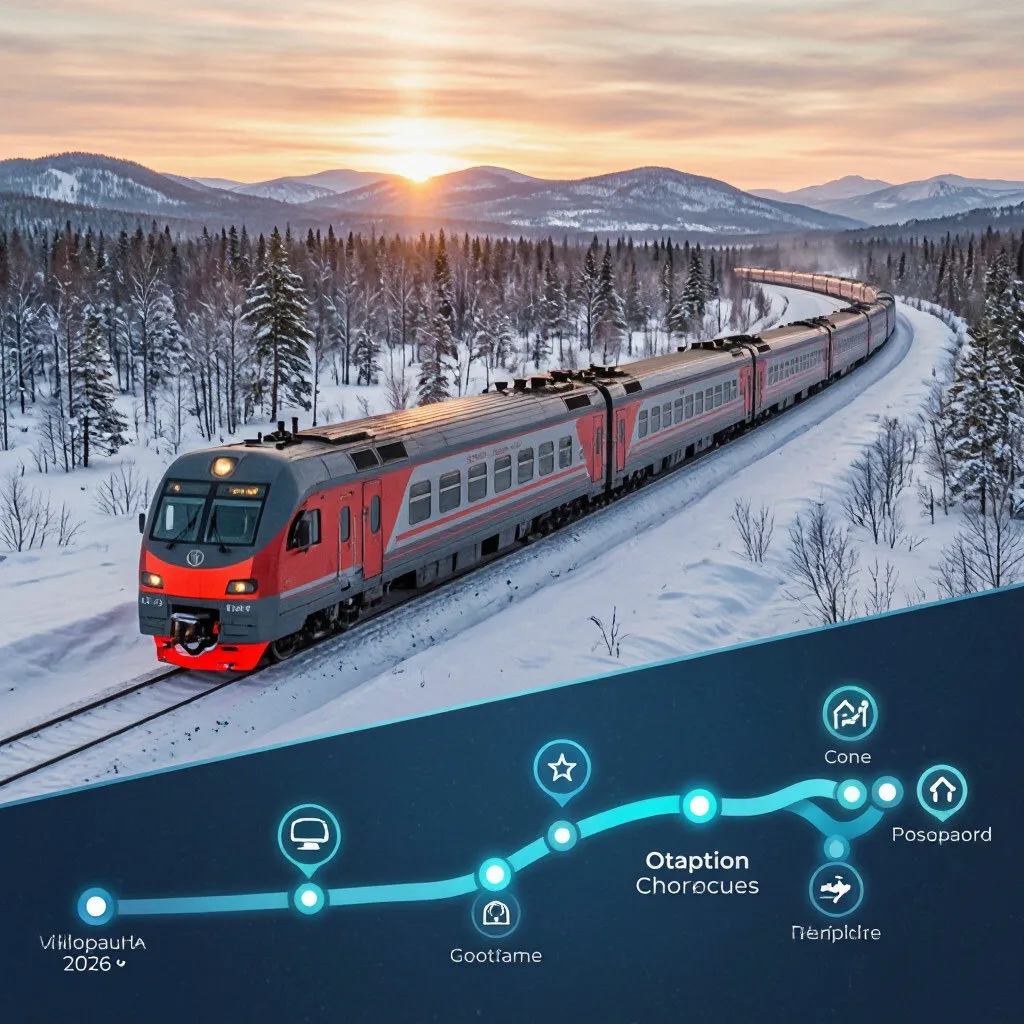
even time zones, nine thousand two hundred eighty-eight kilometers, and a landscape that shifts from European-style boulevards to frozen taiga to subtropical Pacific coastlines. The Trans-Siberian Railway is not just a train ride — it is the longest continuous rail journey on the planet, and riding it remains one of the most misunderstood adventures in travel. People imagine a single train that rumbles nonstop from Moscow to Vladivostok, but the reality is far more interesting: a web of routes, dozens of worthwhile stops, and a pricing system that can either save you a fortune or quietly cost double what it should. Whether you are planning to ride the entire length in one go or hop on and off over several weeks, the logistics deserve real attention — because the difference between a smooth crossing and a stressful one almost always comes down to decisions made before you ever step on the platform.
Understanding the three routes
The Trans-Siberian is often spoken about as if it were one line, but there are actually three distinct routes that share the Russian main line for large portions before branching off. Knowing which one fits your goals determines everything from visa requirements to the countries you pass through.
The classic Trans-Siberian runs from Moscow to Vladivostok, staying entirely within Russia. It is the most straightforward option logistically — one visa, one currency, one language — and the route covers the greatest variety of Russian landscapes, from the Ural Mountains to Lake Baikal to the taiga of the Far East. This is the line most people picture when they think of the journey.
The Trans-Mongolian branches south at Zaudinsky near Ulan-Ude, cutting through Mongolia to Beijing. This is the most popular variant for travellers who want cultural variety — you get Russia, Mongolia’s grasslands and nomadic culture, and China’s capital all in one trip. It requires both a Mongolian and a Chinese visa in addition to Russian visa arrangements, and the border crossings add a few hours at each stop.
The Trans-Manchurian branches southeast at Tarskaya, passing through northeastern China to Beijing without entering Mongolia. It is faster than the Trans-Mongolian and skips the Mongolian visa, but it passes through less interesting scenery for most of the Chinese segment. Some travellers combine routes — riding the Trans-Siberian east to Vladivostok, then taking a separate train through Harbin to Beijing — to experience both.
Ticket prices and class options
Train tickets on the Russian rail system are sold in four classes, and the price gap between them is enormous. First class (SV or lyux) gives you a private two-berth cabin with bedding and sometimes meals. Second class (kupe) is a four-berth private compartment — the most popular choice for long-distance travellers, balancing privacy and cost. Third class (platskart) is an open-plan dormitory carriage with fifty-four bunks, no doors, and no privacy. Fourth class (sidyachy) is just a seat, available only on shorter segments and entirely impractical for multi-day journeys.
Pricing on the Russian railways is dynamic, meaning fares change based on demand, season, and how far in advance you book. The system rewards early planners — buying a Moscow-to-Vladivostok kupe ticket three months ahead can cost 40–50% less than buying it a week before departure. High season runs from late June to early September, and prices peak accordingly. Winter tickets are dramatically cheaper, but you trade comfort for cold — platform temperatures in Siberian cities can drop to minus thirty in January, and daylight shrinks to a few hours.
For international segments, the Trans-Mongolian and Trans-Manchurian trains are more expensive than domestic Russian trains covering the same distance, because they include border-crossing fees and international tariff rates. The direct Moscow-Beijing train (Train 004, the “Vostok”) is the most expensive option — a second-class berth for the full run costs roughly $650–900 depending on season. Breaking the journey into segments and using domestic trains within each country is significantly cheaper, though it requires more planning.
What follows is a breakdown of typical fares for the most common segments, based on 2025 pricing with a modest upward adjustment for 2026. All prices are per person in a second-class (kupe) cabin, which is what most independent travellers choose.
| Route segment | Distance (km) | Journey time | Low-season fare (USD) | High-season fare (USD) |
|---|---|---|---|---|
| Moscow → Yekaterinburg | 1,416 | 1 day 4 hrs | 40–55 | 70–95 |
| Yekaterinburg → Krasnoyarsk | 1,536 | 1 day 6 hrs | 45–60 | 75–100 |
| Krasnoyarsk → Irkutsk | 1,065 | 18 hrs | 30–42 | 55–72 |
| Irkutsk → Ulan-Ude | 453 | 8 hrs | 18–25 | 30–42 |
| Ulan-Ude → Ulaanbaatar (Mongolia) | 562 | 12–14 hrs (incl. border) | 35–50 | 55–75 |
| Ulaanbaatar → Beijing (China) | 1,553 | 1 day 6 hrs (incl. border) | 60–85 | 90–130 |
| Moscow → Vladivostok (direct) | 9,288 | 7 days | 280–380 | 450–620 |
The most important takeaway from these numbers is that breaking the journey is almost always the better strategy. A direct Moscow-Vladivostok ticket in second class during high season can reach $620, while buying individual segment tickets for the same route and staying in local guesthouses along the way costs roughly $300–350 in train fares plus accommodation — and you actually get to see the places you are passing through. The direct train is the right choice only if your goal is the experience of uninterrupted travel itself, and you do not mind watching taiga roll past the window for a solid week without stopping.
When to go and how long it takes
The travel window matters more on the Trans-Siberian than on almost any other rail route in the world, because the climate range is so extreme. Summer gives you long daylight hours, green landscapes, and comfortable temperatures — but it also means peak pricing and crowded trains, especially on the Trans-Mongolian, which fills up with tour groups from July through August. Winter offers the cheapest fares and the most authentic experience of rural Russia, but temperatures in Siberia are genuinely dangerous for the unprepared. The sweet spots are late May to mid-June and early September to mid-October: the weather is still agreeable, prices have not peaked, and the autumn foliage along the taiga is spectacular.
How long you need depends on your approach. The nonstop Moscow-Vladivostok run takes seven days, but that is more of an endurance test than a holiday. Most travellers who stop along the way allocate two to three weeks for a relaxed pace, with stops in Yekaterinburg, Irkutsk and Lake Baikal, and either Ulaanbaatar or Vladivostok. Four weeks gives you room for deeper detours — Krasnoyarsk’s Stolby Nature Reserve, the Mongolian steppe, or a ferry from Vladivostok to South Korea or Japan. Anything under ten days means you will spend most of your time on the train and very little actually exploring, which defeats the purpose of choosing this route over a flight.
The best stops along the way
Every traveller has different priorities, but certain stops consistently earn their place on the itinerary. These are the ones that justify getting off the train, organised roughly from west to east.
Kazan (Day 1–2 from Moscow)
Kazan is the capital of Tatarstan, and it is worth a full day or two. The Kazan Kremlin is a UNESCO site that blends Russian Orthodox and Islamic architecture in a way you will not see anywhere else on the route. The Kul Sharif Mosque, built inside the Kremlin walls, is stunning and free to enter. Tatar food is a highlight — try chak-chak (a honey-soaked pastry) at any bakery near Bauman Street, and echpochmak (meat pastries) for about a dollar each. A train from Moscow to Kazan takes eleven to thirteen hours, making it an easy overnight first leg.
Yekaterinburg (Day 2–3)
The boundary between Europe and Asia runs just outside Yekaterinburg, and a monument marks the spot — a popular photo stop if you arrange a taxi or join a short tour. The city itself has a gritty, industrial charm, and the Yeltsin Center offers a surprisingly candid look at post-Soviet Russian history. The Church on the Blood is built on the site where the Romanov family was executed, and it is a sobering but important visit. Two days here is enough to see the main sights and take a day trip to the Europe-Asia border and the nearby Ganina Yama monastery, built where the Romanovs’ remains were first discarded.
Krasnoyarsk (Day 4–5)
Krasnoyarsk is often skipped, which is a mistake. The Stolby Nature Reserve, a short bus ride from the city center, is one of the most accessible wilderness areas on the entire route. Massive rock formations rise out of the taiga, and the hiking trails are well-marked and free. The reserve is also famous for its “stolbist” climbing culture — locals who free-climb the rock pillars without ropes, a tradition dating back over a century. If you are travelling in winter, the Yenisei River freezes solid enough to walk across, and the ice formations at the river’s edge are extraordinary.
Irkutsk and Lake Baikal (Day 5–7)
This is the stop that most travellers build their entire trip around, and it deserves the hype. Irkutsk itself is a pleasant city with wooden houses, a decent market, and the Angara River embankment. But the real draw is Lake Baikal, reached via a one-hour marshrutka (minibus) ride to Listvyanka, a village on the lake’s shore. Baikal holds twenty percent of the world’s unfrozen fresh water, and in winter the ice is so clear you can see forty meters down. In summer, you can swim — though the water rarely exceeds ten degrees even in August. The Museum of Lake Baikal in Listvyanka covers the lake’s unique ecology, and the seal (nerpa) is found nowhere else on earth. A sidetrip to Olkhon Island, the largest in Baikal, takes a full day each way but offers shamanic rock formations and some of the most dramatic scenery in Russia.
Ulan-Ude (Day 7–8)
Ulan-Ude is the capital of Buryatia, a region where Mongolian Buddhist culture meets Russian infrastructure. The giant Lenin head in the central square — the largest in the world — is an obligatory photo, but the real attraction is the Ivolginsky Datsan, a Buddhist monastery about forty minutes from the city. It is the spiritual center of Russian Buddhism, and visitors are welcome to walk the grounds, spin prayer wheels, and observe ceremonies. The mix of Tibetan-style architecture against Siberian landscape is unique to this corner of the world. If you are taking the Trans-Mongolian route, Ulan-Ude is your last Russian stop before the border.
Ulaanbaatar and the Mongolian steppe (Day 9–11)
The Trans-Mongolian crosses the border at Naushki (Russia) and Sükhbaatar (Mongolia), and the landscape transforms within hours from forested hills to open grassland. Ulaanbaatar is a sprawling, dusty capital that takes some getting used to — but the Gandantegchinlen Monastery and the Choijin Lama Temple Museum are both worth visiting, and the National Museum gives essential context for understanding Mongolian history. The real experience, though, is getting out of the city. A one-day or overnight trip to Terelj National Park puts you among granite formations, nomad ger camps, and horse herds, and costs very little if you share a vehicle with other travellers. Staying in a ger with a local family costs about $25–35 per night including meals — one of the most authentic cultural experiences available on any rail journey.
Vladivostok (end of the Trans-Siberian line)
If you ride the full Trans-Siberian rather than branching into Mongolia, Vladivostok is your terminus. The city sits on a bay across from Japan, and the mix of Russian naval architecture and Pacific Rim influence gives it a different character from anything else on the route. The Vladivostok Fortress museum, the cable-stayed bridges, and the embankment along Sportivnaya Harbor are the main draws. From here, some travellers continue by ferry to South Korea (Dongil Ferry runs a twice-weekly service to Donghae and Sokcho) or to Japan via a connecting route, extending the overland journey across the Pacific Rim.
What nobody tells you before booking
The logistics of the Trans-Siberian involve a layer of practical knowledge that most guides gloss over. These are the details that catch people off guard, usually discovered mid-journey when it is too late to adjust.
- Your ticket is your life. Russian train tickets are specific to you — your passport number is printed on them, and the conductor checks it against your passport at boarding. Lose your ticket, and you are buying a new one at full price. Keep paper backups even if you have a digital copy, because conductors on some trains do not accept screenshots.
- Toilet access is not guaranteed at all hours. On older Russian trains, the toilets are locked during station stops and sometimes for long stretches near cities due to waste disposal restrictions. Newer carriages with bio-toilets do not have this problem, but if you are on an older train, plan accordingly — use the toilet when it is open, not when you need it.
- The samovar is your best friend. Every long-distance Russian carriage has a samovar — a coal-fired or electric hot water boiler — that runs constantly and is free to use. Bring tea bags, instant noodles, and a mug. This single feature saves most travellers a significant amount on food and drinks over a week-long journey.
- Border crossings happen in the middle of the night. On the Trans-Mongolian route, the Russia-Mongolia crossing at Naushki/Sükhbaatar and the Mongolia-China crossing at Dzamin Uud/Erenhot both tend to occur between 1:00 and 5:00 AM. You will be woken by customs officials, asked to leave the train with your passport and luggage, and processed through immigration in a border station. This can take two to four hours, and you will not get much sleep.
- Mongolian visas are not always available at the border. While some nationalities can get a visa on arrival at Sükhbaatar, many cannot — and the rules change. If you are on the Trans-Mongolian route, secure your Mongolian visa before you leave home. Chinese visas require even more lead time and are never issued at the border.
- Provodnitsa expects tips. The provodnitsa (or provodnik, for male attendants) is the carriage attendant who manages your cabin, provides bedding, serves tea from the samovar, and keeps order. A small tip at the end of your journey — 100–200 rubles, or about $2–3 — is expected and appreciated. They work long shifts on difficult routes, and the gesture goes a long way.
- Glonass replaces GPS. Russian trains use the GLONASS navigation system, which means Google Maps may not always track your location accurately. Download offline maps in advance, especially for areas with no signal — which is most of Siberia.
- Dining car food is overpriced and mediocre. The restaurant car on Russian trains charges two to three times what you would pay at a station platform vendor. At major stops (twenty minutes or longer), platform vendors sell hot food — pirozhki, boiled corn, smoked fish, instant noodles — for a fraction of the dining car price. Stock up at every long stop.
- Train numbers matter for train quality. Faster trains (numbered 001–100) are newer, cleaner, and more expensive. Trains numbered 300 and above are older, slower, and cheaper. Train 002, the Rossiya, is the flagship Moscow-Vladivostok service and the most comfortable of the long-haul options.
- Alcohol is technically banned but tolerated in moderation. Official rules prohibit drinking on Russian trains, but in practice, a quiet beer or shot of vodka shared with cabin mates is common and unremarkable. Obnoxious drunken behavior, however, will get you reported and potentially removed at the next station.
Every one of these details seems minor in isolation, but collectively they define the difference between travellers who arrive in Vladivostok or Beijing feeling satisfied and those who arrive exhausted, frustrated, and over budget. The Trans-Siberian rewards preparation the way few journeys do — not with hidden dangers, but with the quiet satisfaction of knowing how things work before they happen.
Visa and documentation requirements
The visa situation is the single biggest barrier for most travellers, and it deserves its own attention. Russia requires a visa for nearly all Western passport holders, and the process involves an invitation letter (issued by a hotel, tour operator, or visa agency), a completed application, and a consular fee. Processing times range from five business days (expedited) to twenty (standard), and fees vary by nationality and processing speed — expect $80–200 for a standard tourist visa. Russian e-visas became available for citizens of certain countries in recent years, simplifying the process, but they are limited to specific regions and entry points, so check whether your planned route qualifies.
If you are taking the Trans-Mongolian, you need a Mongolian visa in addition to the Russian one. Mongolian tourist visas are straightforward — an invitation is rarely required, and the consular fee is $30–60 depending on your nationality. The catch is timing: if you are crossing by train, you need the visa in your passport before you board in Russia, which means applying at a Mongolian consulate in your home country or in Moscow before departure. The Mongolian consulate in Moscow processes visas in three to five days.
Chinese visas for the Trans-Mongolian or Trans-Manchurian route are the most complex. China requires a visa application with detailed itinerary, hotel bookings, and sometimes proof of onward travel. Processing takes four to seven business days, and fees range from $50–140. If you are ending your journey in Beijing and flying home, a single-entry visa is sufficient. If you plan to continue overland into Southeast Asia, you need to plan your visa chain carefully — each country’s visa has entry and exit requirements that must align with your travel dates.
Packing for a week on the rails
What you carry on the Trans-Siberian is different from what you carry on a normal trip, because you are living in a small space for days at a time with limited access to shops, laundry, and amenities. The goal is to be comfortable enough to enjoy the journey without overpacking to the point where storage in your cabin becomes a problem.
Essentials for the train
- A power bank and the right adapter. Older carriages may have only one outlet per cabin, shared between four passengers. A high-capacity power bank (20,000 mAh or more) ensures your phone stays charged for music, podcasts, offline maps, and reading. Russian outlets use the Type C and Type F standards, same as most of Europe.
- Slip-on shoes or thick socks. You will take your shoes off in the cabin, and the corridor floor is cold and not particularly clean. A pair of warm socks or cheap slippers makes the experience far more comfortable. Many Russians bring dedicated train slippers for exactly this reason.
- Wet wipes and hand sanitizer. Train toilets are functional but basic, and soap is not always available. Wet wipes also serve as a substitute for a shower on longer segments, though most major stops allow time for a hotel night with a proper bathroom.
- A refillable water bottle and instant food. The samovar provides unlimited hot water, which turns instant noodles, oatmeal, and tea into actual meals. Bring enough for each segment between major stops — at least three or four instant meals per day on the train, plus snacks. Station platforms sell food, but selection is limited in remote areas.
- Earplugs and an eye mask. Russian trains run on schedule, meaning the train moves, stops, and shakes at all hours. Cabin mates snore, children cry, and conductors announce stops over the intercom. Good earplugs and a mask are the difference between arriving rested and arriving wrecked.
- A book or downloaded entertainment. Mobile signal is absent for large stretches through Siberia and Mongolia. Download books, films, music, and podcasts before departure, and treat the offline time as a feature rather than a limitation — one of the most common pieces of feedback from Trans-Siberian travellers is that the disconnection was the best part.
- Layered clothing. Carriage temperatures fluctuate wildly — the heater may be blasting at night and off during the day. Wear layers you can add and remove easily. A light jacket or fleece is essential even in summer, because Siberian nights are cold year-round.
- Basic first aid and medications. Pharmacy access is limited on the train and non-existent at many rural stations. Bring painkillers, anti-diarrhea tablets, any prescription medications, and motion sickness remedies. Food poisoning from platform vendors is not common but does happen.
This list is deliberately practical — every item has earned its place through the experience of thousands of travellers who discovered, somewhere between Moscow and Irkutsk, that they wished they had packed something they left behind. The train is self-contained in a way that few modern travel experiences are, which means what you bring is what you have. Get it right, and the journey becomes something you will talk about for the rest of your life — the scenery, the people, the silence of the taiga at midnight, the strange warmth of a shared compartment with strangers who become friends over bowls of instant noodles and broken conversations in three languages. The Trans-Siberian is not the easiest way to cross a continent, but it might be the most memorable.